
24/7 Customer Support

Free returns

Same-day & Next-day Delivery

Quality Guaranteed

Unlock Your Welcome Offers: FREE Delivery | Up to 80% OFF | Free 30-day JoyPlus trial
Download the APP
A jewellery box should make getting ready easier, not leave you sorting tangled chains through a crowded drawer. Yet attractive photographs and generous-sounding storage claims can hide practical problems. The right jewellery organiser depends on the size of your collection, the types of accessories you own and where you plan to use it.
Before buying, watch for these common pitfalls.
A stylish jewellery storage box may look spacious online, but photographs can make it difficult to judge scale. A compact case might suit a few rings and earrings, while a larger collection of necklaces, bracelets and watches needs deeper compartments or multiple drawers.
Always check the listed measurements in centimetres and compare them with the intended space on your dressing table, shelf or wardrobe.
A multi-tier jewellery organiser can offer useful capacity, but the internal layout matters more than the number of layers. Shallow sections may work for rings and studs but not for chunky bracelets or watches. Similarly, necklace hooks are useful only if chains can hang freely without pressing against other items.
Look for a combination of ring slots, earring holes, necklace hooks, removable trays and deeper drawers rather than focusing on tier count alone.
A lockable jewellery box can help prevent casual access, particularly in a busy household, but it should not be treated as a safe or high-security storage unit. Check how the case closes, whether keys are included and whether the handle makes it easy to move.
For travel, a secure zip or magnetic closure may be more practical than a large, heavy lockable jewellery holder.
Think about your collection by category:
If your collection is growing, leave some spare capacity. Overfilling a jewellery box can make compartments difficult to use and may cause pieces to rub together.
A travel jewellery case should fit into a handbag, cabin bag or suitcase without taking up excessive room. For example, the JOYFURNOS portable case measures 11 x 16 x 8 cm and weighs 0.3 kg, making its proportions easier to manage when travelling.
For home storage, larger designs can be substantially heavier. One six-tier model measures 15.6 x 26 x 32 cm and weighs 3.1 kg, so it is better suited to a fixed position than frequent carrying. Measure your available surface, including the clearance needed to open drawers and lids.
Common materials include MDF, PU, plastic, glass and velvet lining. A soft lining can provide a cushioned surface for accessories, while MDF gives many structured cases a firm shape. A jewellery box with a glass lid offers quick visibility, but the glass adds weight and should be handled carefully.
Keep jewellery storage dry and away from direct sunlight where the care instructions advise it. Use a soft, dry cloth rather than chemical cleaners, particularly on PU-coated surfaces and velvet interiors.
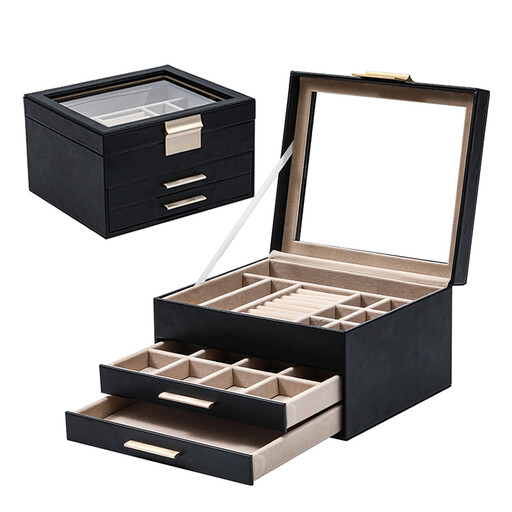
Why This Fits Their Persona: The three-layer format suits shoppers starting to organise a small or medium collection on a dressing table, desk or shelf.
Separate compartments help avoid placing rings, earrings and necklaces together in one crowded section.
Three layers, multiple compartments and a soft lining provide structured everyday storage.
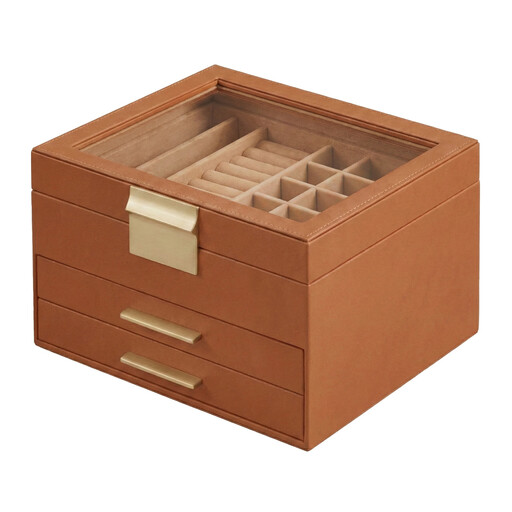
Why This Fits Their Persona: This is suited to shoppers who want jewellery storage that can remain on display in a bedroom or cloakroom.
The stated dimensions and two lower drawers make its capacity easier to assess than a product image alone.
A transparent glass lid, velvet lining, three layers and two drawers support visible, categorised storage.
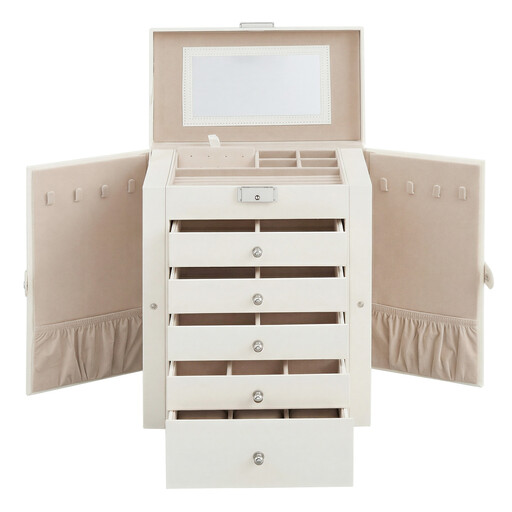
Why This Fits Their Persona: A substantial collection of necklaces, watches, rings and larger accessories calls for dedicated sections and fixed home storage.
Four rows of necklace hooks and a deep bottom drawer address the common lack of space for long chains and watches.
Six tiers, five drawers, an internal mirror, a lock with two keys and space for three watches are specified.
We have compiled a complete, real-time list of products that fully satisfy these strict selection criteria and UK safety regulations.
Once your jewellery box arrives, group accessories by type and frequency of use. Keep everyday pieces in the most accessible tray, while occasional items can go into lower drawers. Fasten necklace clasps before storing them on hooks, and avoid placing damp jewellery into a closed compartment.
Keep the box away from radiators, bathrooms and windows where humidity or direct sunlight may affect the exterior and lining. If the product includes a mirror or glass lid, lift and close it carefully rather than placing pressure on the frame.
For anyone with several rings, earrings or necklaces, a dedicated jewellery box can make pieces easier to find and reduce contact between items. The value depends on whether the compartments match your collection. A small jewellery holder is sufficient for a few daily accessories, while a larger jewellery storage case is more suitable for an expanding collection.
Count your accessories by category before shopping. Choose a case with enough ring slots and earring spaces, then check for necklace hooks and deeper sections for bracelets or watches. Always compare the external dimensions with your available furniture space and remember to allow room for drawers or lids to open.
Yes, but choose a purpose-designed travel jewellery case rather than carrying a large home organiser. Look for compact measurements, a secure closure, soft lining and separate necklace storage. A built-in mirror can be convenient, while a lockable design may be useful when the case is stored around children or shared accommodation.