
24/7 Customer Support

Free returns

Same-day & Next-day Delivery

Quality Guaranteed

Unlock Your Welcome Offers: FREE Delivery | Up to 80% OFF | Free 30-day JoyPlus trial
Download the APP
A jewellery box should make getting ready easier, not create another drawer of tangled chains and misplaced earrings. Yet attractive photographs and phrases such as “large capacity” can hide practical shortcomings. Before buying a jewellery organiser, consider how much space you actually need, where it will sit and whether you plan to carry it.
This guide explains the main buying pitfalls, the specifications worth checking and suitable options for different lifestyles.
A tall jewellery storage box may look spacious, but some of its volume can be taken up by thick dividers, shallow compartments or decorative structure. Check the internal layout rather than relying on the number of tiers. A box designed for rings and earrings may not accommodate watches or long bracelets.
Necklace hooks are useful only when there is enough vertical clearance between the hooks and the base. Long chains can still bunch together if the hanging area is too short. Look for dedicated hooks, side panels or separate necklace sections and check the product dimensions before ordering.
A lockable jewellery box can help prevent children from opening the case casually, but it is not a substitute for a household safe or insurance requirements. Also check how many keys are supplied and whether the lock is positioned conveniently for everyday use. A lock that makes access awkward may discourage regular organisation.
Measure the available space on your dressing table, inside a wardrobe or in a drawer. Include clearance for opening the lid and pulling out drawers. A jewellery box with drawers usually suits collections containing bracelets, brooches and hair accessories, while a vertical case can make better use of a narrow surface.
For larger collections, compare the overall dimensions and weight. For example, a six-tier case measuring 15.6 x 26 x 32 cm offers a different storage arrangement from a compact travel case measuring approximately 11.4 x 11.4 x 5.5 cm.
A practical jewellery organiser should match the contents of your collection:
If you own several watches or sunglasses, look for a deeper drawer rather than a case designed primarily for delicate pieces.
Many jewellery cases use MDF construction, a PU-covered exterior and velvet lining. These materials can provide a structured shape and a soft contact surface, but they still need protection from damp rooms, direct sunlight and sharp objects.
A glass lid makes it easier to view your collection while helping keep dust away. A jewellery organiser with mirror can be convenient for choosing accessories, particularly in bedrooms with limited dressing-table space. However, a mirror adds weight and may reduce the available lid storage area.

Why This Fits Their Persona: A compact choice for someone starting a collection or needing simple storage for a few everyday pieces, including during short UK trips.
Its small format makes the capacity clear, reducing the risk of buying a bulky case with unused sections.
Portable format; intended sections for earrings, necklaces and rings.
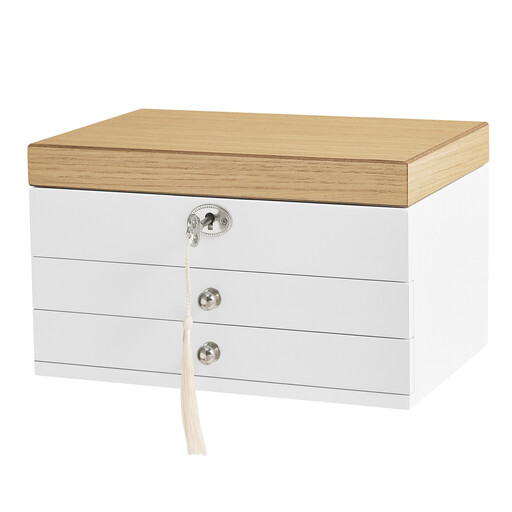
Why This Fits Their Persona: Suits shoppers who want a coordinated dressing-table accessory with a mirror, layered storage and a lockable design.
The listed three-tier layout, two drawers and lock provide specific details instead of relying only on broad capacity claims.
Measures 17 x 25 x 15 cm; includes a large mirror, two drawers and a key.
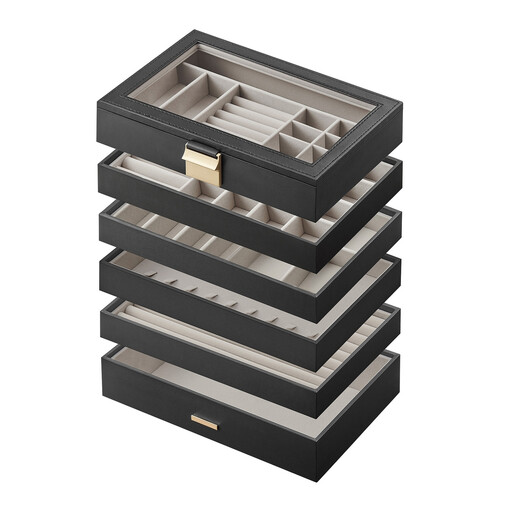
Why This Fits Their Persona: Designed for extensive collections containing jewellery, watches and glasses, particularly where a dressing table or wardrobe provides enough room.
The six layers are stackable and the clear lid shows the contents, helping avoid hidden or inaccessible storage.
Six tiers; clear glass lid; dimensions of 17 x 28 x 25.3 cm; stackable tray format.
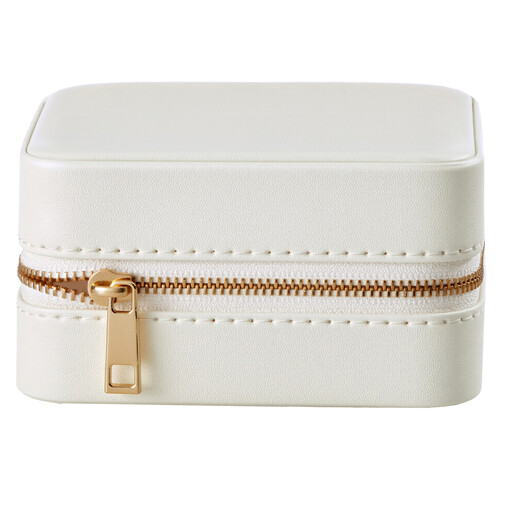
Why This Fits Their Persona: A travel jewellery case for handbags, overnight bags or suitcases, with dedicated areas for common everyday accessories.
The exact compact dimensions and removable dividers make its travel purpose clear rather than implying it can replace a large home organiser.
Includes a mirror, three necklace hooks, eight earring holes, seven ring slots and four compartments.
We have compiled a complete, real-time list of products that fully satisfy these strict selection criteria and UK safety regulations.
Place the case in a dry room away from radiators and direct sunlight. Velvet and PU surfaces are generally better maintained with a soft, dry cloth rather than water or abrasive cleaners. Do not overfill compartments, as pressure can affect hinges, drawers and closures. Keep small ring boxes and loose components away from young children because they may present a choking hazard.
Choose a size based on your current collection, with some spare room for future purchases. A small jewellery case is suitable for essentials and travel, while a large jewellery box with drawers or stackable trays is more practical for watches, necklaces and multiple pairs of earrings.
It can be useful if you select jewellery at a dressing table or while travelling. A mirror adds convenience, but compare the case dimensions and weight to ensure it does not make the organiser too bulky for your intended location.
Use separate hooks, leave space between longer chains and fasten each clasp before hanging. Avoid placing several necklaces in one shallow compartment. For frequent travel, choose a case with individual necklace sections or removable dividers.