
24/7 Customer Support

Free returns

Same-day & Next-day Delivery

Quality Guaranteed

Unlock Your Welcome Offers: FREE Delivery | Up to 80% OFF | Free 30-day JoyPlus trial
Download the APP
A jewellery organiser can make a dressing table feel calmer, but the wrong design may create new problems. Small compartments can be too shallow for bracelets, necklace hooks may not hold longer chains, and a case that looks spacious online may occupy more room than expected.
Before buying a jewellery box or jewellery storage box, focus on how you actually store and use your accessories. A compact travel jewellery case suits a small collection and frequent trips, while a multi-tier jewellery storage organiser is more practical for rings, earrings, necklaces, bracelets and watches kept at home.
A decorative box may look substantial in product photographs, yet offer limited internal space. Check the external dimensions and internal layout rather than relying on words such as “large” or “generous”. A jewellery box for women with several drawers and trays may hold more than a single deep compartment, because individual pieces remain separated and easier to retrieve.
Ring slots and earring holes are useful for small items, but they do not replace necklace hooks or larger bracelet compartments. A ring and earring organiser may be ideal for daily essentials but unsuitable for chunky watches or statement jewellery. Look for a mix of slots, hooks, trays and open sections.
A lockable jewellery box can help prevent accidental opening by children and keep the lid closed during transport. However, a small lock should not be treated as protection against determined theft. It is also worth checking how many keys are included, whether the case has a carry handle and whether the fastener is suitable for regular travel.
Measure the intended location before ordering. Dressing tables, bedside cabinets and wardrobe shelves can have limited depth or height. For example:
Remember to allow space for opening drawers and lifting lids.
Match the layout to your collection:
If you own a mixture of accessories, a jewellery organiser with several storage formats is generally more adaptable than a box designed around one item type.
Soft velvet lining provides a cushioned surface between jewellery and the organiser. MDF frames, PU exteriors and glass lids are common features in home storage designs. Glass can make contents easy to view, but it adds weight and needs careful handling. PU surfaces can usually be wiped gently, while the organiser should be kept away from damp conditions and direct sunlight as advised in the supplied product information.
For travel, consider weight, closure and portability as well as appearance. A zip closure is convenient for a compact case, while a handle and lock may be useful on a larger travel jewellery case.

Why This Fits Their Persona: Its mini format is suited to shoppers starting a collection or carrying a few daily pieces in a handbag or suitcase.
The compact form makes its intended capacity clear, helping avoid paying for a larger case when only a few accessories need organising.
Portable design; intended for earrings, necklaces and rings in a small storage format.
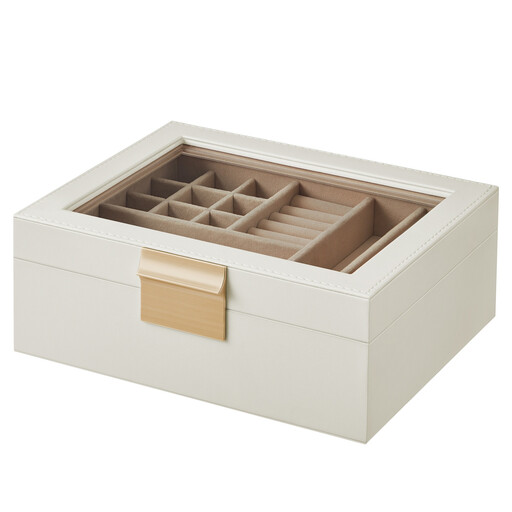
Why This Fits Their Persona: A modern dressing-table option for someone who wants to view jewellery quickly while keeping it covered between uses.
The listed two-layer layout and removable top tray provide more practical separation than a single open compartment.
Glass lid for clear viewing; MDF, PU, velvet and glass construction; dimensions of 18.5 x 23 x 8.5 cm.
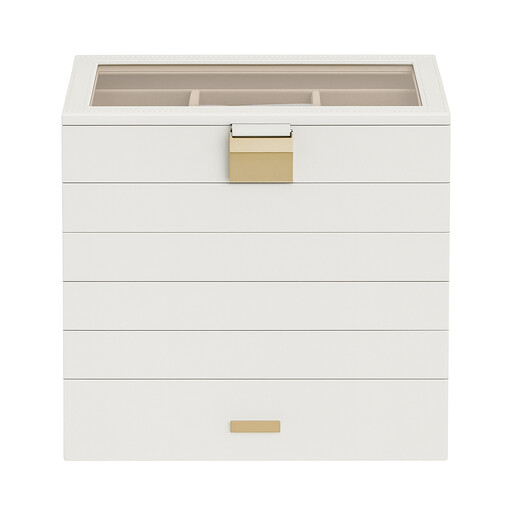
Why This Fits Their Persona: Its six-tier arrangement is designed for established collections that need dedicated jewellery trays at home.
The stackable format separates storage by layer, reducing reliance on one overcrowded drawer or deep compartment.
Six tiers; clear dust-cover lid; listed dimensions of 17 x 28 x 25.3 cm; suitable for jewellery, glasses and watches.
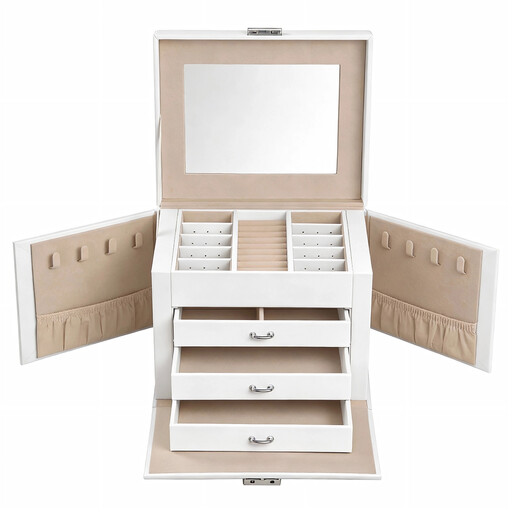
Why This Fits Their Persona: The handle, mirror, lock and four-tier arrangement suit users who want home storage that can also be carried between rooms or taken on trips.
The stated dimensions, three drawers, side hooks, lock and two keys make its storage and closure features clear before purchase.
Four tiers; three drawers; built-in mirror; dual-sided necklace hooks; handle; MDF, PU and velvet construction.
We have compiled a complete, real-time list of products that fully satisfy these strict selection criteria and UK safety regulations.
For a small number of everyday items, choose a compact jewellery box with clearly defined sections. If you regularly wear necklaces, prioritise hooks and enough vertical space to prevent chains from being compressed.
A jewellery organiser with mirror can simplify dressing-table routines and travel preparations. If children may access the storage area, a lockable jewellery box offers a practical additional barrier, although valuable items should still be stored responsibly.
For a growing collection, removable trays and stackable sections offer more flexibility. If the organiser is intended as a birthday, anniversary, wedding or Christmas jewellery gift, consider the recipient’s storage habits rather than selecting solely on colour or decoration. A white or wood-grain finish may suit a dressing table, while a compact black travel case may be easier to coordinate with luggage.
Use separate necklace hooks where possible and fasten each chain before storage. Avoid placing several long necklaces in one deep compartment. For pieces that are particularly delicate or valuable, individual pouches can provide an additional layer of separation.
Lifespan depends on handling, weight, humidity and cleaning. Keep the organiser away from damp bathrooms, direct sunlight and sharp objects. Do not overload drawers or trays, and wipe suitable exterior materials gently with a soft cloth. Check hinges, zips and locks periodically, especially if the case travels frequently.
A compact case with a secure zip, mirror and divided sections can be suitable for travel. Larger glass-lid or multi-tier designs may be more appropriate for home use because they are heavier and require more room. Always compare the listed dimensions and weight with your luggage space before ordering.