
24/7 Customer Support

Free returns

Same-day & Next-day Delivery

Quality Guaranteed

Unlock Your Welcome Offers: FREE Delivery | Up to 80% OFF | Free 30-day JoyPlus trial
Download the APP
Putting a new pen to a fresh journal page should be a satisfying moment. Yet, too often, it ends in frustration: smeared ink, ghostly bleed-through on the reverse side or a cramping hand just a few paragraphs in. The market for journaling pens is flooded with options, but navigating the marketing claims to find a reliable tool can be a challenge.
As the Joybuy Product Recommendation Officer, my role is to help you see past the hype. Many of us have been caught out by a few common purchasing pitfalls. Before you spend another pound on pens that end up in a drawer, let's look at the real issues that can make or break your writing experience.
To make a confident choice, focus on a few core parameters rather than just the packaging. Understanding these will help you find a pen that works for you, not against you.
The type of ink is the single most important factor for a clean, enjoyable journaling experience.
A key consideration is whether a pen is a no bleed pen on your specific journal. As a rule of thumb, finer tips (under 0.5mm) and pigment-based inks tend to perform better on thinner paper.
The pen's point determines the character of your writing and drawing.
For anyone who writes for extended periods, comfort is crucial. An ergonomic design helps reduce strain on your fingers and wrist. Pay attention to:
Instead of a generic list, we've matched some noteworthy options to specific types of users. This way, you can find a pen that aligns with how you actually plan to use it.
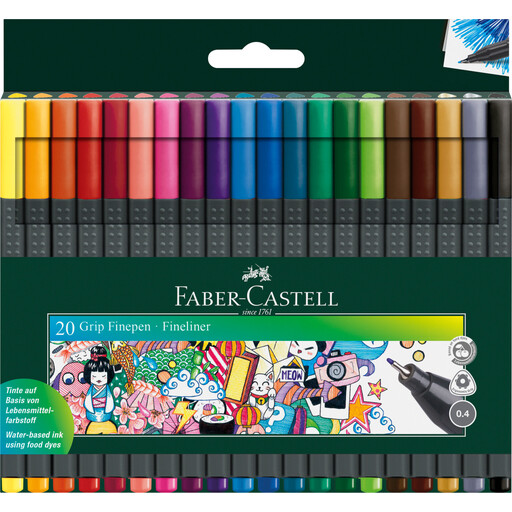
Why This Fits Their Persona: This set is ideal for the bullet journal enthusiast or artist who relies on colour-coding and precision. The 0.4mm fine tip is perfect for detailed habit trackers and drawing, while the 20-colour palette provides ample creative freedom.
The ergonomic triangular barrel and patented grip zone directly combat hand fatigue during long creative sessions. The fine tip and food dye-based ink also minimise the risk of bleed-through on standard journal paper.
A long, metal-framed tip makes it suitable for use with rulers and stencils. The ink is based on food dyes, and the pen barrels are made from at least 56% recycled plastic.
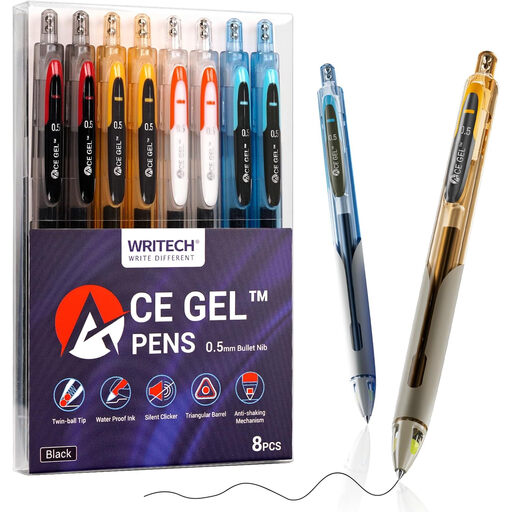
Why This Fits Their Persona: For those in lectures, meetings or quiet offices, a reliable and discreet pen is essential. This pen's silent clicker is a standout feature, while the quick-dry, waterproof ink ensures notes remain neat and professional.
The combination of a soft silicone grip and a triangular barrel provides superior comfort, directly addressing the pitfall of hand fatigue. Its quick-drying ink formulation delivers on the promise of smudge-free writing.
The silent click mechanism is ideal for quiet environments. The 0.5mm twin-ball tip provides a consistently smooth, skip-free line for precise note-taking.
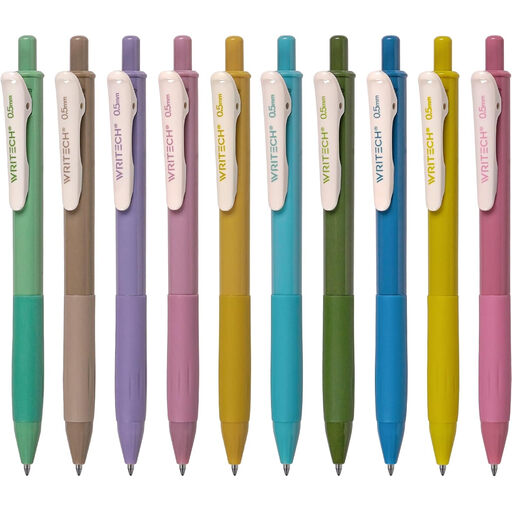
Why This Fits Their Persona: Smudging is the primary frustration for left-handed writers. This pen's main feature is its quick-drying ink, designed to set almost instantly to keep hands and pages clean. The unique vintage colour palette is a bonus for creative expression.
It directly tackles the "quick-dry" pitfall by offering a formulation that genuinely minimises smearing as a left hand moves across the page. The non-slip grip also ensures better control, further reducing the chance of slips and smudges.
The fast-drying ink is the main benefit for left-handers. The set also provides a range of 10 distinct vintage colours for versatile use in journaling and art.
We have compiled a complete, real-time list of products that fully satisfy these strict selection criteria and UK safety regulations.
The most effective method is to match your pen to your paper. If your journal has thin paper (typically below 100 GSM), opt for fine point pens (0.5mm or smaller) with pigment-based or alcohol-based inks, as they tend to sit on top of the paper rather than soaking in. Gel pens can be more prone to bleeding, so it's wise to test them on a back page first.
A gel pen generally provides a bolder, more lubricated writing experience, feeling very smooth on the page. A fineliner offers more precision and control, producing a consistent, crisp line that is excellent for detailed diagrams or very neat handwriting. Fineliners are often preferred for technical work, while gel pens are popular for their comfortable flow in long-form writing.
For a beginner, starting with a smaller, more affordable set is often a practical approach. A large, expensive art pens set can be overwhelming. Consider a small set of high-quality primary colours or a curated palette, like the WRITECH Arts Sign Brush Pen sets. This allows you to understand the medium and your own preferences before committing to a larger investment. The key is to look for good tip quality and blendable ink, features which are not always exclusive to the most expensive brands.