Family-breakfast makers
If you want several servings before school or work, compare finished-juice capacity, the feed opening and the work involved in cleaning.


Choose a fruit-and-vegetable juicer rather than a citrus-only machine for pears. For several breakfast servings, prioritise the finished-juice container, feed opening and cleaning steps: a centrifugal model may suit a routine focused on batch size and less cutting, while a slow juicer suits a preference for its pressing format if its feeding and clean-up requirements work for you.
If you want several servings before school or work, compare finished-juice capacity, the feed opening and the work involved in cleaning.
If washing, cutting and cleaning the sieve could put you off using the machine on an ordinary morning, examine the chute, removable parts and assembly steps.
If you specifically want a masticating juicer, check how you feed pears into it and how much finished juice its container holds, rather than judging batch size by hopper capacity.
Choose when: You want to compare models with wide feed chutes and containers suited to your breakfast batch.
Bear in mind: Jug capacity varies; a large pulp basin does not hold finished juice.
Choose when: You prefer the pressing-style format and are willing to assess its feeding and washing steps.
Bear in mind: A self-feeding hopper does not tell you the size of the finished-juice container.
| Concern | What to check | Who this matters to |
|---|---|---|
| Breakfast batch size | Compare finished-juice jug capacity with the servings you intend to make; check pulp-bin capacity separately. | If I am making juice for several people, I want to know how much finished juice I can collect before emptying the jug. Around 31% of consumers would put batch capacity first. |
| Cleaning | Check which removable parts are dishwasher-safe and what must be washed by hand. | When breakfast is over, I need the sieve and other food-contact parts to be manageable to clean. Cleaning would be the primary concern for around 25% of consumers. |
| Pear preparation | Compare chute dimensions and follow the model's instructions for washing, removing stems and cutting fruit to fit. | I have little time to cut pears in the morning, but I still need to prepare each one to fit safely. Around 25% of consumers would prioritise preparation time. |
| Slow-press format | Check the feeding method, juice-container capacity and cleaning steps of the specific slow juicer. | If the pressing-style method matters most to me, I can assess its extra feeding and washing steps against my morning routine. For around 19% of consumers, that format would come first. |
The nutribullet Juicer 800W has a stated 1.5L pulp basin but an 800ml finished-juice pitcher. The larger figure does not describe how much juice the pitcher holds.
Compare the two container capacities separately, alongside the appliance dimensions.
Motor wattage does not tell you whether pears will fit the chute or whether the juice jug suits your family's servings.
Check the juicing method, feed opening, finished-juice capacity and cleaning design as well as the stated wattage.
Even a wide opening has size limits. Kuvings' pear recipe instructs users to wash ingredients, remove pear stems and cut ingredients as needed to fit.
Inspect and wash pears, remove stems, and follow the specific machine's preparation instructions; do not force fruit into the chute.
A product-specific claim about how long juice keeps is not a universal rule for every fresh-juice preparation.
Handle juice hygienically and follow current Food Standards Agency household food-safety guidance when deciding how to store it.
These examples show features of specific models, not specifications shared by every juicer from each brand.
The centrifugal Nutri Juicer Cold XL, model SJE830BSS2GUK1, is an option to examine when finished-juice capacity and chute width are priorities.
The centrifugal Viva Collection HR1855/70R1 combines a stated batch capacity with cleaning features.
The centrifugal Juicer 800W is worth comparing if you expect to make smaller batches and value a wide feed opening.
The B8200S is a slow-juicer option for consumers who want to assess a wide feeding tube within a pressing-style workflow.
The H70ST is a self-feeding slow juicer for consumers considering how hopper loading fits their routine.
This centrifugal juicer is relevant if you prefer a wide chute and manageable clean-up, and can accommodate an 800ml finished-juice pitcher in your breakfast routine.
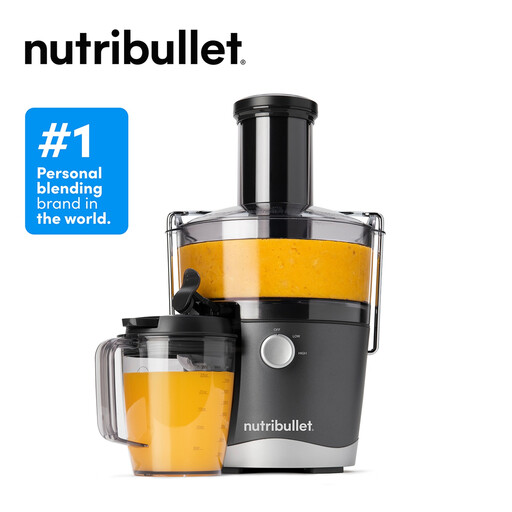 No image available
Consider this centrifugal juicer for smaller pear-juice batches when fruit can be prepared to fit its 3-inch chute.
The finished-juice pitcher holds 800ml; the separate pulp basin holds 1.5L. The sieve, pulp basin and pitcher are described as dishwasher-safe.
Check the selected unit's voltage and plug configuration for UK use before ordering.
Compare finished-juice capacity with the servings you intend to make, rather than using pulp-bin size as a substitute. Sage states a 2L jug for the Nutri Juicer Cold XL, Philips states up to 2L in one go for the HR1855/70R1, and nutribullet specifies an 800ml pitcher for its Juicer 800W.
No: a wide chute may reduce cutting, but pears still need to fit the particular machine's opening and instructions. Wash and inspect the fruit, remove stems and cut pieces as needed; Kuvings gives those preparation steps in its pear recipe.
No: choose a slow juicer if you want its pressing-style workflow and its feeding, container and cleaning arrangements suit your routine. Hurom lists a 1.8L hopper but a separate 450ml juice container for the H70ST, so the hopper alone cannot answer a family batch-size question.
No: a product-specific storage claim should not be applied to every batch of fresh pear juice. Handle juice hygienically and consult current Food Standards Agency household food-safety guidance for storage decisions.