
24/7 Customer Support

Free returns

Same-day & Next-day Delivery

Quality Guaranteed

Unlock Your Welcome Offers: FREE Delivery | Up to 80% OFF | Free 30-day JoyPlus trial
Download the APP
A flat battery on a frosty morning or a slowly deflating tyre on the motorway can turn a routine journey into a stressful ordeal. A multi-function jump starter with air compressor seems like the perfect all-in-one solution to keep in your boot. However, the market is flooded with devices promising immense power and endless features, making it difficult to separate genuine performance from marketing hype.
As a Joybuy Product Recommendation Officer, my role is to help you navigate these choices. Many drivers invest in a device only to find it fails when needed most. This is often due to a few common but costly purchasing pitfalls.
emergency jump starter designed for a 1.4L petrol hatchback will likely struggle with a 3.0L diesel van on a cold day. Engine size, fuel type and even the ambient temperature are critical factors that are frequently overlooked.To avoid these traps, focus on the specifications that directly impact performance and reliability. Understanding these core parameters will ensure you choose a device that is genuinely up to the task.
While peak amperage gives a general idea of power, the crucial detail is the manufacturer's stated engine compatibility. Look for a clear rating, such as "up to 8.0L petrol / 6.0L diesel". Diesel engines require significantly more power to start due to their higher compression ratios, so a portable car battery booster must be robust enough to handle them. A good 12v jump starter will clearly define its limits, allowing you to match it to your vehicle.
When evaluating the device as a power bank with jump start capabilities, look for the rated capacity if available. This gives a more accurate picture of how many times you can charge your phone or tablet. The overall battery capacity, often listed in mAh or Watt-hours (Wh), also determines how many jump-start attempts or tyre inflations you can perform on a single charge. Features like QC3.0 or PD fast charging are valuable additions for quickly powering up modern electronics.
Nearly every car jump starter with tyre inflator will claim a maximum pressure of 150 PSI, which is more than enough for any passenger vehicle tyre. The more important, and often unlisted, metric is the airflow rate, measured in litres per minute (L/min). A higher airflow rate means the car tyre pump will inflate your tyres much faster, getting you back on the road with minimal delay. Also, look for features like an auto-shutoff function, which prevents over-inflation by stopping at a preset pressure.
Instead of a single "one-size-fits-all" recommendation, the right choice depends on your vehicle, your driving habits and your priorities. Here are a few options tailored to different UK driver profiles.
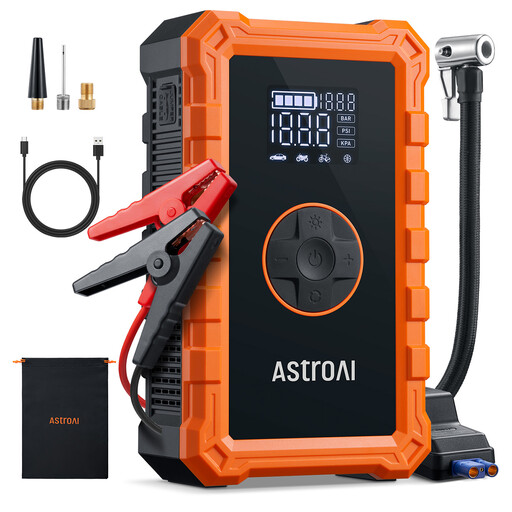
Why This Fits Their Persona: Ideal for drivers of standard petrol or small diesel cars (e.g., hatchbacks, saloons) who need a reliable, no-fuss emergency tool. Its compact design is easy to store in the boot or even the glove compartment, and the large, clear screen makes it straightforward to use in a stressful situation.
It avoids the "one-size-fits-all" myth by clearly stating its capability for up to 6.0L petrol and 3.0L diesel engines, a range that covers the vast majority of UK commuter cars without overpromising.
The large 2.4" digital screen clearly displays operational status, battery level and tyre pressure, removing guesswork. The built-in storage for accessories prevents losing essential parts.
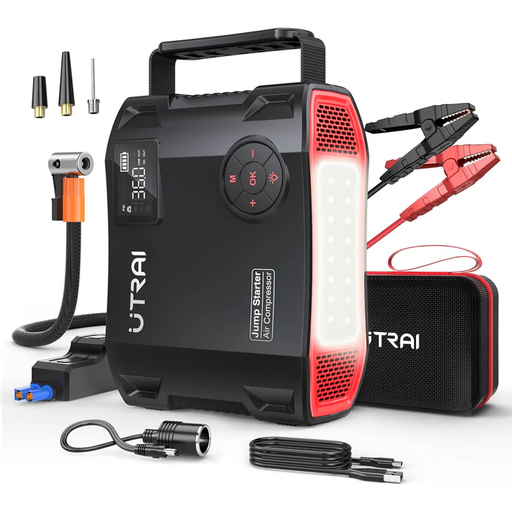
Why This Fits Their Persona: Perfect for those with larger vehicles like SUVs, vans or motorhomes, and for anyone who enjoys camping or outdoor activities. Its high power output handles large engines, and the dedicated DC output is a standout feature for powering other 12V equipment away from the car.
This unit counters the peak amperage trap by backing its 6000A claim with a concrete compatibility of all petrol and up to 10.0L diesel engines. Its high airflow of 45L/min also ensures the compressor is genuinely fast, not just high-pressure.
The 160W DC output port is a significant advantage, allowing you to power devices like portable fridges, dash cams or car vacuum cleaners directly, making it a true multi-purpose tool for travel.
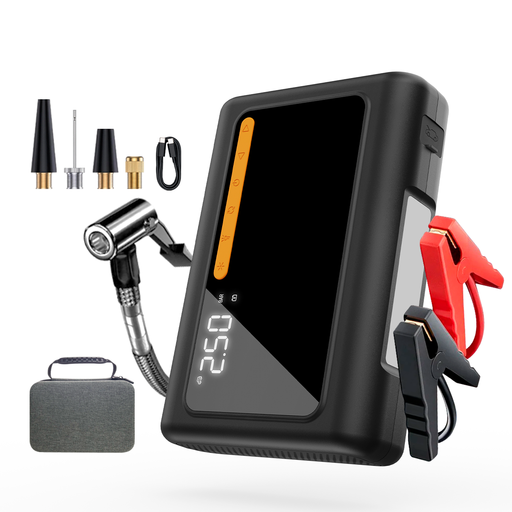
Why This Fits Their Persona: For the driver who prioritises long-term reliability, advanced safety and low maintenance. This unit uses sodium-ion battery technology, which offers significant advantages over traditional lithium-ion, especially for a device stored in a car through hot summers and cold winters.
It directly addresses the hidden flaw of battery degradation. Unlike lithium batteries that require frequent recharging, its ultra-low self-discharge rate means it can hold a charge for years. It also operates safely in a much wider temperature range (-40°C to 80°C).
The core advantage is the sodium-ion battery chemistry. It is more chemically stable, can be reactivated even if fully discharged to 0V, and offers a vastly longer cycle life (up to 6,000 cycles) for a truly long-term investment.
We have compiled a complete, real-time list of products that fully satisfy these strict selection criteria and UK safety regulations.
The physical device can last for many years with proper care. The lifespan of the internal battery, however, is the main consideration. For most lithium-ion models, you can expect a lifespan of 3-5 years or between 500-1000 charge cycles. To maximise this, it is important to recharge the unit every 3-6 months, even when not in use. Some newer models with different battery chemistries, such as sodium-ion, may offer a significantly longer cycle life.
Yes, these devices are designed to be stored in a vehicle. However, it is wise to be mindful of extreme temperatures. Most lithium-ion units have an operational temperature range of approximately -20°C to 60°C. Leaving one in a car during a typical UK winter or summer is generally fine. However, prolonged exposure to the intense heat of a car interior during a summer heatwave can degrade the battery over time. Always check the manufacturer's recommended storage temperature range.
It is highly recommended to fully charge your emergency jump starter when you first receive it. Units are typically shipped with only a partial charge for safety reasons. A full initial charge ensures the device has maximum power for its first potential use and helps to calibrate the battery management system, contributing to its long-term health and accuracy.