
24/7 Customer Support

Free returns

Same-day & Next-day Delivery

Quality Guaranteed

Unlock Your Welcome Offers: FREE Delivery | Up to 80% OFF | Free 30-day JoyPlus trial
Download the APP
A flat battery or a deflated tyre can turn a routine journey into a roadside headache. While many UK drivers rely on breakdown services, having the right tool on hand offers immediate peace of mind and self-sufficiency. A multi-function jump starter with an air compressor seems like the perfect all-in-one solution, but the market is flooded with options that often over-promise and under-deliver.
As a Joybuy Product Recommendation Officer, my role is to help you navigate the marketing jargon. Before you invest in an emergency car kit, it's crucial to understand the common pitfalls that lead to buyer's remorse.
To ensure you get a reliable tool that performs when you need it most, focus on these three non-negotiable specifications.
Instead of getting fixated on the advertised peak amps, look for the manufacturer's stated engine compatibility. This is a far more practical measure of a unit's capability. A quality heavy duty jump starter will clearly specify the maximum engine size it can handle, for both petrol and diesel vehicles (e.g., up to 9.0L petrol / 8.0L diesel). This tells you it has been designed to provide the necessary power for a wide range of UK cars, vans and SUVs. A reliable 12v jump starter pack should handle the majority of consumer vehicles without issue.
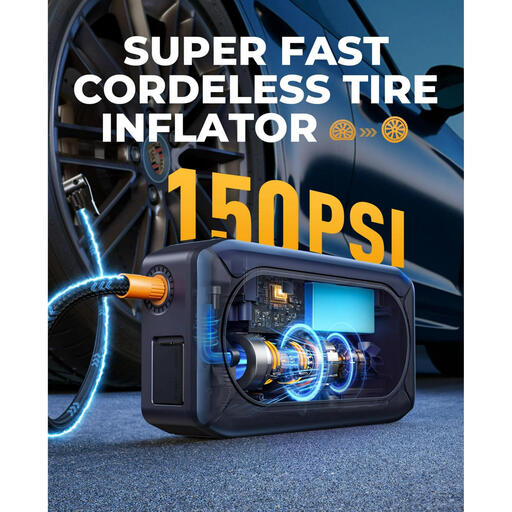
A functional tyre inflator air compressor is more than just an add-on; it's a core feature. Look for a unit with a maximum pressure of at least 120-150 PSI. While your car tyres only need 30-40 PSI, a higher rating indicates a more powerful motor that can inflate them quickly without straining. Essential features to check for include:
A modern jump starter should be virtually foolproof. Look for "smart clamps" or systems with at least 8-10 layers of protection. Critical safety features include reverse polarity protection (prevents sparks if you mix up the terminals), overload protection and short-circuit protection.
Beyond safety, consider its role as a power bank with jump starter. Check for USB output ports to charge your phone and other devices. A built-in, multi-mode LED light (with steady, strobe and SOS functions) is another indispensable component of a complete emergency car kit.
We've analysed the specifications of various models to match them with the needs of different UK drivers.
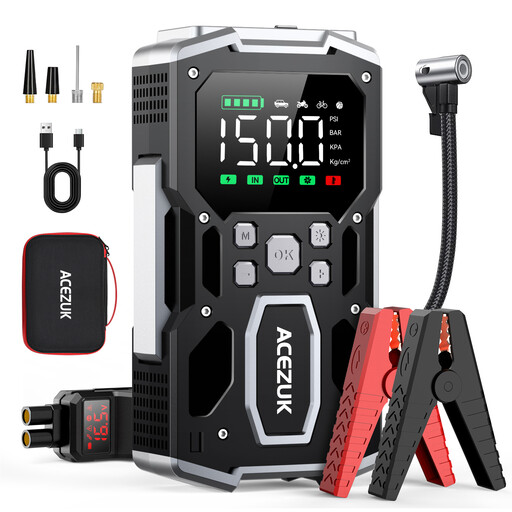
Why This Fits Their Persona: This unit offers a strong balance of power for the majority of UK family cars and SUVs, combined with practical features for everyday life. The fast-charging USB ports are ideal for keeping family devices powered up on long journeys.
It directly counters the safety gamble with a 10-in-1 intelligent protection system and smart cable. The clear LCD screen and preset pressure function for the compressor avoid the risk of over-inflation.
Features two QC3.0 fast-charging USB ports, turning it into a genuinely useful high-speed power bank for phones and tablets, not just an emergency tool.
Why This Fits Their Persona: This is a powerful unit for those with larger vehicles. Its clear compatibility with petrol engines up to 9.0L and diesel up to 8.0L provides confidence for owners of vans, large 4x4s and even some commercial vehicles.
It bypasses the inflated power myth by providing clear, verifiable engine size ratings. It also addresses the overheating compressor flaw with its honeycomb cooling technology, designed to reduce heat buildup during use.
The combination of high starting power and an all-weather operating range (-20°C to 60°C) makes it a dependable tool for demanding conditions, from frosty mornings to summer heatwaves.
Why This Fits Their Persona: For those who venture further afield for camping or hiking, reliability is paramount. This unit's robust build, wide operating temperature range and genuinely powerful 500-lumen LED light make it an ideal off-grid companion.
Many units have a token, dim LED. This model's multi-mode light, including a bright white beam and an SOS signal, is a genuinely useful emergency feature, not just a marketing bullet point.
The 5-in-1 functionality (jump starter, compressor, power bank, LED light and safety system) consolidates multiple pieces of emergency gear into one compact, easy-to-store case.
We have compiled a complete, real-time list of products that fully satisfy these strict selection criteria and UK safety regulations.
To ensure the internal battery remains healthy and ready for an emergency, it is advisable to recharge the unit every 3 to 6 months, even if it has not been used. After any significant use, such as jump-starting a car or fully inflating a tyre, you should recharge it as soon as possible to ensure it's at full capacity for the next time.
Most quality jump starters are designed with a specific operating temperature range. Models like the ones recommended are often rated to function in temperatures as low as -20°C. While they are built to withstand being left in a cold car, remember that all batteries experience some performance degradation in extreme cold. For optimal longevity, check the manufacturer's storage guidelines in the user manual.
Yes, it is perfectly safe. Modern jump starters with smart clamps are designed to deliver only the amount of current the vehicle's battery requests. The high peak amp rating indicates the unit's maximum capability, not the amount of power it forces out. Using a heavy-duty portable car battery booster on a smaller car will not cause any damage; it simply means the device will be working well within its capacity.