
24/7 Customer Support

Free returns

Same-day & Next-day Delivery

Quality Guaranteed

Unlock Your Welcome Offers: FREE Delivery | Up to 80% OFF | Free 30-day JoyPlus trial
Download the APP
A flat battery or a soft tyre can turn a routine commute into a roadside headache. A modern jump starter with air compressor seems like the perfect all-in-one solution to keep in your boot. However, the market is flooded with devices promising incredible power and features, making it difficult to separate genuine performance from marketing hype.
As a Joybuy Product Recommendation Officer, my role is to help you see past the flashy numbers and identify the practical features that matter for UK drivers. Before you buy, be aware of these common purchasing pitfalls that can leave you with an unreliable gadget when you need it most.
To ensure you get a reliable emergency car tool, focus on these three core parameters. They are the true indicators of a device's real-world performance.
Instead of focusing solely on the advertised peak amps, check the manufacturer's recommended engine compatibility. A reputable brand will clearly state the maximum petrol and diesel engine sizes (in litres) that the car battery booster pack can reliably start. For most UK cars, a unit rated for up to 6.0L petrol and 3.0L diesel is sufficient. However, if you drive a large SUV, van or a vehicle with a bigger diesel engine, you will need a more powerful model. Look for a portable car jump starter with a higher rating specifically for diesel engines, as they require more power to turn over.
A functional jump starter with tyre inflator needs more than just high pressure.
The utility of the device as a portable power bank depends on its rated capacity and charging outputs. A unit with a rated capacity of 10,000mAh or more will provide several phone charges. Also, check the USB ports. A QC3.0 (Quick Charge) or PD (Power Delivery) port will charge compatible devices much faster than a standard USB port. An integrated, bright LED light with an SOS mode is another non-negotiable feature for any roadside emergency kit.
To help you choose, we have matched some suitable models to different types of UK drivers, explaining how they address the common pitfalls.
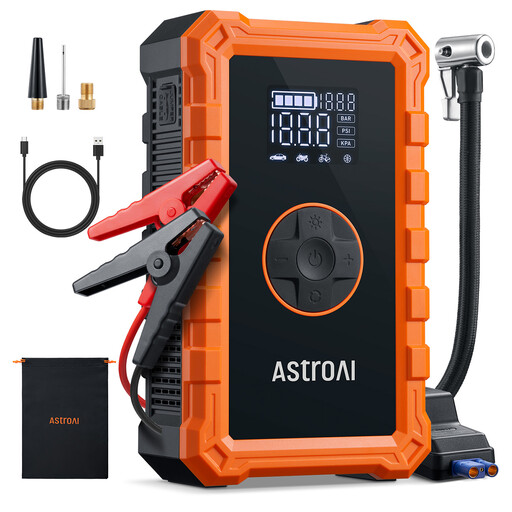
Why This Fits Their Persona: Ideal for drivers of standard petrol or smaller diesel cars who need a compact, reliable tool for everyday peace of mind. It's small enough to fit in a glovebox and provides all the essential functions without paying for excessive power you don't need.
It avoids the 'Peak Amp' trap by clearly stating its suitability for engines up to 6.0L petrol/3.0L diesel, a realistic range for its 1500A rating. This manages expectations and ensures it performs as intended for the right vehicles.
Its highly compact design includes integrated storage for cables and accessories, keeping everything neat and tidy. The large 2.4" screen is easy to read in daylight.
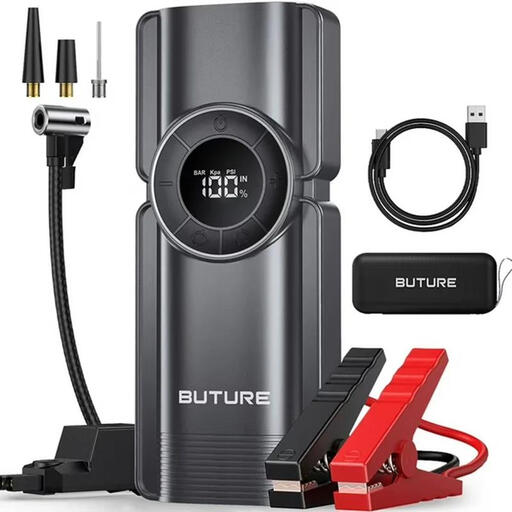
Why This Fits Their Persona: A great all-rounder for drivers of family SUVs, people carriers or larger estate cars. It offers a solid power reserve for bigger engines and the convenience of dual USB ports to keep tablets and phones charged during long journeys.
This unit's 3500A peak current is backed by a clear rating for up to 8.5L petrol and 8.0L diesel engines, providing a genuine safety margin for larger family vehicles. Its smart compressor with auto-shutoff prevents accidental over-inflation.
It features a clear, intelligent digital display showing remaining battery and tyre pressure, making it very user-friendly. It comes in a tidy, heat-pressed storage bag.
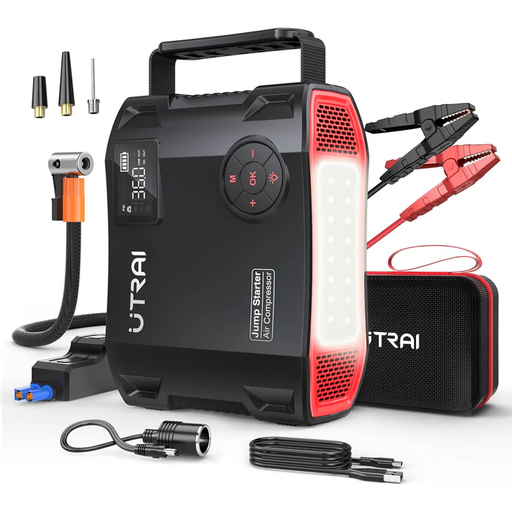
Why This Fits Their Persona: Designed for those who cannot afford to be stranded. This is a high-performance unit for drivers of large diesel vans, trucks, 4x4s or anyone who wants maximum power and versatility for any eventuality, including powering other 12V equipment.
It counters the 'slow compressor' pitfall with a high airflow rate of 45L/min, inflating tyres much faster than basic models. Its 6000A peak current is genuinely capable of starting diesel engines up to 10.0L, as stated.
Its standout feature is the 160W DC output, which can power other 12V car accessories like portable fridges, dash cams or vacuum cleaners, making it a true multi-function power pack.
We have compiled a complete, real-time list of products that fully satisfy these strict selection criteria and UK safety regulations.
This depends heavily on the device's battery capacity and the condition of your car's battery and engine. A fully charged, good-quality unit should be able to provide anywhere from 15 to 30 jump-starts on a smaller petrol car. For larger diesel engines, this number will be lower. It is good practice to recharge the jump starter after each use to ensure it is always ready.
Most modern lithium-battery jump starters are designed to operate within a wide temperature range, typically from -20°C to 60°C, making them suitable for storage in a car year-round in the UK. However, extreme cold can reduce battery efficiency. To maintain battery health, manufacturers generally recommend recharging the unit every 3 to 6 months if it's not being used.
Not at all. Modern jump starters are designed with multiple safety features to make them almost foolproof. They include protection against reverse polarity (connecting the clamps to the wrong terminals), short circuits and over-current. The process is straightforward: connect the clamps to the battery, wait for a green light or indicator and start your car. The air compressor function is equally simple, especially with an auto-shutoff feature.