
24/7 Customer Support

Free returns

Same-day & Next-day Delivery

Quality Guaranteed

Unlock Your Welcome Offers: FREE Delivery | Up to 80% OFF | Free 30-day JoyPlus trial
Download the APP
A flat battery or a soft tyre can turn a routine commute into a roadside headache. A multi-function jump starter with air compressor seems like the perfect all-in-one solution for your emergency car kit. However, the market is flooded with devices that promise the world but often fail when you need them most. Many UK drivers find themselves with a gadget that can't start their engine or takes an eternity to inflate a tyre.
As the Joybuy Product Recommendation Officer, my role is to help you see past the marketing jargon. Before you buy, be aware of these common purchasing pitfalls that lead to disappointment:
To choose a reliable device, focus on the specifications that directly impact performance. Here’s what to look for to ensure you get a dependable car battery booster pack and car tyre pump in one.
The power you need is directly related to your vehicle's engine. Don't just look at the peak amps; check the manufacturer's recommended engine compatibility.
While 150 PSI is a standard maximum pressure, the airflow rate (L/min) is what determines how quickly your tyre will inflate. A higher number means faster inflation. For a standard car tyre, an airflow of 25 L/min is adequate, but for larger SUV or van tyres, look for 40 L/min or more to save time. Also, an automatic shut-off feature is essential—it lets you set the desired pressure and stops automatically, preventing over-inflation.
A good multi-tool should also serve as a useful power bank with tyre inflator. Check for:
Based on these practical criteria, we've matched several products to different UK driver profiles.
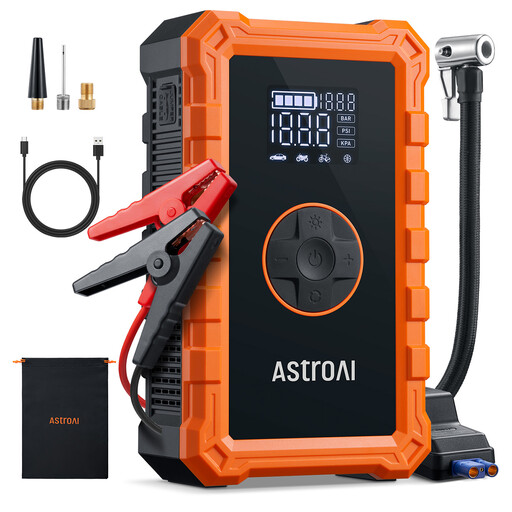
Why This Fits Their Persona: Ideal for drivers of standard petrol or small diesel cars who need a reliable, no-fuss device for peace of mind on daily commutes and school runs. It's compact enough to live in the boot without taking up valuable space.
It avoids the "peak power" illusion by clearly stating its suitability for engines up to 6.0L petrol / 3.0L diesel, matching its 1500A rating to realistic vehicle types.
Features a large, easy-to-read 2.4" screen and a fast 25L/min airflow, which is practical for quick top-ups. The built-in storage for cables is a thoughtful touch.
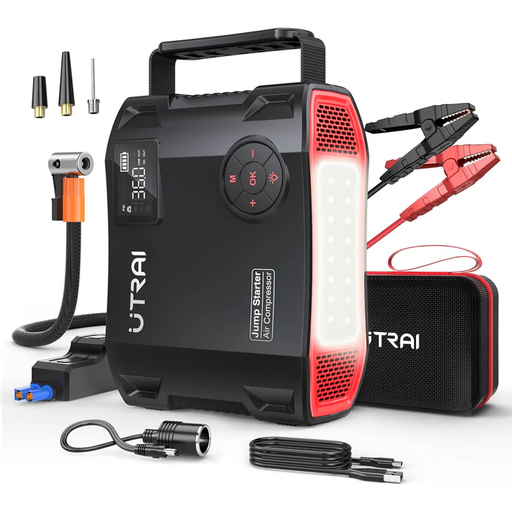
Why This Fits Their Persona: Built for those with large SUVs, vans or who frequently travel long distances. Its immense power and robust compressor provide confidence for handling larger vehicles and more demanding situations.
It counters the "weak compressor" trap with a powerful 45L/min airflow, capable of inflating a standard car tyre from 0 to 36 PSI in around 4 minutes, making it genuinely useful for larger tyres.
The 6000A peak current can start all petrol and up to 10.0L diesel engines. A unique 160W DC output can also power other 12V accessories like a car fridge or vacuum.
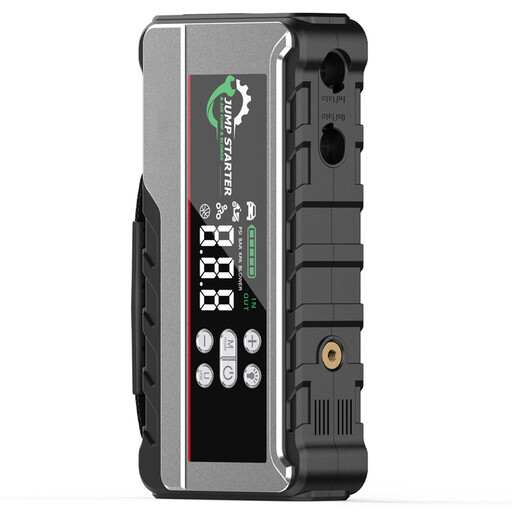
Why This Fits Their Persona: For the user who works on the go and needs a single device to power their car and their tech. This unit is as much a high-speed charging hub as it is an emergency tool.
It sidesteps the "underpowered power bank" trap by offering true fast charging. The PD65W USB-C port can genuinely charge a compatible laptop, not just slowly top up a phone.
The standout feature is its versatility. It combines a 3000A jump starter, a 150 PSI tyre inflator and a powerful 65W power bank, making it a true all-in-one work and travel companion.
We have compiled a complete, real-time list of products that fully satisfy these strict selection criteria and UK safety regulations.
Most modern lithium-ion units have a low self-discharge rate and can hold a significant charge for 3 to 6 months. However, to ensure it's ready for an emergency, it is good practice to check the battery level and top it up every 3 months. This also helps maintain the long-term health of the internal battery.
Yes, the majority of these devices are designed to function in a wide range of temperatures, often from -20°C to 60°C. While they are built to withstand being stored in a car, extreme cold can temporarily reduce battery efficiency. It is always wise to ensure the unit is well-charged before the winter months begin.
Absolutely. The 150 PSI rating refers to the maximum pressure the compressor can generate, which is far higher than what is required for any passenger vehicle. Car tyres in the UK typically require between 30 and 40 PSI. The more practical specification to consider is the airflow rate (L/min), as this will determine how quickly the device can inflate your tyre to the correct pressure.