
24/7 Customer Support

Free returns

Same-day & Next-day Delivery

Quality Guaranteed

Unlock Your Welcome Offers: FREE Delivery | Up to 80% OFF | Free 30-day JoyPlus trial
Download the APP
A flat battery on a frosty morning or a tyre pressure warning light flashing on the motorway are situations every UK driver dreads. A single, compact device that can solve both problems sounds like the perfect addition to any car's emergency kit. However, the market is flooded with gadgets promising the world and it's easy to end up with a tool that fails when you need it most.
As the Joybuy Product Recommendation Officer, my role is to help you see past the marketing jargon. Before you invest in a jump starter with air compressor, let's look at the common issues that can lead to a bad purchase.
Many multi-functional tools look impressive online, but their real-world performance can be disappointing. Here are three pitfalls to watch out for:
To choose a reliable car emergency tool, you need to focus on the specifications that directly impact performance and safety.
Instead of getting fixated on peak amps, check the manufacturer's stated engine compatibility. A good listing will specify the maximum petrol and diesel engine size (e.g., "up to 6.0L petrol / 4.0L diesel") the car battery booster can handle. For most standard UK cars, a unit rated for petrol engines up to 5.0L is more than sufficient. This is a much more practical measure of a portable jump starter's real-world power.
Nearly every portable tyre inflator advertises a maximum pressure of 150 PSI. While this sounds impressive, your car tyres likely only need 30-40 PSI. A more useful metric is the airflow rate, measured in Litres Per Minute (L/min). A higher L/min means the car tyre pump will inflate your tyre faster, getting you back on the road sooner. Also, look for a digital tyre inflator with an automatic shut-off function. This allows you to set your target pressure and the machine stops by itself, preventing over-inflation.
The battery is the core of any cordless air compressor or jump starter. Look for information on the battery's operating temperature range. A device that works between -20°C and 60°C is well-suited for the unpredictable UK climate. Some newer models use advanced battery technology with very low self-discharge rates, meaning they can hold a charge for months or even years, ensuring your power bank with jump starter is ready when an emergency strikes.
Choosing the right tool depends on your vehicle and how you use it. Here are a few options that align with different driver profiles.
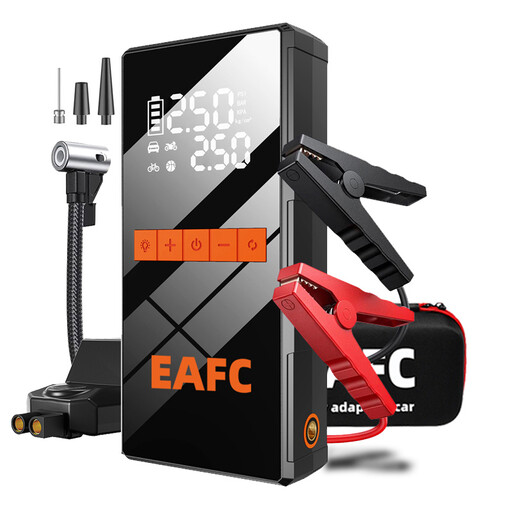
Why This Fits Their Persona: Ideal for drivers of small to medium-sized cars (e.g., Ford Fiesta, VW Golf) who need a compact, all-in-one solution for common roadside issues without paying for excessive power they don't need. It fits easily in a glove box or boot organiser.
It focuses on practical power, clearly stating its compatibility with petrol engines up to 4.0L and diesel up to 2.0L, avoiding the "peak power" myth. It includes smart safety clamps to prevent dangerous connection errors.
A true 4-in-1 device combining a jump starter, air compressor, power bank and LED torch in a very compact form factor. The compressor features an auto shut-off function for ease of use.
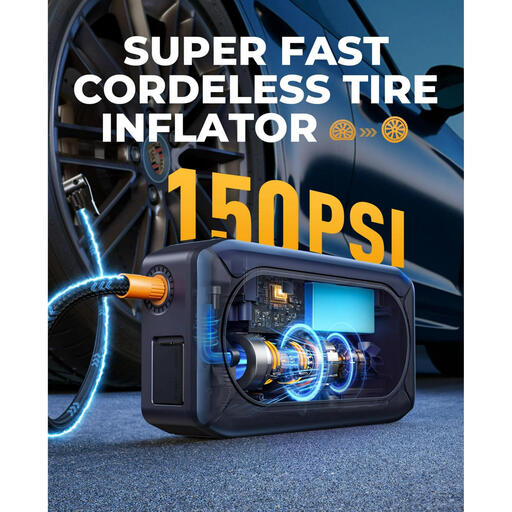
Why This Fits Their Persona: Built for drivers of larger vehicles like SUVs, people carriers or vans (e.g., Nissan Qashqai, Land Rover Discovery). They need a powerful, reliable unit with robust safety features to ensure family safety on long journeys or school runs.
This model directly counters the "flimsy build" trap. It features 10 layers of smart protection, including spark-proof and reverse polarity systems, housed in a durable case with advanced cooling to prevent overheating during use.
Its high power output is suitable for large petrol (up to 9.0L) and diesel (up to 8.0L) engines. The bright, 500-lumen multi-mode LED light is genuinely useful for nighttime emergencies.
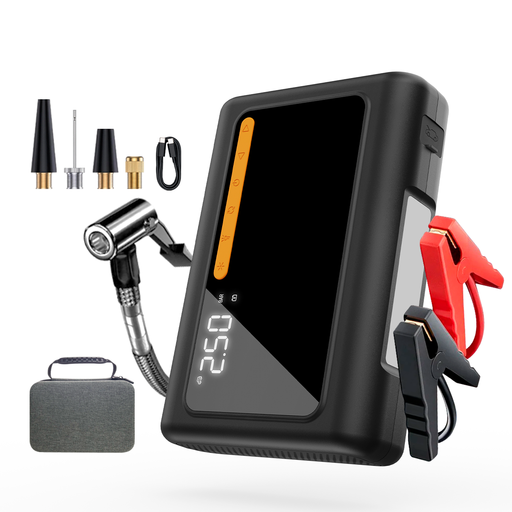
Why This Fits Their Persona: For the user who values long-term reliability, cutting-edge technology and performance in all conditions. Perfect for outdoor enthusiasts, campers or anyone who wants a "buy it once, trust it for years" tool.
It completely solves the "disappearing charge" problem. The sodium-ion battery has an extremely low self-discharge rate, allowing it to hold a charge for years. It also operates safely in a huge temperature range (-40°C to 80°C).
Exceptional battery longevity and stability. It can be fully discharged to 0V and reactivated by charging, unlike lithium batteries. It also supports fast PD60W charging to get it back to full power quickly.
We have compiled a complete, real-time list of products that fully satisfy these strict selection criteria and UK safety regulations.
How often should I charge my jump starter with air compressor? This depends on the model's battery technology. For standard lithium-ion units, it is good practice to check and top up the charge every 3 to 6 months to ensure it's ready for an emergency. For models with newer battery types, like sodium-ion, the self-discharge rate is much lower and they may only need checking once a year. Always refer to the manufacturer's guidance.
Can I leave it in my car during a UK winter? Most quality units are designed to be stored in a vehicle. Check for the operating temperature range in the product specifications. A device rated to work in temperatures down to -20°C will be reliable during a typical British winter. Remember that extreme cold can reduce any battery's immediate power output, so keeping it fully charged is key.
Is a 150 PSI compressor necessary for my car? No, it is not. Standard car tyres require a pressure of around 30-40 PSI. The 150 PSI figure simply indicates the maximum pressure the pump is capable of producing. For everyday use, features like the inflation speed (L/min), a clear digital display and an automatic shut-off function are far more important for convenience and safety.