
24/7 Customer Support

Free returns

Same-day & Next-day Delivery

Quality Guaranteed

Unlock Your Welcome Offers: FREE Delivery | Up to 80% OFF | Free 30-day JoyPlus trial
Download the APP
A pressure washer can remove visible dirt quickly, but the detergent you pair with it determines how easily oily grime, traffic film, moss-related dullness and weathering marks lift from the surface. Choosing the wrong formula, however, can waste money or create extra work.
The main buying traps are easy to overlook:
Start by identifying the main job. For a car, look for a car foam cleaner or pressure washer detergent intended for vehicle and road dirt. For paving, choose a dedicated stone patio cleaner, patio tile cleaner or paving stone cleaner.
Porous stone and concrete can hold onto dirt more deeply than smooth, sealed surfaces. A specialist outdoor surface cleaner may therefore be more suitable than a general-purpose wash. If you are unsure whether your patio is sealed, check the original installation guidance or test the cleaner in a hidden corner.
A detergent can be used in one of three common ways:
This affects both convenience and running cost. A 1-litre cleaning solution may provide several sessions, but the actual coverage depends on dilution, surface size and how much product is dispensed.
Detergent needs enough contact time to loosen dirt, but it should not be allowed to dry on the surface. Work in manageable sections and rinse thoroughly. For stone cleaning, applying the product on a cool surface and avoiding direct sunlight can make the process easier to control.
Weather also matters in the UK. Rain soon after application can dilute the cleaner, while strong sun can dry it before it has worked. Choose a calm, dry period and follow the label instructions. Wear suitable gloves and eye protection where directed, keep children away from the work area and never mix cleaning products.
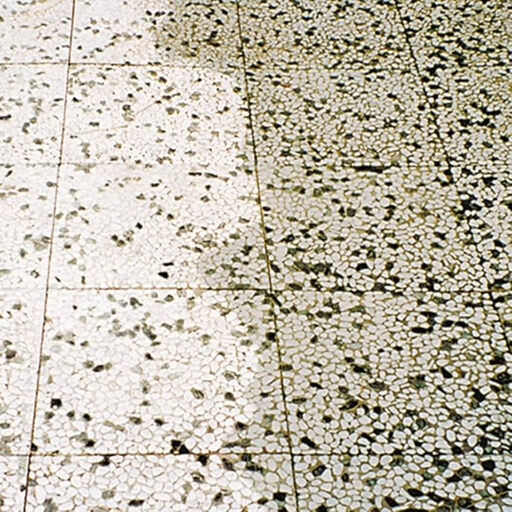
Why This Fits Their Persona: A practical option for homeowners who want to refresh terrace tiles, concrete tiles or paving without committing to a pressure washer detergent system.
It is positioned for patio tiles and paving stones rather than being presented as a universal vehicle-and-garden cleaner. Dilution and small-area testing help reduce misuse.
A 1-litre concentrate; suitable for gravel and concrete tiles, patio tiles and paving stones; can be applied with a mop or brush.
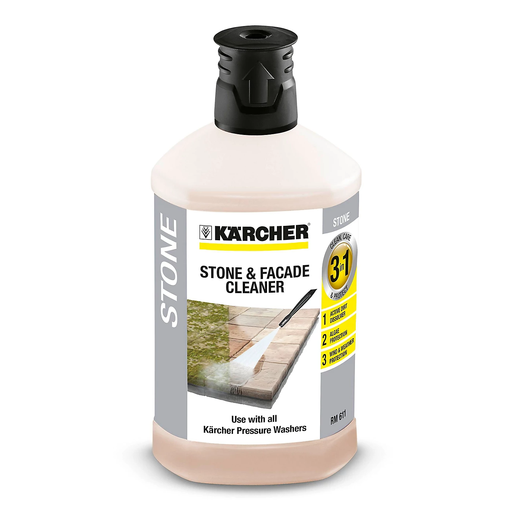
Why This Fits Their Persona: Suits Kärcher pressure washer owners who want a dedicated product for stone patios, garden walls and exterior façades.
The intended material and Plug ‘n’ Clean connection are clearly defined, helping avoid the mistake of using a car foam cleaner on porous outdoor stone.
Active dirt remover; designed for stone patios, walls and façades; includes a protective formula and 1-litre bottle.
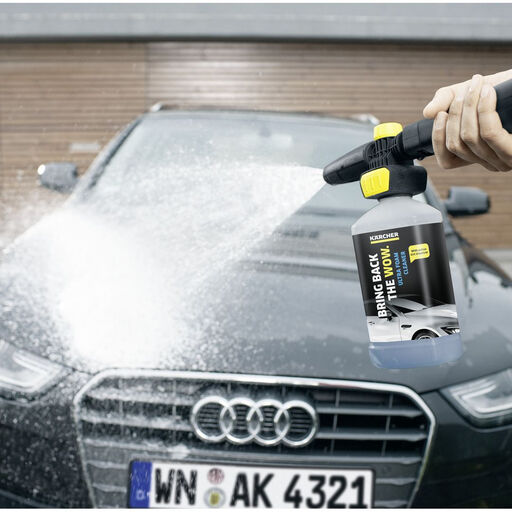
Why This Fits Their Persona: A focused choice for car owners and DIY users regularly removing oily, greasy and typical road dirt from vehicles.
It is specifically formulated for vehicle and road dirt, rather than relying on a general patio product. The foam nozzle requirement is also clear before purchase.
Extra foam booster; active dirt dissolver for oily and greasy grime; compatible with Kärcher pressure washers and foam nozzles.
We have compiled a complete, real-time list of products that fully satisfy these strict selection criteria and UK safety regulations.
Before applying any detergent, sweep away loose grit and remove furniture, pots and toys from the area. For pressure washer use:
Avoid directing high-pressure spray at damaged pointing, loose render, vehicle seals or delicate paintwork. Collect or control runoff where practical, particularly near planted beds, drains and neighbouring property. Never combine different detergents and store opened bottles securely according to the label.
It is designed for vehicle and road dirt and is intended for Kärcher pressure washers and foam nozzles. For paving, stone or patio tiles, a dedicated stone patio cleaner or patio tile cleaner is a more appropriate starting point. Check the product label and surface manufacturer’s guidance before applying any detergent.
No. HG Outdoor Patio Tile Cleaner Concentrate can be diluted and applied with a mop or brush according to the instructions. A pressure washer may speed up rinsing, but manual application can be useful where water spray could affect pointing, plants or nearby surfaces.
Coverage varies according to dilution, application method, surface porosity and the amount of dirt. A concentrate may cover more area than a ready-to-use product, but the label’s dilution ratio is the reliable guide. Work in small sections to avoid unnecessary wastage and prevent the solution drying before rinsing.