Carb-counting biscuit shoppers
If you want a custard cream, the carbohydrate figure for each biscuit helps you account for the number you intend to eat. Tesco Groceries and Asda Groceries publish per-biscuit figures for the checked classic products.


Choose a custard cream if you want the filled biscuit and its labelled carbohydrate fits the number you plan to eat. If cocoa flavour matters more than the biscuit format, compare a separate dark chocolate bar by carbohydrate for your intended portion. Tesco Groceries and Asda Groceries list 8.1–8.4g carbohydrate per biscuit for the checked classic custard creams, while Lindt Shop UK lists 9–14g per 100g across its checked 99%, 100% and 90% bars; neither a dark description nor cocoa percentage decides whether a portion fits your plan.
If you want a custard cream, the carbohydrate figure for each biscuit helps you account for the number you intend to eat. Tesco Groceries and Asda Groceries publish per-biscuit figures for the checked classic products.
If the cocoa flavour matters more than a vanilla-filled biscuit, a separate bar is another format to consider. Lindt Shop UK lists different carbohydrate figures for its checked 90%, 99% and 100% bars, so compare the exact bar and portion.
A dietary description does not replace the ingredients and allergen information on the particular pack. The checked classic biscuit listings include wheat and milk ingredients; check any biscuit or chocolate you choose for the allergens relevant to you.
Start with the format you want, then compare the carbohydrate declaration using the serving unit on each label and the amount you intend to eat.
| Priority | What to check | Your needs |
|---|---|---|
| Carbohydrate per portion | Read carbohydrate per biscuit where stated. For a chocolate bar, use its per 100g figure to work out the amount in the portion you plan to eat. Tesco Groceries and Asda Groceries list 8.1–8.4g per biscuit for the checked classic custard creams; Lindt Shop UK lists 9–14g per 100g across the checked high-cocoa bars. | I want to account for the biscuits or chocolate I will actually eat, rather than compare a whole bar with one biscuit. |
| Label descriptions | Compare the carbohydrate line as well as ‘of which sugars’. Check cocoa percentage and the exact formulation rather than treating ‘dark’, chocolate-coated or ‘free from’ as a carbohydrate figure. | A description on the front of the pack catches my eye, but I need the nutrition panel to decide whether the portion fits my plan. |
| Biscuit or chocolate | Check whether you want a vanilla-filled sandwich biscuit, a coated biscuit or a separate chocolate bar. Asda Groceries describes its checked coated custard cream as milk-chocolate coated; the checked Lindt high-cocoa products are bars, not filled biscuits. | If the custard-cream filling and biscuit texture matter to me, a plain dark chocolate bar will not provide them. |
| Allergens and storage | Read the ingredients and allergen information on the exact pack. For an opened biscuit pack, follow its storage directions; Tesco Groceries instructs shoppers to use an airtight container after opening its checked custard creams. | I need to check ingredients that matter to me and know how to keep an opened pack. |
Lindt Shop UK declares 11g carbohydrate per 100g for its checked 100% bar, compared with 9g per 100g for its checked 99% bar. Cocoa percentage does not order these two bars by carbohydrate.
Compare the carbohydrate declarations for the exact bars on the same per 100g basis, then calculate the amount for your intended portion.
Tesco Groceries lists 3.4g sugars and 8.4g carbohydrate per biscuit for its checked custard creams. The sugars figure is not the total carbohydrate figure.
Use the carbohydrate line when accounting for carbohydrate, keeping the label’s serving unit consistent.
Asda Groceries lists 11g carbohydrate per biscuit for its checked free-from custard creams. Its checked chocolate-coated version uses milk chocolate and lists 65g carbohydrate per 100g.
Identify the exact product and read its full nutrition panel rather than deciding from its front-of-pack description.
These references describe the cited product listings, not every biscuit or chocolate made by each brand.
Joybuy UK lists McVitie's Tasties Custard Creams as a 300g sandwich-biscuit pack.
Tesco Groceries lists a 300g pack of Crawford's classic custard creams with a per-biscuit declaration.
Tesco Groceries lists its own-label custard creams in a 400g pack.
Sainsbury's lists classic custard creams in a 200g pack with a per-biscuit nutrition table.
Asda Groceries lists classic, milk-chocolate-coated and free-from custard creams as distinct products.
Ocado lists M&S Extra Cream Custard Creams as vanilla-flavoured sandwich biscuits.
Lindt Shop UK lists high-cocoa EXCELLENCE bars for shoppers considering chocolate instead of a custard cream.
These Joybuy options cover two different choices: a high-cocoa chocolate bar if the biscuit format is optional, and a gluten-free custard cream if you want a filled biscuit. Check the carbohydrate declaration for the exact pack and portion before deciding.
 No image available
This is a chocolate-bar option rather than a custard cream. Compare the pack’s carbohydrate declaration with the amount you intend to eat; the 90% cocoa description alone does not determine whether that portion fits your plan.
 No image available
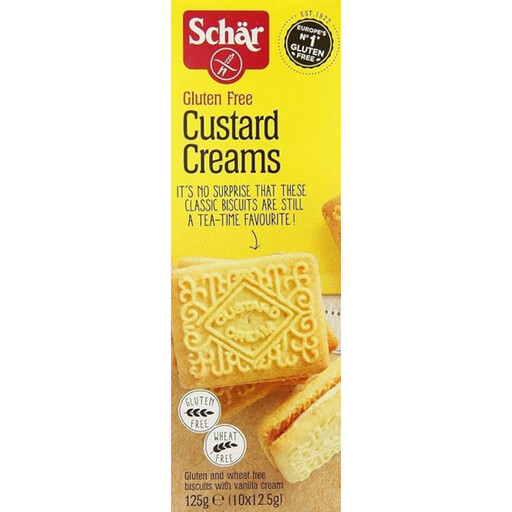
This keeps the custard-cream biscuit format rather than switching to a chocolate bar. Check the pack’s carbohydrate figure for the number of biscuits you plan to eat; ‘gluten free’ does not state how much carbohydrate a biscuit contains.
No: compare the labelled carbohydrate for the portion you intend to eat with your own plan. Lindt Shop UK declares 14g, 9g and 11g carbohydrate per 100g for its checked 90%, 99% and 100% bars respectively, so cocoa percentage alone does not settle the choice.
Not necessarily. Asda Groceries declares 11g carbohydrate per biscuit for its checked free-from custard creams and 8.1g per biscuit for its checked classic version. Compare the exact products you are considering rather than treating ‘gluten free’ as a carbohydrate claim.
Follow the directions on the particular pack. Tesco Groceries instructs shoppers to keep its checked custard creams in a cool, dry place and use an airtight container after opening.
Read the ingredients and allergen information for the exact biscuit or chocolate pack before choosing it. GOV.UK guidance says food businesses must identify specified allergens when they are ingredients; a description such as ‘dark’ or ‘free from’ does not replace that check.