People counting carbohydrates closely
A sugar-free claim does not tell you how a portion of mints fits your own counting method. Check the pack’s carbohydrate declaration and how many mints you expect to have.


For a keto-oriented purchase, avoid assuming that a small mint roll or a sugar-free label settles the carbohydrate question. Sainsbury’s lists 95.6g sugars per 100g for Polo Original, while sugar-free examples listed by Waitrose & Partners and Marks & Spencer still declare 94–98.4g carbohydrate per 100g. Check the current pack’s carbohydrate figures, sweeteners and the portion you expect to eat against your own counting method before choosing.
A sugar-free claim does not tell you how a portion of mints fits your own counting method. Check the pack’s carbohydrate declaration and how many mints you expect to have.
Sugar-free mints offer a different choice from conventional sugar-containing rolls. Compare the sugars and ingredients, and read any warning about excessive consumption.
A mint label cannot settle a wider change to carbohydrate intake. Diabetes UK says low-carbohydrate eating is not for everyone and advises speaking with a diabetes healthcare team before significant dietary changes.
Start with the sugars and total carbohydrate figures, then check the sweeteners, warnings and amount you would actually eat.
| Priority | What to check | Your needs |
|---|---|---|
| Sugars | Compare sugars per 100g and, where shown, per serving. Check whether sugar or glucose syrup appears in the ingredients. | I want to avoid choosing a conventional sugary roll just because each mint is small. Sainsbury’s lists 4.3g sugars per three Polo Original mints and 95g sugars per 100g for Trebor XXX Extra Strong. |
| Total carbohydrate | Read carbohydrate as well as sugars. Compare the declared basis—per 100g or per serving—with the number of mints you expect to eat. | A sugar-free label is not enough for my carbohydrate count. Waitrose & Partners lists 98.4g carbohydrate per 100g for Polo Sugar Free in a four-pack and 94g per 100g for Peppersmith Peppermint; Marks & Spencer lists 97.3g per 100g for its Sugar Free Curiously Strong Mints. |
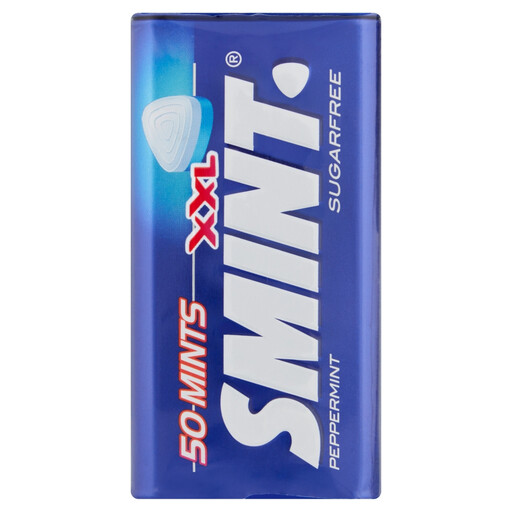
| Sweeteners and warnings | Check the sweetener ingredients and any excessive-consumption or ingredient-specific warning on the current pack. | If I might reach for mints repeatedly, I need to read the warnings rather than treat sugar-free as unrestricted. Waitrose & Partners lists an excessive-consumption laxative warning for Polo Sugar Free and Smint XXL Peppermint; the Smint XXL label also identifies a source of phenylalanine. |
| Pack and portion | Check whether the format is a single roll, tin or pocket pack, and whether the label gives figures for the portion you intend to have. | I want a pack I can carry, but its size does not tell me the carbohydrate amount in my usual portion. |
Sugar-free examples listed by Waitrose & Partners and Marks & Spencer still declare 94–98.4g carbohydrate per 100g. The claim alone does not establish how a portion fits a particular carbohydrate-counting approach.
Read carbohydrate, sugars and ingredients on the current pack, then consider the amount you would eat.
Sainsbury’s lists 4.3g sugars per three Polo Original mints and 95g sugars per 100g for Trebor XXX Extra Strong. A portable format does not change those label figures.
If avoiding conventional sugar is central to your choice, check the nutrition panel before picking a roll or tube.
Product information from Waitrose & Partners for Polo Sugar Free, Smint XXL Peppermint and Sulá Mint Humbugs warns that excessive consumption may produce laxative effects. Its Smint XXL listing also identifies a source of phenylalanine.
Read the current pack’s ingredients and warnings, particularly if you expect to use mints throughout the day or need to check a specific ingredient.
These examples show why the exact product and its current label matter more than the brand name alone.
Polo has original and sugar-free mint rolls; their nutrition figures should not be treated as interchangeable.
Trebor has conventional and sugar-free mint products, so the variant needs checking.
Marks & Spencer lists Sugar Free Curiously Strong Mints in an 18g pack.
Waitrose & Partners lists Peppersmith Peppermint as sugar-free mints sweetened with xylitol.
These portable sugar-free mints suit a label-checking approach to the keto-oriented question; neither product is presented as suitable for every carbohydrate plan.
 No image available
A 35g tin offers a portable peppermint mint when avoiding sugar is a priority. Its listed figures per 100g are 98g carbohydrate, 0g sugars and 98g polyols; check the current pack for the carbohydrate in your intended portion. Confirm the sweeteners on the pack before buying, as the product descriptions disagree, and note the stated choking caution for young children.
 No image available
These sugar-free grape mints come in a portable 22g case. The product description lists sorbitol and aspartame; check the current pack’s carbohydrate and sugars figures, portion information and warnings before deciding whether they fit your plan.
No. Sugar-free does not establish how a mint fits your carbohydrate-counting method. Waitrose & Partners lists 98.4g carbohydrate per 100g for Polo Sugar Free in a four-pack and 94g per 100g for Peppersmith Peppermint; Marks & Spencer lists 97.3g per 100g for Sugar Free Curiously Strong Mints. Check the current pack and the portion you expect to eat.
Polo Sugar Free is the lower-sugar option in the cited listings, but it does not receive an automatic keto approval. Sainsbury’s lists 4.3g sugars per three Polo Original mints; Waitrose & Partners lists 0.5g per three Polo Sugar Free mints in a four-pack, alongside 98.4g carbohydrate per 100g and sorbitol.
The product information for Polo Sugar Free, Smint XXL Peppermint and Sulá Mint Humbugs at Waitrose & Partners says excessive consumption may produce laxative effects. Follow the warning on the particular pack rather than assuming that sugar-free mints can be eaten without limit.
A mint label is not a substitute for advice about a significant dietary change. Diabetes UK says low-carbohydrate eating is not for everyone and advises speaking with a diabetes healthcare team before making significant changes to your diet.