Choose a conventional jug kettle if you mainly need boiling water or regularly make several teas at once. Temperature control is worth considering when you will use settings below boiling; a one-cup dispenser suits a routine centred on single mugs, provided you are comfortable with its cleaning requirements. If scale recurs in your kettle, make filter access and descaling part of the decision, and check what repairability means for the exact model.
Who each option suits
Tea drinkers who use different water temperatures
If you deliberately prepare drinks with water below boiling, selectable settings may be useful. Bosch UK, for example, specifies settings from 70°C to boiling on its TWK7201GB. The extra controls matter less if you always select a full boil.
Frequent one-mug tea makers
If you usually make one drink, look for a kettle whose small fill levels you can read easily, or consider a dispenser that lets you select a cup quantity. Groundwork advises heating only the water needed rather than routinely overfilling a kettle.
Households dealing with recurring scale
If scale builds up regularly, consider how easily you can remove the filter and follow the model’s descaling instructions. The Drinking Water Inspectorate identifies hard water as a cause of scale in kettles; local water conditions can vary.
What matters when choosing
Conventional jug kettle
Choose it when: You want boiling water for tea and often make several drinks together.
Bear in mind: A large capacity still leaves you to judge the fill level for one mug. Some conventional kettles also offer repairable parts, but check the exact model and available service.
Variable-temperature kettle
Choose it when: You will actually select lower water temperatures for particular teas or other drinks.
Bear in mind: Check that the exact model also reaches boiling if it must replace your usual kettle.
One-cup hot-water dispenser
Choose it when: Most drinks are single mugs and selecting a dispense quantity appeals more than judging a kettle fill.
Bear in mind: This is a different appliance format with its own cleaning routine; Breville advises that excessive scale can affect HotCup dispensing.
| Concern |
What to check |
Who this matters to |
| Water temperature |
Check the selectable temperatures and whether the exact model reaches boiling. |
I prepare drinks at different water temperatures and would use a setting below boiling. Around 31% of consumers put temperature flexibility first. |
| One-mug filling |
Look at the lowest readable fill mark or selectable dispense quantity, and check that your mug fits beneath a dispenser spout. |
When I make one mug, I want to avoid heating water I will not use. For around 31% of consumers, controlling a single-cup quantity is the main concern. |
| Limescale care |
Check local water hardness, filter access and the model’s descaling instructions. |
Scale keeps returning in my kettle, so straightforward cleaning matters to me. Keeping up with scale care comes first for around 23% of consumers. |
| Multi-cup use and repairability |
Confirm usable capacity, automatic shut-off features and what parts or repair services are available for the model. |
I regularly make several teas and want to know whether the kettle can be serviced if needed. Around 15% of consumers make multi-cup use and longevity their primary concern. |
Buying pitfalls
-
Choosing maximum capacity for a single-mug routine
A 1.7L kettle can be useful for several drinks, but filling it well beyond what you need for one mug heats surplus water. Groundwork advises filling a kettle only as much as needed.
Check whether you can see a small fill clearly. If single mugs are your usual pattern, compare that with a dispenser offering selectable quantities.
-
Expecting a limescale filter to replace descaling
Hard water can cause scale inside a kettle. Breville also identifies excessive scale as a possible reason its HotCup dispenser may not dispense a full cup.
Check your water supplier’s local hardness information and follow the cleaning and descaling instructions for the exact appliance.
-
Assuming similarly named models have identical features
Temperature settings, capacity, filter design and electrical configuration need to be checked for the particular variant you intend to buy.
Match the complete model number to the manufacturer’s specifications and manual, especially when comparing listings intended for different markets.
-
Using a kettle with damaged electrical parts
The Health and Safety Executive advises taking electrical equipment out of use if its plug or connector is damaged. Visible wires or signs of overheating also call for attention.
Stop using a damaged kettle and arrange assessment or repair by a competent person; automatic shut-off is not a remedy for damaged electrical parts.
Brands to consider
Bosch
Bosch has conventional kettles with different approaches to fill visibility and temperature selection.
- Bosch UK specifies seven settings from 70°C to boiling for the TWK7201GB; its DesignLine TWK4P437GB has a water scale readable from both sides.
- Check the exact model: a readable scale does not mean it has selectable temperatures.
Breville
Breville offers conventional jug kettles as well as HotCup dispensers for selected cup quantities.
- The Curve VKT117 is a 1.7L jug kettle; Breville’s HotCup range illustrates the alternative dispensing format.
- Breville advises descaling a HotCup according to its manual if excessive scale affects dispensing.
Dualit
Dualit’s Classic Kettle offers a multi-cup conventional format with a stated repairable element.
- Dualit specifies a 1.7L, six-cup capacity and a repairable element for the Classic Kettle.
- Confirm service options and parts for the exact variant before making repairability a deciding factor.
Russell Hobbs
Russell Hobbs has distinct conventional, glass, Quiet Boil and BRITA-filter kettle lines.
- Russell Hobbs UK specifies a 1.7L capacity for its Classic Glass Kettle 26081.
- Quieter-boil and filtration features belong to particular lines; check the features of the model you choose.
Joybuy kettle choices
These kettles cover a conventional multi-cup choice and a temperature-control choice. If you mainly want a measured single-cup dispense, compare that appliance format using the criteria above rather than assuming either kettle works the same way.
 No image available
Breville Curve VKT117 1.7L kettle, White & Chrome
Consider this conventional kettle if you usually need a full boil or make several teas together. The named variant has a 1.7L capacity and a stated 3kW rating.
If you often make one mug, check whether its water-window markings let you judge the amount you need. Confirm the plug and voltage configuration for the exact listing before purchase.
View on Joybuy
 No image available
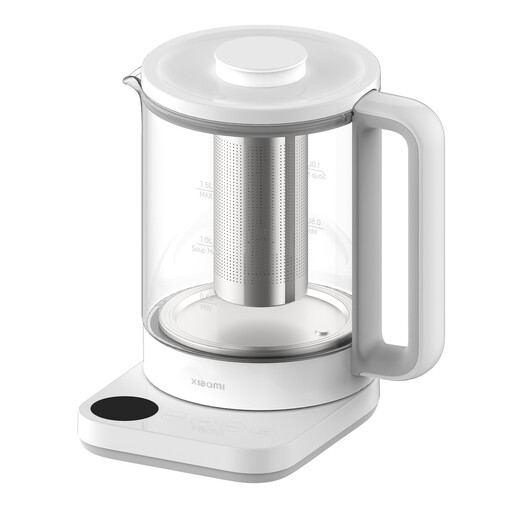
Xiaomi MJDGNYSH04DEM 1.5L variable-temperature kettle, White
Consider this 1.5L kettle if you intend to select different water temperatures; its named variant includes temperature control and a digital display.
Before relying on it for teas that need a full boil, confirm the maximum temperature for MJDGNYSH04DEM. Check its cleaning arrangements and plug and voltage configuration against the exact model information too.
View on Joybuy
Common questions
Do I need a variable-temperature kettle for tea?
No, not if you normally want boiling water and would not use lower settings. If you prepare drinks at different water temperatures, compare the settings on the exact model; Bosch UK, for instance, specifies 70°C to boiling for its TWK7201GB.
What should I look for if I usually make one mug?
Look for a clearly readable small fill on a kettle, or compare dispensers with selectable cup quantities. Groundwork advises heating only the water needed; with a dispenser, also check that your mug fits beneath the spout.
Does a kettle’s filter remove the need to descale?
No. The Drinking Water Inspectorate identifies hard water as a cause of scale in kettles, so check your local water hardness and follow the exact appliance’s descaling instructions even if it has a filter.
What if a kettle’s plug or cable is damaged?
Stop using the kettle. The Health and Safety Executive advises taking electrical equipment out of use when a plug or connector is damaged; have the fault assessed by a competent person rather than relying on the kettle’s automatic shut-off.


