Shared-office transcribers
If you type interviews near colleagues, key noise matters alongside a familiar typing layout. Logitech and HP both describe noise-conscious keyboards, though their claims do not establish which model sounds quieter.


For transcribing interviews near colleagues, start with a keyboard whose exact variant is described as quiet, then choose a layout you can use comfortably through a long session. A low-profile board keeps a familiar shape; a Tactile Quiet mechanical option suits those who want that key feel, while a wave or split layout is worth considering when hand and forearm positioning matters more. Check the UK layout, connection and shortcut compatibility before buying.
If you type interviews near colleagues, key noise matters alongside a familiar typing layout. Logitech and HP both describe noise-conscious keyboards, though their claims do not establish which model sounds quieter.
If hand or forearm positioning becomes your main concern, a wave-shaped or split layout may be worth trying. The Health and Safety Executive also advises positioning the keyboard just below elbow height and centrally in front of you.
If you switch computers or repeatedly control playback while typing, consider device switching and programmable keys. Check that the keyboard software can send the commands your transcription tools use.
Settle the shared-office noise requirement first, then decide whether your longer sessions call for a different shape or whether shortcuts and connections will make the larger difference to your work.
| Concern | What to check | Who this matters to |
|---|---|---|
| Key noise | Check the selected switch or key variant for an explicit quiet-key or noise-reduction description; do not assume every version of a model has the same sound. | If I type beside colleagues, I want to limit avoidable key noise without giving up a usable typing feel. Around 31% of consumers put noise control first. |
| Typing comfort | Consider whether a wave or split shape suits you, and whether the keyboard can sit appropriately at your workstation. | During long transcription sessions, I need a hand position I can sustain, not just a different-looking keyboard. Comfort comes first for roughly 31% of consumers. |
| Workflow shortcuts | Check operating-system support and whether the keyboard software can assign the commands used by your playback or text-entry tools. | When I repeatedly pause audio or enter the same text, I want shortcuts that work in my applications. About 23% of consumers prioritise that workflow need. |
| Desk and device fit | Confirm the UK or US key layout, connection type, desk space and whether you need to switch devices. | If my keyboard stays at one desk or moves between devices, the connection and layout must fit that setup. For around 15% of consumers, this is the primary concern. |
Logitech offers MX Mechanical with Tactile Quiet, Clicky and Linear switch options. Choosing by the family name alone may give you a different sound and feel from the one you intended.
Check the switch named on the exact variant before ordering.
Logitech and HP describe quiet or noise-reducing keys, but those descriptions are not a shared measured decibel comparison between models.
Use the claims to narrow your choices, then check the mechanism and exact variant. Try the keyboard where possible, and read the applicable return terms before committing.
A wave or split shape cannot, by itself, address an awkward desk position. The Health and Safety Executive advises keeping the keyboard just below elbow height and centrally in front of you.
Check your chair, screen and keyboard placement alongside the layout you are considering.
Keychron specifies compatibility for Silent K Pro switches with particular hot-swappable keyboards; the switch name alone does not establish a fit.
Confirm that your exact board and the selected switch version are compatible before ordering replacements.
Incompatible replacement switches may leave you unable to use the planned quieter setup.
Its relevant lines include the low-profile MX Keys S, switch-selectable MX Mechanical and wave-shaped Wave Keys.
Relevant options include the multi-device HP 490, wired HP 400 and split-layout HP 960.
Keychron is relevant if you want to configure a mechanical keyboard and are willing to check switch and layout compatibility.
These keyboards cover different ways to approach the same task: a split layout for comfort, conventional wireless boards, mechanical options and a compact wired board. Match the listed layout and switch variant to your desk and noise needs rather than treating the products as interchangeable.
 No image available
Consider this model if hand and forearm positioning is your priority during long transcripts. HP describes split zones and negative tilt; the selected keyboard is wireless and has a padded wrist rest. Confirm that its exact key layout suits you before ordering.
 No image available
Its full-size UK layout may suit you if you want a familiar wireless board for transcription. If key noise is decisive, assess its typing sound before committing rather than assuming wireless or full-size design makes it quiet.
 No image available
Consider this configuration if you want mechanical tactile feedback and an explicitly named Silent Tactile switch. Its 108-key US layout may take adjustment if you use UK key mappings; check that layout and the selected switch variant before buying.
 No image available
This keyboard-and-mouse set is an option if you want both devices for one desk. The title describes a full-size keyboard and 2.4GHz wireless connection, but its quietness wording is a product claim rather than a measured comparison. Check whether its US layout suits your typing.
 No image available
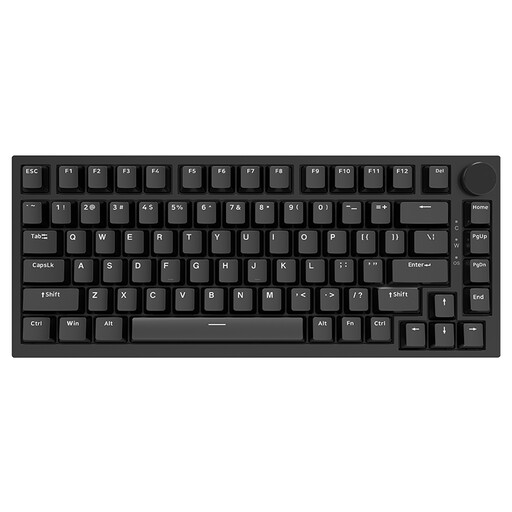
Its wired 75% layout suits a fixed desk where you prefer a compact mechanical board. The listed switches are linear, not identified as silent, so check whether its typing sound is acceptable near colleagues. The US layout also needs to suit your key-mapping preferences.
It can be if you prefer mechanical feedback and choose an explicitly quieter switch variant. Logitech offers MX Mechanical in Tactile Quiet, Clicky and Linear versions, so check the selected switch rather than assuming the family name tells you how it will sound.
No. Reducing typing noise does not prevent nearby people from hearing interview audio. Choose an appropriate way to listen and follow your workplace’s confidentiality rules for recordings and transcripts.
Not necessarily; consider a wave or split layout if hand or forearm positioning is your main difficulty. The Health and Safety Executive also advises placing the keyboard just below elbow height and centrally in front of you, so assess the workstation as well as the keyboard.
Check the keyboard’s operating-system support, any software needed to configure its keys and whether it can assign the commands used by your audio player or text expander. A programmable-key count alone does not establish compatibility with a particular application.