Choose a compact keyboard if making room for your mouse is the priority; consider a programmable low-profile mechanical model if reusable design or coding shortcuts matter more. For a Mac-centred setup, a British English Magic Keyboard offers an Apple-focused option, provided your devices are compatible. Whichever route you take, check the keys you use regularly, the connection requirements and how the keyboard will sit at the shared workstation.
Who needs which features?
Designers short on desk space
If landing-page work involves frequent mouse use, a smaller keyboard can leave more room beside it. Logitech presents MX Keys Mini as a space-saving keyboard for creators, but the keys retained on any compact layout still need checking.
Workers who rely on shortcuts
Moving repeatedly between design tools, browser tasks, content systems and code can make key remapping useful. Keychron lists QMK/VIA remapping for its K3 Max; this route makes more sense if you are willing to set up and maintain your mappings.
Mac-centred shared-desk users
For work on compatible Apple devices, a British English layout and straightforward pairing may matter more than extensive remapping. Apple lists Bluetooth connectivity and USB-C charging for its Magic Keyboard (USB-C); check the requirements for each device you plan to use.
What should you check before buying?
Compact wireless productivity keyboard
Choose it when: Mouse clearance and moving between compatible desk setups matter most.
Allow for: A smaller layout may omit a numeric keypad or keys you use frequently.
Programmable low-profile mechanical keyboard
Choose it when: You will configure reusable shortcuts for recurring design, browser or coding tasks.
Allow for: Switch feel and typing sound vary with the configuration; a low profile does not establish that a board will be quiet.
Mac-focused compact keyboard
Choose it when: Compatible Apple devices and a familiar British English layout take priority.
Allow for: Check device compatibility and required keys before choosing ecosystem fit over broader customisation.
| Concern | What to check | Who this matters to |
|---|
| Desk space and disturbance |
Compare the keyboard footprint and the keys retained; assess the chosen switch or key feel if nearby colleagues will hear you type. |
I need room to use a mouse without crowding a colleague, and I do not want typing to dominate the shared space. Around 36% of consumers might put this need first. |
| Connections and device switching |
Confirm the connection modes, supported device count and any receiver or USB-port requirements. |
When I change computers or desks, I want my keyboard to work with the devices I use without repeated setup. Roughly 29% of consumers might prioritise that flexibility. |
| Shortcuts and macros |
Check remapping support for your operating system and whether the layout retains the keys your workflow needs. |
I repeat the same design, browser or coding commands and would use time spent configuring shortcuts. About 21% of consumers might make customisation their primary concern. |
| Mac fit and British English layout |
Verify the exact layout variant and compatibility with each Apple device and software version you use. |
I mainly work on Apple devices and want familiar British English key labels. Around 14% of consumers might put that combination ahead of other features. |
Shared-desk buying pitfalls
-
Assuming compact size solves the whole workstation setup
A smaller keyboard may free space, but its position still affects how far you reach for the mouse. The Health and Safety Executive advises placing the keyboard centrally, just below elbow height, with the mouse in line with the elbow.
Before choosing by size alone, check where both keyboard and mouse can sit on the desk you actually use.
-
Assuming every wireless keyboard switches between your devices
Connection methods and supported device counts differ. Logitech lists switching among up to three devices for MX Keys Mini for Business, subject to its connection requirements; that does not establish the same capability for other keyboards.
List the computers and tablets you use, then check their Bluetooth, operating-system and receiver-port requirements against the exact model.
-
Choosing a mechanical keyboard without checking its switches
Keychron offers selectable switches for the K3 Max. The choice can affect typing feel and sound, so its 75% layout alone cannot tell you how suitable a particular configuration will be beside colleagues.
Confirm the switch and UK-ISO variant, then check the applicable return terms if trying the feel matters to your decision.
-
Assuming a UK listing has the key layout you expect
Products in the same family can have different key legends and symbol positions. Keychron distinguishes UK-ISO variants, while Logitech lists specific English UK QWERTY variants.
Check the stated variant and physical key image against the layout you already use, particularly for symbols needed in content or code.
Relevant brands to consider
Logitech
Logitech positions MX Keys Mini as a compact keyboard for creators who want more workspace.
- Logitech lists English UK QWERTY variants and, for MX Keys Mini for Business, Bluetooth Low Energy or Logi Bolt connectivity with switching among up to three devices.
- The compact MX Keys Mini layout has no integrated numeric keypad. Logitech describes reduced noise from greater key stability, but that is the brand's claim, not a comparable sound measurement.
Keychron
The K3 Max line is relevant if you want a UK-ISO, low-profile mechanical keyboard with configurable shortcuts.
- Keychron lists a 75% layout, QMK/VIA remapping and wired, Bluetooth and 2.4 GHz connection options for the K3 Max.
- Typing feel and sound depend on the switch selected; confirm the exact layout and configuration rather than assuming all K3 Max variants will feel alike.
Apple
Apple's British English Magic Keyboard (USB-C) is an option for a desk centred on compatible Apple devices.
- Apple lists Bluetooth connectivity and USB-C charging, with compatibility across specified Mac, iPad, iPhone and Apple Vision Pro devices.
- Check the software and device requirements for the exact version. A Touch ID model has additional Mac compatibility conditions and is not the same product as the standard Magic Keyboard.
Joybuy keyboard choices
These keyboards offer different ways to use a shared desk: four have compact layouts, while the full-size option retains a larger key arrangement. Check the stated layout and connection modes against your own setup; these products are not a comparison of every keyboard route discussed above.
 No image available
Rapoo E9050L 75% Wireless Membrane Keyboard, US QWERTY, White
A compact option if mouse space and switching between devices both matter at your desk.
The title specifies 78 keys, Bluetooth 5.0/4.0 and 2.4 GHz connectivity, with support for four devices. It states a US QWERTY layout, so check the key legends and symbol positions if you need UK keys.
Joybuy
 No image available
AULA F75 75% Mechanical Keyboard, US QWERTY
Consider this compact layout if you want to choose between wired and wireless connections at the shared desk.
The title lists wired, Bluetooth and 2.4 GHz modes, PBT keycaps and RGB backlighting. It specifies US QWERTY; check symbol placement and assess the selected switches if typing sound matters nearby.
Joybuy
 No image available
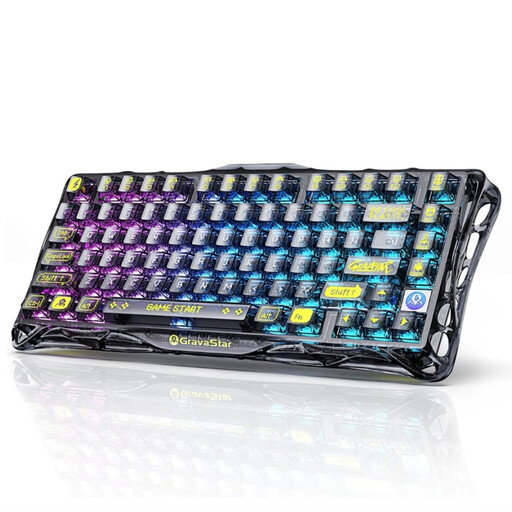
GravaStar Mercury K1 Lite 75%, Chinese Retail Version, US QWERTY
This compact mechanical option suits a desk where a choice of connection modes matters.
The title lists Bluetooth 5.0, 2.4 GHz and USB-C modes, plus hot-swap switches. Check its US key legends, the selected switches and how device switching works for the computers you use.
Joybuy
 No image available
Lofree OE907 65% Mechanical Keyboard, US QWERTY, with Mouse Gift
The 68-key layout is worth considering when the space beside your keyboard is particularly limited.
The title lists Jellyfish switches, Bluetooth 5.1 and a wired connection. Check that the reduced key layout and US symbol positions work for your tasks, and assess typing sound if colleagues sit close by. Confirm the mouse-gift offer before ordering.
Joybuy
 No image available
Targus EcoSmart Full-Size Wireless Keyboard (UK)
Consider a full-size layout if retaining a larger key arrangement matters more than maximising mouse space.
The title identifies this as a UK wireless model, but check its physical key legends before buying. Measure the available desk space and confirm the connection and device-switching requirements for your setup.
Joybuy
Common questions
Does a shared desk require a particular type of keyboard?
The Health and Safety Executive does not prescribe a particular keyboard model or switch type in its display-screen guidance. It advises a basic workstation risk assessment when workers change desks regularly, so consider the whole setup rather than choosing on keyboard size alone.
Where should I put the keyboard for prolonged design work?
The Health and Safety Executive advises placing the keyboard centrally, just below elbow height, with the mouse in line with your elbow. For prolonged laptop use, it advises a separate keyboard and mouse so the screen can be raised.
Should I choose a UK-ISO keyboard?
Choose the physical layout that matches the symbols and key positions you use regularly. Keychron distinguishes UK-ISO from other ISO variants of its K3 Max, and Logitech lists English UK QWERTY variants; check the exact product variant rather than relying on a general listing image.
How should I dispose of an old rechargeable keyboard?
Check your local authority's electrical recycling options or a retailer's current take-back arrangements rather than treating it as ordinary household waste. GOV.UK notes that battery-powered products may still fall within electrical and electronic equipment guidance.


