Choose the keyboard layout after deciding whether you need to enter the language in software or learn the positions shown on its keys. Microsoft Support explains how to change input layouts in Windows, but that will not change printed key labels; for physical-layout practice, check the exact regional variant. At a shared desk, weigh that choice against key noise and the space available, rather than assuming a compact or mechanical keyboard will meet every need.
Who this is for
Layout-focused language learners
If you are learning the positions of characters and punctuation, printed legends matter as well as the software input layout. Keychron UK lists regional layout variants, while Microsoft Support explains how to change input layouts in Windows.
Quiet shared-desk practisers
If someone sits beside you, key sound and the room needed to put the keyboard away may shape your choice. Logitech describes the Pebble Keys 2 K380s as compact with quiet low-profile keys; a mechanical keyboard needs a closer look at its particular switches and construction.
Long-session and multi-device learners
If lessons move between a computer and a mobile device, device switching may be useful. For longer sessions, you may instead prioritise a shape and key feel you find comfortable, provided the keyboard fits the shared desk.
What matters when choosing
Settle the language-input method first, then check how the keyboard will work beside another person. Space, device switching and comfort can change which layout and form factor you are willing to use.
| Concern |
What to check |
Who this matters to |
| Language layout |
Decide whether you need printed character positions or software input. Check the exact regional key layout and available keycaps, then select the corresponding input method. |
If I am memorising where characters and punctuation sit, I need the keys in front of me to match what I practise. Around 36% of consumers would put layout and input fit first. |
| Key noise |
Look for an explicit quiet-key description for the exact model, or check the specified mechanical switch; neither keyboard category guarantees a particular sound. |
Typing beside someone else makes the sound of each session important to me. For roughly 29% of consumers, avoiding disturbance would be the primary concern. |
| Space and devices |
Check the keyboard’s dimensions, the keys a compact layout leaves out, and supported switching between the devices you use. |
I need room to share the desk and may move between a lesson and another study device. About 21% of consumers would prioritise space and device management. |
| Long-session comfort |
Assess the keyboard’s shape and key profile alongside the desk space it requires; confirm that its layout still suits the exercise. |
For extended typing practice, I care more about a shape I can use comfortably than one I can easily put away. Around 14% of consumers would make long-session comfort their first priority. |
Buying pitfalls
-
Expecting a language setting to change the key labels
Microsoft Support explains how to change a Windows input layout, but a software setting does not replace the legends printed on the keyboard. That distinction matters when the exercise is about finding keys by sight.
Decide whether you are practising software input, physical key positions or both. For physical-layout practice, check the regional variant shown in the listing and its photos.
-
Judging noise from the word “mechanical” alone
Switch choice and keyboard construction affect sound. CHERRY describes damping in its MX Silent Red switch, but that switch specification does not establish the sound of every keyboard that uses it.
Check the switch variant and any quiet-operation description for the keyboard itself. If sound is decisive and you cannot try it, review the seller’s return terms before ordering.
-
Choosing a compact size without checking the keys
A smaller layout may leave out keys used for punctuation, symbols or shortcuts in your lessons. Its size label alone will not show whether the exercises remain convenient.
Compare the actual key arrangement with your lesson materials and intended input layout before choosing a compact model.
Brands to consider for these keyboard features
Logitech
Relevant if you are considering a compact keyboard with quiet-key claims, multi-device switching or a larger comfort-oriented shape.
- Logitech describes Pebble Keys 2 K380s as compact, with quiet low-profile keys and switching among three devices. Its MX Keys S and ERGO K860 pages describe different low-profile and split-shape options.
- Check the exact physical layout of the model you choose; those feature descriptions do not establish printed legends for every language.
Keychron
Relevant when learning a particular regional physical layout is central to the exercise.
- Keychron UK lists UK, German, Swiss, Nordic, French and Spanish ISO versions in its K10 Pro range, alongside extra keycaps and hot-swappable switches.
- The K10 Pro is a full-size mechanical keyboard. Check both its desk footprint and the sound of the exact switch option for shared use.
CHERRY
Relevant to checking switch options if you want a mechanical keyboard but need to consider noise.
- CHERRY describes its MX Silent Red as a damped linear switch.
- A switch specification alone cannot tell you how loud a complete keyboard will sound; its case and keycaps also matter.
Joybuy keyboard choices
These keyboards offer different combinations of physical layout, desk footprint and connection options. Check the language printed on the keys and the space you have before treating any one of them as suitable for your practice.
 Image unavailable
AULA F75 75% wireless mechanical keyboard, US QWERTY
The 75% layout may suit a desk where a smaller keyboard is easier to accommodate, provided its keys cover your lessons.
The product title specifies wired, Bluetooth and 2.4G connection modes, PBT keycaps and a US QWERTY layout. Check whether those printed legends suit your target language and whether its sound is acceptable beside another person.
View on Joybuy
 Image unavailable
Ticktype DP104 Gecha Gray, silent tactile switches, US layout
Consider this full-size option if you want its stated switch variant and have room for a larger keyboard.
The title specifies 108 keys, hot-swappable switches, tri-mode connectivity and an 8000mAh battery. The physical layout is US; check its fit for your language exercises and assess the complete keyboard’s sound rather than relying on the switch name alone.
View on Joybuy
 Image unavailable
Targus EcoSmart full-size wireless keyboard, UK layout
A UK-layout keyboard may suit practice based on software input rather than unfamiliar printed key positions, if you have space for its full-size form.
Check whether the UK legends match your learning task and whether the keyboard’s dimensions fit your shared workspace.
View on Joybuy
 Image unavailable
HP 960 ergonomic split wireless keyboard with padded wrist rest
If you practise for long sessions and want a split shape, check whether this keyboard and its wrist rest fit the area available to you.
Confirm the physical key layout for your target language before buying; the split shape does not by itself establish the printed legends.
View on Joybuy
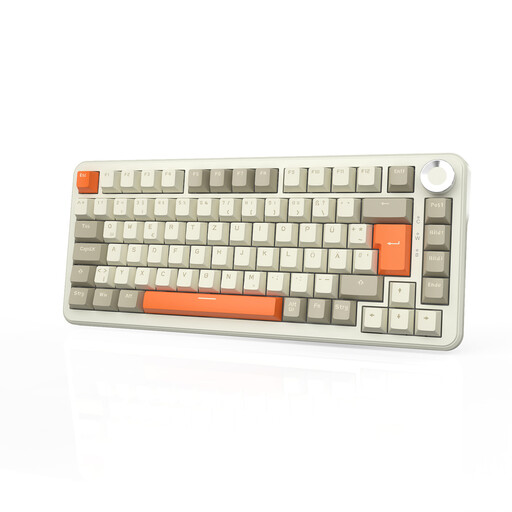 Image unavailable
AJAZZ AK820 MAX 75% wireless keyboard, German QWERTZ
The stated German QWERTZ keycaps make this a layout to consider if your exercise is learning German key positions, rather than another language’s physical layout.
The title also specifies tri-mode connectivity, a volume knob and an 8000mAh battery. Check access to the keys your lessons require and the sound of this switch variant at a shared desk.
View on Joybuy
Frequently asked questions
Do I need a keyboard with foreign-language keys to practise typing?
Not if your aim is simply to enter the language using a suitable software input layout. Microsoft Support explains how to add and change layouts in Windows; if you are learning where a national layout puts its characters, check for matching printed keys or compatible replacement keycaps instead.
Should I avoid a mechanical keyboard at a shared desk?
Not automatically: check the particular switches and the complete keyboard’s sound. CHERRY describes damping in its MX Silent Red switch, but the keyboard’s construction and your typing also affect what someone beside you hears.
Can I use one keyboard with my lesson computer and a phone or tablet?
Yes, if the exact model supports your devices and lets you switch between them. Logitech says Pebble Keys 2 K380s can switch among three devices; check the operating systems you use and the switching controls before choosing a keyboard for that purpose.


