What matters when choosing?
One-piece ergonomic
Choose it when: You want a shaped typing position without independently placing two keyboard halves.
Accept: A fixed relationship between the left and right key areas; check whether the board fits your desk.
Conventional compact layout
Choose it when: Familiar key positions, shortcuts and room for a pointing device take priority over split positioning.
Accept: Smaller layouts may move keys you use into different positions or layers.
Independently split
Choose it when: You want to set the separation and angle of each half yourself.
Accept: An unfamiliar layout can take time to learn; PCMag UK notes that adaptation to ergonomic layouts may take weeks.
For code reviews at a standing desk, decide which requirement would drive your choice, then check the physical layout and workstation fit of the exact model.
| Concern |
What to check |
Who this matters to |
| Standing position |
Check keyboard height at your standing setting and whether its shape and tilt suit your hand position. The Health and Safety Executive advises relaxed shoulders and a keyboard just below elbow height. |
If I cannot keep my shoulders relaxed at the desk, changing the keyboard shape alone will not settle my setup. Around 36% of consumers might put standing position first. |
| Navigation and shortcuts |
Compare the keys you use in your editor, terminal and review tool with the layout diagram; check whether any commands require layers or remapping. |
When I move through changes and use frequent commands, I need those actions to remain easy to find. Roughly 29% of consumers might make review workflow their primary concern. |
| Pointing-device space |
Measure the usable desk area and compare keyboard width with the space your mouse or trackball needs. |
I want enough room to position my pointing device without crowding it against the keyboard. About 21% of consumers might prioritise desk space. |
| Layout and connections |
Confirm the exact physical key variant and the connection methods your work devices require. |
If I rely on familiar UK key positions or switch between devices, the variant and connections need to match my setup. Around 14% of consumers might put compatibility first. |
Joybuy keyboard choices
These keyboards cover shaped one-piece typing, familiar full-size keys and compact conventional layouts for reviewing code at a standing desk. Compare their physical keys and desk fit rather than treating a smaller footprint or adjustable angle as a substitute for setting the workstation height.
 No image available
HP 960 Ergonomic Split-Layout Wireless Keyboard with Padded Wrist Rest
Consider its shaped, one-piece layout if hand position matters alongside a familiar keyboard arrangement. Check the exact physical key variant against your usual symbols and shortcuts; the split-zone description does not mean the keyboard halves can be placed independently.
View on Joybuy
 No image available
Targus EcoSmart Full-Size Wireless Keyboard (UK)
A full-size layout may suit reviewers who want familiar physical keys. Allow room for the keyboard and your pointing device, and confirm that the exact UK variant matches the key positions you expect.
View on Joybuy
 No image available
AULA F99 Wireless Mechanical Keyboard, US QWERTY, Light Blue, Reaper Switch
Consider this conventional board if you want to compare a more compact arrangement with a full-size keyboard. Its title specifies wired, Bluetooth and 2.4 GHz connections and a US QWERTY layout; check those physical key positions against the symbols you use for code review.
View on Joybuy
 No image available
ASUS ROG Falchion Ace HFX 65 Keyboard, UK Layout
The 65% UK-layout variant is worth comparing if pointing-device space and physical key positions matter to you. Check that its key arrangement suits your review shortcuts; if you use an operating system other than Windows 10 or 11, confirm compatibility before choosing it.
View on Joybuy
 No image available
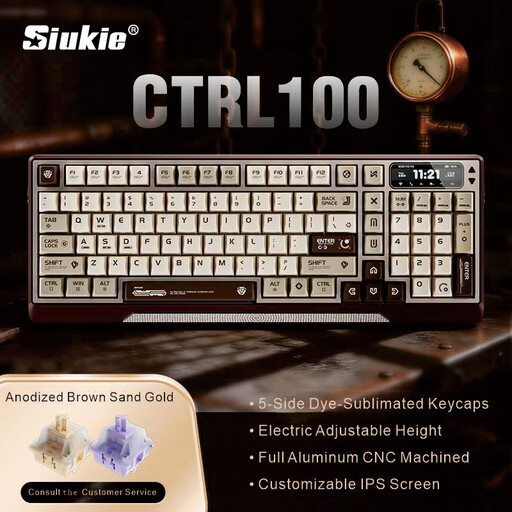
Siukie CTRL100 Motorised-Lift Mechanical Keyboard, 96% US QWERTY, HMX Cream Taro Switches, Brown
Consider its motorised lift only after checking the typing angles against your standing setup; the mechanism alone does not establish a comfortable position. The title specifies a 96% US QWERTY layout, so compare its symbol positions with your workflow. Keep fingers and objects clear when adjusting the lift.
View on Joybuy
Frequently asked questions
Where should my keyboard sit when I work standing up?
Position it just below elbow height, with your shoulders relaxed, as the Health and Safety Executive advises. Adjust the desk to achieve that position before deciding whether a different keyboard shape helps your setup.
Does an ergonomic keyboard by itself meet UK display screen equipment requirements?
No: the keyboard is only one part of a workstation. The Health and Safety Executive says the UK display screen equipment regulations apply to workers who use display screen equipment daily for continuous periods of an hour or more; if that describes your work, discuss the workstation setup with your employer rather than treating a keyboard purchase as a compliance decision.
Should I choose a UK-ISO keyboard for code review?
Choose UK-ISO if those physical key positions match the symbols and shortcuts you use. Keychron lists UK-ISO variants of the K1 Max and K3 Max, but confirm the selected variant’s layout rather than relying on a product photo or your computer’s language setting.
Do I need independently split halves at a standing desk?
No; choose independently split halves when control over their separation and angle is important to your setup. A one-piece ergonomic keyboard retains a fixed relationship between its key areas, while a specialist split layout may require more adjustment to your typing habits; PCMag UK notes that adapting to ergonomic layouts can take weeks.


