For frequent route editing on a small desk, consider a 75% keyboard if you need room for the mouse while keeping everyday controls within reach; check the exact key arrangement rather than assuming every 75% model is alike. A smaller layout gives mouse movement more priority but may move familiar controls to key combinations, while a layout with a number pad needs more desk space. Confirm the variant and your workstation fit before choosing.
Who each layout suits
Mouse-space-first route planners
If you spend much of a session panning maps and dragging waypoints, room to move the mouse may matter more than a number pad. The Health and Safety Executive advises keeping the mouse in line with the elbow; a narrower keyboard can help only if the rest of your desk setup allows that position.
Shortcut-heavy route editors
If you repeatedly use navigation keys or route-editing shortcuts, compare the physical keys and key combinations before choosing the smallest layout. Keychron lists remapping and macros for the K3 Version 3, subject to its configuration requirements.
Multi-device route planners
If you move between a computer and a tablet or phone, check how a keyboard switches connections as well as how its keys are laid out. CHERRY says the KW 7100 MINI BT can connect to up to three Bluetooth devices and switch channels using F1–F3.
What to check before buying
For cycle-route mapping at a small desk, work out how much mouse room and which physical keys you need before deciding between a very small layout, a 75% board and a layout with a number pad. Then check the exact regional variant and connection method.
| Concern |
What to check |
Who this matters to |
| Mouse clearance |
Measure the available keyboard space and the area your mouse needs for panning and waypoint work. Check the keyboard’s actual dimensions rather than relying on its layout label. |
If I move the mouse constantly while editing a map, I need enough clear desk space to use it without reaching around the keyboard. Around 42% of consumers would put mouse clearance first. |
| Shortcut access |
Compare your route-planning shortcuts with the exact arrow, function and navigation-key arrangement. For remapping, check the configuration requirements and application compatibility. |
Repeated route edits make me value keys I can reach without interrupting the task; roughly 33% of consumers would prioritise shortcut access. |
| Layout and devices |
Confirm the exact UK-layout variant if key placement matters to you. Check operating-system compatibility, supported connections and how device switching works. |
When I plan on more than one device, I want straightforward switching without giving up familiar key placement. About 25% of consumers would make device and layout fit their primary concern. |
Common buying mistakes
-
Assuming the smallest layout suits map editing
Some very compact layouts remove dedicated arrow or function-row keys. That matters if your map application or browser uses those controls regularly.
Write down the shortcuts you use, then compare them with the exact physical layout and its function-key combinations.
-
Assuming QWERTY means UK layout
Compact keyboards can have different regional key arrangements, even when their listings all say QWERTY.
If familiar British key placement matters, check that the exact variant is identified as UK layout or UK-ISO.
-
Choosing remapping without checking how it works
Keychron specifies wired mode and a current Chrome, Opera or Edge browser for configuring the K3 Version 3 through Launcher. Wireless use alone does not establish how you can configure its keys.
Check the keyboard’s configuration method and whether your route-planning application accepts the shortcut or macro you intend to use.
-
Expecting keyboard width alone to fix workstation discomfort
A compact keyboard may leave more space for the mouse, but the screen, chair, desk and position of both input devices still matter.
Follow the Health and Safety Executive’s positioning advice: keep the keyboard central and just below elbow height, with the mouse in line with the elbow. Reassess the whole setup if it feels uncomfortable.
Brands to consider
Logitech
The MX Keys Mini is a compact productivity option for someone who wants a low-profile keyboard without a dedicated number pad.
- Logitech describes programmable keys and illumination, and says the compact format lets the mouse sit closer to the keyboard.
- If number entry is a major part of your workflow, account for the lack of a dedicated number pad.
Keychron
The K3 Version 3 UK-ISO option is a 75% low-profile mechanical keyboard for route editors interested in configurable shortcuts.
- Keychron lists Bluetooth and wired connections, plus QMK and Launcher-based remapping and macros for this model.
- Using Launcher to configure the K3 Version 3 requires wired mode and a current Chrome, Opera or Edge browser; check that your application can use the resulting shortcuts.
CHERRY
The KW 7100 MINI BT is a compact scissor-switch Bluetooth keyboard for someone who wants to switch between devices.
- CHERRY specifies connections to up to three Bluetooth devices, with channel switching through F1–F3.
- Check its exact key arrangement against your route-planning shortcuts before treating the compact layout as a replacement for your current keyboard.
Joybuy product choices
These keyboards offer different approaches to the same small-desk decision: a compact UK-labelled wireless option, a smaller UK-layout wired option, a UK-layout wireless option for shoppers considering more keys, and a US-layout option for those interested in customisation. Check physical dimensions and the keys you use before deciding which leaves enough room for your mouse.
 Image unavailable
HyperX Alloy Rise 75 Wireless Keyboard, UK
Consider this if you want a compact keyboard for route editing while keeping mouse space in mind. The product name identifies a wireless UK variant; check its exact key arrangement, remapping options and dimensions against your desk and shortcuts.
View on Joybuy
 Image unavailable
ASUS ROG Falchion Ace HFX 65, UK layout
Consider this if you want to assess a smaller keyboard while retaining a UK-labelled layout. The product name identifies an analog gaming keyboard; check whether its physical keys and wired setup suit your route-planning shortcuts and devices.
View on Joybuy
 Image unavailable
ASUS ROG Strix Scope II 96 Wireless, Black, UK layout
Consider this if you would rather assess a layout with more keys than the smallest boards. The product name identifies a wireless UK-layout Black variant; check the precise number-pad arrangement and whether its width leaves enough room for your mouse.
View on Joybuy
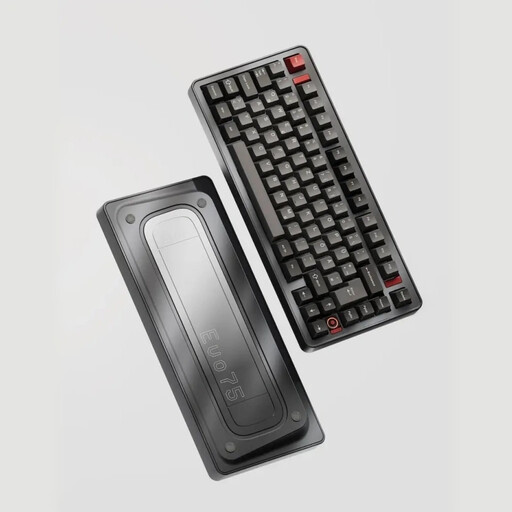 Image unavailable
Ticktype EVO75 Custom, US layout, Creamy Rye switches, Anodized Basalt Grey
Consider this if shortcut customisation interests you and a US layout suits your typing. Its product name specifies tri-mode wireless connectivity, VIA compatibility, a hot-swappable full-aluminium construction and an 8000mAh battery. Check its physical navigation keys, dimensions and configuration compatibility with your route-planning application.
View on Joybuy
Frequently asked questions
Should I choose a 60% keyboard just because my desk is small?
Not necessarily: a very small layout can leave more room for the mouse but may remove dedicated arrow or function-row keys. Compare its key combinations with the shortcuts you use to edit routes before choosing it over a 75% layout.
Does a route-planning keyboard need a UK-ISO layout?
Choose a UK-ISO variant if familiar British key placement and symbols matter to you; the route-planning task itself does not establish a need for one. Check the exact listing rather than assuming every compact QWERTY keyboard has the same arrangement.
Will a compact keyboard make my small desk more comfortable?
It may create room to place the mouse closer, but keyboard width alone does not settle workstation comfort. The Health and Safety Executive advises keeping the keyboard central and just below elbow height and the mouse in line with the elbow; consider the screen, desk and chair position as well.


