Choose a keyboard with the target language’s physical layout if learning its key positions and printed legends is the point of your practice. If you mainly type in English and only occasionally switch languages, a UK-layout keyboard may suit you instead: Windows and macOS let you change input layouts, but the characters typed will follow the active software layout, which may not match the keys you see.
Who each approach suits
Layout-memory language learners
If you are learning to touch-type on a particular national layout, matching printed legends and key positions can help you practise that arrangement. Keychron and Logitech list regional keyboard variants, so the selected version matters.
Multilingual home-office switchers
If most of your work is in English but you regularly change languages, a familiar physical keyboard may be more useful than a dedicated foreign-layout board. Microsoft Support and Apple Support explain how to add and switch input layouts on Windows and macOS.
Long-session home typists
If you spend extended periods practising at a desk, leave room to position the keyboard and mouse comfortably. The Health and Safety Executive advises placing the keyboard just below elbow height.
What to check before choosing
Decide whether you need to learn a physical national layout or mainly need to produce text in another language. Then check the input layout on your practice device and whether the keyboard fits your desk.
UK layout with software switching
Choose when: English remains your main typing layout and you are comfortable learning other character positions with an on-screen layout.
Bear in mind: Switching the Windows or macOS input layout does not change the printed UK legends.
Target-language physical layout
Choose when: Your goal is to learn the key positions and legends of a particular national layout, such as French AZERTY or German QWERTZ.
Bear in mind: Confirm the exact regional variant; switching back to UK English will not change its printed legends.
| Concern |
What to check |
Who this matters to |
| Physical layout |
Check the named country variant, key positions and photographed legends, not just the keyboard family. |
If I am learning German QWERTZ or French AZERTY key positions, I want the keys in front of me to match what I practise. About 42% of consumers put physical-layout learning first. |
| Language and device switching |
Test the required Windows or macOS input layout; if using several devices, check their compatibility and the keyboard’s switching options. |
When I move between English work and another language, I need to change the active input layout without losing track of what each key will type. Around 33% of consumers prioritise language or device switching. |
| Workstation fit |
Check the keyboard’s footprint and whether you need a number pad; allow space for central placement. |
For long sessions at my home desk, I need room to place the keyboard without an awkward reach to the mouse. Roughly 25% of consumers put workstation fit first. |
Mistakes to avoid
-
Assuming printed letters determine what appears on screen
Windows and macOS use the active input layout to determine what keys type. If it differs from the physical legends, punctuation and symbols may not appear where you expect them.
Try the intended input layout on your current device before ordering, then select the layout that corresponds to the physical arrangement you want to practise.
-
Choosing a keyboard family without checking its regional variant
Keychron and Logitech offer keyboard ranges with different regional versions. A family name alone does not tell you which legends the selected keyboard carries.
Check the variant name, key photographs and model description for UK ISO, French AZERTY, German QWERTZ or the other layout you intend to use.
-
Assuming a compact keyboard will suit every desk setup
A smaller board may leave more desk space but can omit a number pad or navigation keys you use. Comfort also depends on placement, not keyboard size alone.
Check which keys you need and whether you can position the board centrally. The Health and Safety Executive advises keeping it just below elbow height.
Brands to consider for these layouts
Keychron
A reference point for buyers considering a configurable mechanical keyboard with a named regional layout.
- Keychron lists the V6 Max ISO in UK and several European layout variants, with VIA remapping and hot-swappable MX-style switches.
- Choose the exact V6 Max ISO variant and check its supplied keycaps; those options should not be assumed for every Keychron model.
Logitech
A reference point for a low-profile home-office keyboard when switching between compatible devices matters.
- Logitech states that MX Keys S can switch among up to three devices and lists compatibility with Windows, macOS, Chrome OS, Linux and iPadOS.
- Check the precise retail variant for its printed language layout; regional options shown across a product range do not identify the selected keyboard.
Apple
A reference point for Mac users who want a British English-labelled keyboard and plan to use macOS input sources for other languages.
- Apple lists its Magic Keyboard (USB-C) – British English with Bluetooth and USB-C charging.
- British English legends do not teach a different physical national layout. Check the exact model’s device and operating-system requirements before choosing it.
Joybuy keyboards for these setups
These keyboards cover UK-labelled options for typing with software language switching, a German QWERTZ option for practising that physical layout, and US-layout options. Match the stated layout to your learning goal before comparing size and connection choices.
 No image available
Targus EcoSmart Full Size Wireless Keyboard (UK)
Consider this UK-labelled keyboard if English is your main physical layout and you plan to practise other languages using software input layouts.
Full-size wireless model. Check the exact key arrangement and legends if you need a particular ISO layout; changing the software layout will not change the printed keys.
View on Joybuy
 No image available
Hyper HyperSpace Next Bluetooth Wireless Keyboard (UK), White
This UK-labelled option suits a setup where you intend to switch software input layouts rather than learn from foreign-language key legends.
Bluetooth wireless keyboard in white. Confirm the exact physical arrangement and printed legends before ordering.
View on Joybuy
 No image available
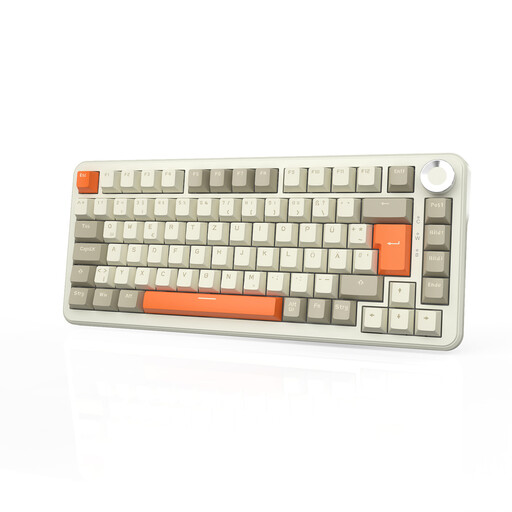
AJAZZ AK820 MAX German QWERTZ Keyboard, 75%
Choose the German QWERTZ variant if that is the physical layout you intend to practise, rather than simply because you need to type some German text.
The product name specifies a 75% layout, tri-mode connection, Flying Fish switches, a volume knob and an 8000mAh battery. Check that the selected key legends match your practice goal.
View on Joybuy
 No image available
Ticktype DP104 US-Layout Mechanical Keyboard, Gecha Gray, Silent Tactile Switches
This is a full-size choice if you want to practise on a US physical layout or use another software input layout while keeping US legends.
The product name specifies 108 keys, hot-swappable switches, tri-mode connection and an 8000mAh battery. Silent Tactile is the stated switch variant, not an independent noise measurement.
View on Joybuy
 No image available
AULA F75 Mechanical Keyboard, 75% US QWERTY Layout
Consider the compact format if it fits your desk and you want US QWERTY key legends; it is not a substitute for printed legends in another national layout.
The product name specifies wired, Bluetooth and 2.4G connection modes, RGB backlighting and PBT keycaps. Do not rely on its sound description as a measured noise level.
View on Joybuy
Common questions
Can I type in another language on a UK keyboard?
Yes. Microsoft Support explains how to add or change keyboard input layouts in Windows, and Apple Support describes adding and switching input sources on a Mac. The UK legends stay as printed, so an on-screen layout can help you find unfamiliar keys.
Do I need a French or German keyboard to practise that language?
Not necessarily: a UK keyboard with the appropriate software input layout can work when your aim is to type the language. If you specifically want to learn French AZERTY or German QWERTZ key positions and legends, choose the corresponding physical variant and set the input layout to match.
How should I position a keyboard for long practice sessions?
Place it centrally and just below elbow height. The Health and Safety Executive also advises using a separate keyboard and mouse for prolonged laptop work so the screen can be raised.
What safety information should I check on a rechargeable keyboard?
Check the exact model’s charging instructions, power requirements and supplied safety information. For products placed on the market in Great Britain, Department for Business and Trade guidance explains that UKCA and, where recognised, CE markings relate to applicable product requirements; a marking does not tell you whether the keyboard has the language layout you need.


