Designers with a small desk
If your laptop, mouse and keyboard share a narrow surface, a separate keyboard needs to fit without pushing the mouse out of comfortable reach.


A compact keyboard is a sensible starting point if your student-room desk must also hold a laptop and leave room for mouse-led design work. A larger board may suit you if its layout or typing features matter more than the space it takes; whichever format you choose, check the physical keys, connection and device compatibility before ordering.
If your laptop, mouse and keyboard share a narrow surface, a separate keyboard needs to fit without pushing the mouse out of comfortable reach.
If you move between editing, coding and visual assets, key placement and model-specific remapping may matter as much as the keyboard’s size.
If building your homepage involves sustained writing or coding, weigh typing sound and desk setup alongside any preference for a larger keyboard or wrist rest.
Start with the room your keyboard and mouse can share, then decide how much weight to give typing sound, shortcuts and longer-session setup.
| Concern | What to check | Who this matters to |
|---|---|---|
| Desk space | Compare the keyboard’s dimensions and key layout with the space left for your mouse. On a compact board, check where the arrow and navigation keys sit. | If my mouse keeps running out of room while I adjust a page layout, I need a keyboard that fits beside it. Around 27% of consumers put desk space first. |
| Typing sound | Check the exact switch or key mechanism and any model-specific sound features; a mechanical label alone does not establish how a board will sound. | In a shared room, I want to work without making typing sound my main distraction. Roughly 27% of consumers prioritise keeping typing disruption low. |
| Devices and shortcuts | Confirm the supported connection modes, device switching and any remapping requirements for the exact model and your computer. | If I move between devices or repeat the same editing commands, I want the keys and connections to suit that workflow. About 20% of consumers make this their primary concern. |
| Longer-session setup | Allow room for the keyboard and mouse at a workable height. The Health and Safety Executive advises placing the keyboard just below elbow height and the mouse in line with the elbow. | When I spend longer stretches writing and coding, I need the whole workstation to remain workable, not just a preferred typing feel. Around 26% of consumers put this setup first. |
A smaller layout can free desk space while moving navigation keys or frequently used commands to an Fn layer.
Look at the exact key layout and find the keys you use for symbols, screenshots and editing shortcuts before buying.
Switch and construction choices vary. Razer describes sound-dampening features on its Pro Type Ultra, while Keychron offers different K3 Version 3 variants; neither detail establishes how every mechanical keyboard will sound in your room.
Check the named switch and exact variant rather than relying on the word mechanical or a general quietness claim.
A separate keyboard does not by itself address a low laptop screen or poorly placed mouse.
Make room for the mouse and, if you raise the laptop screen for prolonged work, a separate keyboard. Follow the Health and Safety Executive’s guidance on keyboard and mouse placement.
Apple specifies its British English Magic Keyboard with Touch ID for Mac models with Apple silicon running macOS 15.1 or later.
Check your Mac’s processor and operating-system version, as well as the keyboard’s physical layout, before choosing it for Touch ID.
Compact productivity keyboards are worth considering when mouse space and device switching matter.
The K3 Version 3 UK-ISO route combines a compact mechanical layout with remapping options.
Apple’s British English Magic Keyboard with Touch ID is a Mac-specific compact option.
The Pro Type Ultra is a full-size mechanical option to assess when desk width is less restrictive.
These keyboards cover compact layouts for desks where mouse room matters, alongside larger or split-layout options for consumers weighing typing setup more heavily. Check each listing’s physical key layout: several choices specify US QWERTY rather than a UK layout.
 No image available
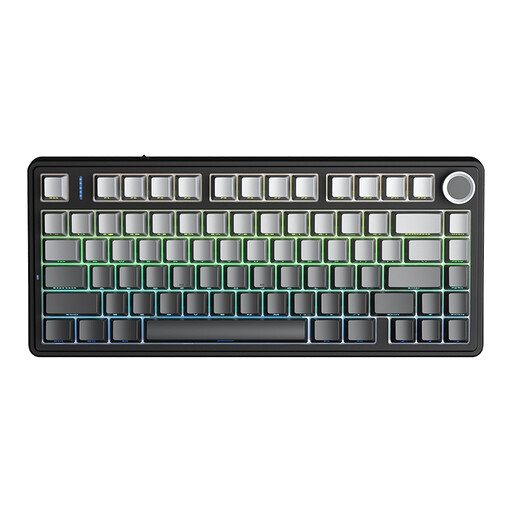
Consider this 75% board when desk space and connections to different devices are priorities. Its title specifies 78 keys, 2.4GHz and Bluetooth 5.0/4.0 connections, and support for four devices; check whether its US physical layout suits the symbols you type.
 No image available
This compact mechanical option may suit a desk where you want a choice of wireless or wired connection. The title specifies Bluetooth, 2.4GHz and wired modes, hot-swappable switches and RGB backlighting; confirm the US key positions suit your shortcuts.
 No image available
The 68-key layout is worth assessing if mouse room takes priority over a larger key arrangement. Its title specifies Jellyfish switches, Bluetooth 5.1 and wired connections, and white backlighting; confirm the physical layout and whether the advertised mouse is included when you order.
 No image available
Consider this full-size option if you have room for a 108-key board and prefer the listed Silent Tactile switch variant. The title specifies hot-swappable switches, an 8000mAh battery and a US layout; check desk fit and do not treat the switch name as a measured noise result.
No image available
This is an option to assess if a split layout and padded wrist rest matter more to you than a conventional compact shape. Check the physical key layout and the space needed for your keyboard and mouse before deciding whether it fits your desk.
Choose a compact layout if keeping the mouse within easy reach is your main constraint; consider full-size if you need its separate number pad or key arrangement and have room for both it and the mouse. Check the actual dimensions and key positions, because layout names alone will not tell you how the board fits your desk.
Windows lets you change the software keyboard layout, according to Microsoft Support, but that will not change the legends or positions of the physical keys. If you often type symbols for code or page content, check the keycaps and physical layout before buying.
No: Apple specifies the cited British English Touch ID model for Mac computers with Apple silicon running macOS 15.1 or later. Check your exact Mac and operating-system version before making Touch ID a deciding feature.
Leave room to position the keyboard and mouse comfortably rather than placing them wherever the laptop allows. The Health and Safety Executive advises a keyboard just below elbow height and a mouse in line with the elbow; for prolonged laptop use, a separate keyboard and mouse allow the screen to be raised.