Level designers with small desks
If your mouse, sketchbook and laptop share a narrow surface, a compact keyboard may leave more working room. Check that its retained keys cover the shortcuts you use, particularly if your editor relies on a numpad.


For puzzle-level design in a student room, start with a compact keyboard that keeps the keys your editor needs and leaves room for mouse movement. Prioritise configurable shortcuts if you use repeated editor commands, or a quiet-oriented variant if you work near other people; a larger board makes sense when you need its extra keys and have space for it. Check the exact physical layout, key bindings and connection options before choosing.
If your mouse, sketchbook and laptop share a narrow surface, a compact keyboard may leave more working room. Check that its retained keys cover the shortcuts you use, particularly if your editor relies on a numpad.
Late-night work near flatmates makes the exact switch variant worth checking. Logitech and Razer describe quiet-oriented features on particular models, but those descriptions do not establish how quiet every configuration will sound in your room.
Placing objects, testing builds and switching tools can involve repeated commands. Keychron and Razer describe remapping or macro features on particular models; these matter most if you are willing to configure them and can use the required software.
Check your level editor’s key bindings before deciding how small a keyboard can be. Then weigh noise, customisation and workstation space against the need for extra keys.
| Concern | What to check | Who this matters to |
|---|---|---|
| Desk space and keys | Compare the layout with your editor’s bindings; check for a numpad and the physical layout you prefer. | If I need room to move a mouse beside my laptop, I want a smaller board without losing essential editor keys. Around 36% of consumers might put desk space and retained keys first. |
| Shared-room noise | Check the switch fitted to the exact variant and any stated quiet-oriented construction. | When I work while someone else studies or sleeps nearby, switch sound matters more to me than decorative features. Roughly 29% of consumers might make reduced disturbance their primary concern. |
| Shortcut customisation | Identify repeated commands, then check remapping or macro support for your operating system and intended connection mode. | If I repeatedly place objects and test a level, I want shortcuts I can configure for those actions. Around 21% of consumers might prioritise that flexibility. |
| Long-session setup | Allow space for the keyboard and mouse; the Health and Safety Executive advises positioning the keyboard just below elbow height where practical. | For extended editing sessions, I need a setup that lets me position the screen, keyboard and mouse comfortably. Approximately 14% of consumers might put workstation comfort first. |
A 75% board saves space partly by omitting a numpad, which may matter if you use numpad commands in your editor.
List your frequent commands in the editor before buying, and check whether the retained keys or available remapping cover them.
Logitech offers Tactile Quiet, Clicky and Linear versions of the MX Mechanical Mini, so the variant changes the switch choice.
If disturbance is a concern, check the selected switch and any sound-dampening features rather than relying on the keyboard family name.
Keychron’s K3 Max ISO range includes regional variants; a general model name alone does not identify the precise key arrangement.
Check the variant selector and key legends for UK-ISO if that is the layout you want.
A compact board or wrist rest does not determine where your laptop screen and mouse sit. The Health and Safety Executive advises using a separate keyboard and mouse for prolonged laptop work so the screen can be raised.
Plan space for the screen, keyboard and mouse together, with the keyboard just below elbow height where practical.
Its compact MX Keys Mini and MX Mechanical Mini are relevant when desk space and multi-device use matter.
The K3 Max UK-ISO is relevant to a compact layout with configurable editor commands.
The larger Pro Type Ultra is relevant when you have desk space for a productivity keyboard and wrist rest.
These keyboards offer different ways to balance desk space and key access for puzzle-level design. Compare their stated layouts with your editor’s commands, and check the exact variant where physical key arrangement matters.
 No image available
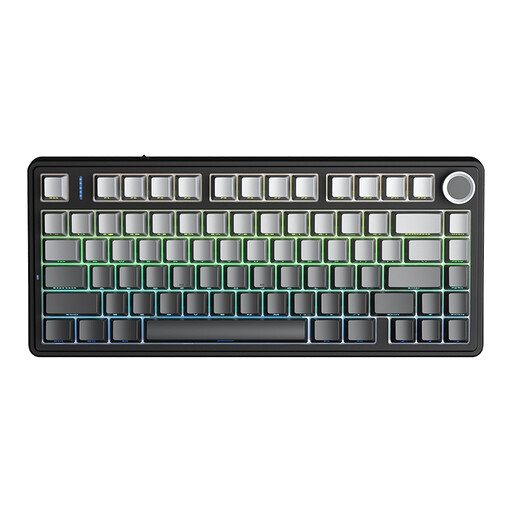
Consider this 75% board if mouse space is a priority and you can work without a numpad.
The name specifies Bluetooth, 2.4G and wired connections and hot-swappable switches. It specifies a US QWERTY layout, so check that its physical keys suit you; confirm compatibility before relying on configurable commands in your editor.
 No image available
Consider this model if keeping access to a numpad matters more than choosing a smaller 75% board.
The name identifies the 96 variant and a UK layout. Check the selected product’s physical key arrangement and whether its footprint fits alongside your mouse.
 No image available
The 75 variant is worth considering if you want a smaller board while checking which dedicated keys your editor requires.
Confirm the exact physical layout and whether any key-assignment software works with your computer and intended shortcuts.
 No image available
Consider the 65 variant when desk space takes priority, but compare its keys with the commands you use most often.
The name specifies an analog keyboard and UK layout. Check the connection and whether your editor can use any custom key assignments you need.
 No image available
This 80% board may suit a desk-space priority if its retained keys match your level-editor workflow.
The name specifies a mechanical tri-mode keyboard, US QWERTY layout, gasket mount and Latte Switch-Pink variant. Check the exact key set and shortcut options before relying on them.
Not necessarily: a 75% keyboard can suit a small desk if your level editor’s essential commands work without a numpad. Check its key bindings for placement, testing and camera controls before giving up those keys.
No keyboard’s switch label alone guarantees silence. Logitech offers distinct Tactile Quiet, Clicky and Linear MX Mechanical Mini variants, while Razer describes silent switches and sound-dampening foam on Pro Type Ultra; check the precise configuration rather than treating those manufacturer descriptions as a measured noise comparison.
For prolonged laptop work, the Health and Safety Executive advises a separate keyboard and mouse so you can elevate the screen. Position the keyboard just below elbow height where practical and keep the screen and keyboard central.