Terminal-heavy incident responders
If you spend long periods searching and paging through log output, start with the navigation keys you actually use. A fixed-desk setup also gives you room to position the keyboard for extended work.


Choose the layout around the keys you use to navigate logs: a full-size board keeps more controls directly available, while a 75% board saves desk space if you are comfortable with its key arrangement. For dim rooms, shared spaces or several devices, check the exact backlight, switch, connection and layout variant. For long sessions, assess the keyboard as part of the whole workstation rather than treating its shape as an ergonomic solution.
If you spend long periods searching and paging through log output, start with the navigation keys you actually use. A fixed-desk setup also gives you room to position the keyboard for extended work.
If you move between a workstation, laptop or tablet, check both device-switching support and compatibility with each operating system you use. Connection options and optional software features can differ by model.
A small desk, dim room or shared workspace makes key visibility, board size and switch choice more consequential. Check the exact configuration rather than assuming every compact or mechanical variant feels and sounds alike.
For server-log work, settle the layout and key positions you need before choosing a switch type or connection method. Then check visibility, device compatibility and how the keyboard fits your workstation.
| Concern | What to check | Who this matters to |
|---|---|---|
| Navigation and numbers | Check for dedicated arrow keys, the other navigation keys you use and a numpad if numeric entry is frequent. Confirm UK symbol positions if they matter to your shortcuts. | If I regularly page through long logs and enter numeric values, I want those keys within easy reach rather than relying on combinations. Around 27% of consumers put direct navigation and numeric entry first. |
| Visibility and noise | Check the exact model’s backlight controls and the named switch variant; illumination and sound differ between configurations. | On call in a dim or shared room, I need to identify keys without disrupting other people. For around 20% of consumers, visibility or low-disruption typing is the primary concern. |
| Shortcuts and devices | Check device-switching methods, declared operating-system compatibility and whether the remapping you need works on your setup. | Moving between consoles and computers, I want my shortcuts or device changes to fit the way I work. Around 27% of consumers prioritise that workflow. |
| Extended-session comfort | Check keyboard height and placement alongside the screen, chair and mouse. For prolonged laptop use, consider a separate keyboard and mouse. | During a long log review, I need a workstation arrangement I can use comfortably, not just a keyboard labelled ergonomic. Sustained-use comfort comes first for around 26% of consumers. |
A compact layout takes less desk space, but keys you use for paging, navigation or numeric entry may move to combinations or layers.
List the keys you use to search, scroll, copy and filter logs, then compare their positions on the exact layout.
Switch variants can have different feel and sound. Logitech, for example, lists Tactile Quiet, Clicky and Linear choices for MX Mechanical.
For a shared room, confirm the named switch option rather than assuming that a mechanical keyboard will be quiet.
The UK Health and Safety Executive addresses posture through the overall display-screen workstation, not keyboard shape alone.
Position the keyboard just below elbow height and review the screen, chair, mouse and desk arrangement together.
Layout and switch options can change the key positions and typing experience you receive.
Before checkout, check the selected UK or US layout, legends, switch, connection method and current availability.
Logitech’s MX Keys S and MX Mechanical lines provide different approaches to multi-device desk work.
Keychron offers UK-ISO mechanical options here in both compact K3 Max and full-size V6 Max formats.
HP’s 400 Backlit Wired Keyboard is a fixed-desk option with a numpad and directional keys.
These keyboards cover full-size, split-layout and compact choices for checking logs. Compare each listing’s exact keys and layout with your workstation before choosing, particularly if UK symbol positions or dedicated navigation keys matter.
 Image unavailable
Consider this wireless option if Bluetooth fits your workstation. Confirm the exact key legends and whether its navigation arrangement suits the controls you use in logs.
 Image unavailable
A full-size option to assess if desk space is less restrictive. Check its exact UK legends and navigation keys; if you work in low light, confirm whether the selected configuration has backlighting.
 Image unavailable
Consider the split layout if you want to assess a different key position during long sessions; comfort will also depend on the rest of your workstation. Check the navigation-key arrangement, UK legends and backlighting before buying.
 Image unavailable
Its stated US layout is an important check if you rely on familiar UK symbol positions. The title identifies a full-size 108-key board, RGB lighting and Silent Tactile switches; the switch name alone does not establish how it will sound in your room.
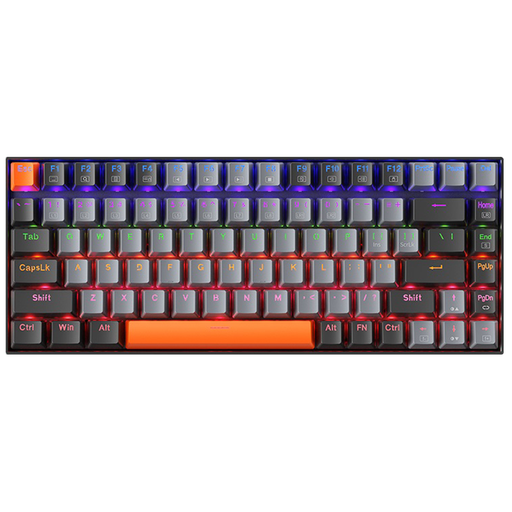 Image unavailable
The 75% format may suit a smaller desk if its key arrangement works for your log-review shortcuts. Its title specifies a US QWERTY layout and LED backlighting; check the symbol positions and the exact navigation keys before choosing it for a UK workstation.
Choose full-size when directly available navigation keys and a numpad are important to your workflow and you have the desk space. A 75% board is worth considering when space matters more, provided its key positions and any required combinations work for you. HP lists a numpad and directional keys on its 400 Backlit Wired Keyboard; Keychron identifies K3 Max as 75% and V6 Max as full-size.
Backlighting can help you identify key legends in a dim room, but check the controls on the exact model. Logitech describes adjustable backlighting for MX Keys S, while HP lists three backlight levels for its 400 Backlit Wired Keyboard.
Some keyboards can switch between compatible devices: Logitech states that MX Keys S and MX Mechanical support switching across up to three. Check the intended operating systems, connection methods and any software-dependent functions for the exact configuration.
No keyboard design replaces a suitable workstation arrangement. The UK Health and Safety Executive advises positioning the keyboard just below elbow height and, for prolonged laptop use, using a separate keyboard and mouse with an elevated screen. Assess the keyboard alongside your desk, chair, screen and mouse.