For tests that depend on several held keys registering together, choose a keyboard with an explicit full N-key rollover or full-key anti-ghosting specification, then check the exact combinations in your application. If you also need to test actuation settings or how the keyboard handles opposing directions, look for documented controls for those behaviours. Match the physical layout and dedicated keys to your test cases before buying.
Who needs this keyboard?
Multi-key input testers
If a game, prototype or browser application must receive several held keys, the keyboard itself must not obscure the result by dropping a press. KeyboardTester.uk explains how a keyboard matrix can fail to register particular combinations; test the combinations your work actually uses.
Directional-input behaviour testers
Tests involving rapid direction changes or simultaneous opposing keys need a clear distinction between keyboard settings and application behaviour. Logitech G documents adjustable actuation and opposing-key priority on its G515 RAPID TKL; either setting can change what the application receives.
UK-layout test-set builders
When test cases depend on physical key positions, check the keyboard rather than its language setting alone. As Logitech explains, ISO and ANSI layouts differ around Enter and left Shift, including an additional key on the ISO layout.
What matters when choosing?
Decide whether your primary test is held-key registration, configurable input behaviour or coverage of particular physical keys. A keyboard can suit one of those tasks without covering the others.
| Concern |
What to check |
Who this matters to |
| Simultaneous-key registration |
Look for explicit full N-key rollover or full-key anti-ghosting support. Test your held-key and modifier combinations on the intended setup. |
If several gameplay keys must stay pressed together, I need to know whether a missing input comes from the keyboard or the application. Around 42% of consumers put reliable multi-key registration first. |
| Configurable input behaviour |
Check the available actuation, rapid-trigger and opposing-key priority controls on the exact model; record the active settings for each test. |
When testing direction changes, I need to know whether a keyboard setting resolves opposing presses before the application sees them. Roughly 33% of consumers prioritise configurable input behaviour. |
| Layout and key coverage |
Confirm UK ISO physical key positions if required, and check that every necessary navigation, function or number-pad key is available as a dedicated key. |
If a test calls for a particular physical key, an Fn-layer substitute or a different Enter and left-Shift arrangement may change the procedure. Around 25% of consumers put layout and required-key coverage first. |
Buying pitfalls
-
Assuming mechanical switches guarantee multi-key registration
Switch type alone does not establish which simultaneous presses the keyboard can report. A dropped key could otherwise be mistaken for a failure in the software being tested.
Look for an explicit rollover or anti-ghosting specification, then try the actual combinations in the target application.
-
Choosing a compact US layout for UK-specific test cases
US ANSI and UK ISO differ physically around Enter and left Shift. Compact keyboards can also move commands to Fn layers, changing how a test is performed.
Inspect the exact physical layout and make a list of the dedicated keys your test plan requires before ordering.
-
Attributing directional priority to the application
A keyboard configured to prioritise one of two opposing keys can change the input before the application handles it.
Record the keyboard profile and directional-priority settings with the result; use standard settings for a baseline when the test requires one.
-
Checking size without checking omitted keys
A compact board may fit the workspace yet lack dedicated keys needed for navigation or number-pad test cases.
Compare every required physical combination with the exact keyboard layout, not just its size label.
Brands to consider for these test needs
Corsair
A reference point for a wired, full-size UK-layout test keyboard.
- Corsair specifies full N-key rollover, 100% anti-ghosting, a 105-key UK layout and wired USB connectivity for its UK K60 RGB PRO.
- Those stated features address baseline multi-key registration, not experiments that require adjustable actuation or opposing-direction priority.
Logitech G
A reference point when a test needs configurable keyboard-side input behaviour.
- Logitech G specifies adjustable actuation from 0.1 mm to 2.5 mm and configurable opposing-key priority for the G515 RAPID TKL.
- Check the physical layout variant and keep its keyboard-side settings separate from the application behaviour you intend to measure.
Razer
A reference point for test plans involving programmable commands as well as ordinary key input.
- Razer describes six dedicated programmable macro keys and switch options for the BlackWidow V4.
- For a rollover-focused test, confirm the exact variant’s rollover capability and physical layout before using it as the test keyboard.
Joybuy product choices
These choices include UK-layout keyboards and a compact US-layout option. Compare each one with the physical keys, connection and input behaviour your test requires; none replaces a check of the exact combinations in your application.
 No image available
HyperX Alloy Rise 75 Wireless Keyboard UK
Consider this UK wireless model if it fits your physical-key test cases. For simultaneous-input work, check the intended held-key combinations using the connection and application you will use for testing.
View on Joybuy
 No image available
ASUS ROG Falchion Ace HFX 65 Analog Gaming Keyboard, UK Layout
Consider this UK-layout analogue model for tests involving keyboard-side input settings. Confirm that its controls and physical keys cover the test plan, and check the required simultaneous-key combinations separately.
View on Joybuy
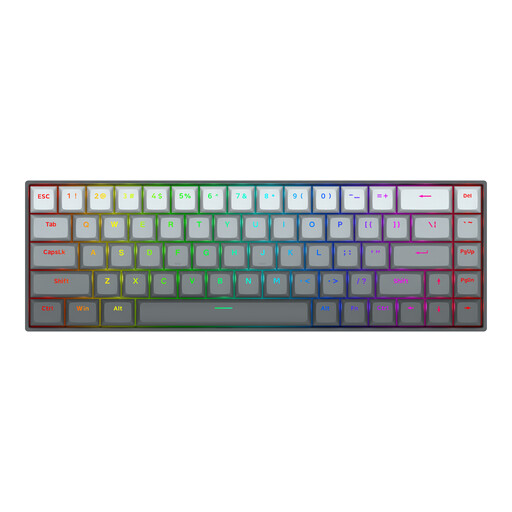 No image available
Redragon M68 68-key magnetic-switch keyboard, US layout
Consider this compact model only if a US physical layout and its 68-key arrangement suit your test cases. Check the exact held-key combinations before using it for rollover-focused work.
View on Joybuy
Common questions
Does a mechanical keyboard automatically prevent ghosting?
No. Mechanical describes the switches, not the keyboard’s rollover implementation. For simultaneous-key tests, check for an explicit N-key rollover or full-key anti-ghosting specification and try the combinations your application uses.
How should I check a keyboard before using it for input tests?
Test each intended held-key combination on the computer and connection you plan to use, noting missing or unexpected inputs. Repeat the checks inside the target game or application: a browser rollover test shows the events the browser receives, not necessarily how the target handles them.
When do adjustable actuation and rapid trigger matter?
They matter when the test deliberately varies when a key actuates or resets, such as during rapid directional changes. They are not required merely to check whether several standard keys register together; keep any active keyboard settings in the test record.
Should I choose UK ISO or US ANSI for these tests?
Choose UK ISO if the test depends on UK physical key positions or an ISO-specific key. As Logitech explains, ISO and ANSI differ around Enter and left Shift; if those positions are irrelevant, check the remaining required keys against the exact layout instead.


