Small-desk landing-page builders
You need room for a mouse and other work materials, but still use keys for writing, editing and moving around a page. The controls retained differ between compact layouts.


Start with the space beside your keyboard and the editing keys you use regularly. A compact scissor keyboard can suit an Apple-centred desk, while a 75% model such as the Keychron K3 Max offers a function row and arrow keys for shortcut-heavy work. Check the exact keyboard layout, device compatibility, connection method and switch noise before choosing: a smaller board may put frequently used controls on another layer.
You need room for a mouse and other work materials, but still use keys for writing, editing and moving around a page. The controls retained differ between compact layouts.
You move between devices or repeat design-tool commands, so connection choices and configurable keys may matter as much as keyboard width.
You type near colleagues, housemates or calls and need to consider the sound and feel of the particular keys or switches you choose.
For landing-page work on a small desk, decide which controls must stay easy to reach before comparing widths. Then check the features that affect your own devices and workspace.
| Concern | What to check | Who this matters to |
|---|---|---|
| Desk space and editing keys | Compare width and depth, then inspect arrow keys and function-row access on the actual layout. | I need more room to move my mouse without making everyday page edits awkward. Around 40% of consumers put that balance of footprint and essential keys first. |
| Shortcuts and connections | Check device pairing and whether configuring keys or macros requires software or a cable. | Switching devices or repeating design-tool commands makes configurable controls important to my workflow; roughly 30% of consumers make this their primary concern. |
| Typing feel and disturbance | Identify the selected switch or key mechanism; do not assume that a low-profile keyboard is quiet. | If I write copy beside other people or take calls at my desk, the feel and sound of the keys affect my choice. For about 20% of consumers, this comes first. |
| Layout and compatibility | Confirm the physical UK-ISO, British-English or US layout you want and the exact model’s device requirements. | I do not want unfamiliar punctuation positions or a keyboard that does not suit my computer; around 10% of consumers prioritise layout and compatibility above the other factors. |
Some smaller layouts remove keys or place them on layers, which can interrupt frequent browser, editor and design-tool navigation.
Inspect the layout image and manual for the arrow, function and navigation commands you actually use. A 75% layout is worth considering if you want to retain more direct controls.
A compact keyboard may fit your desk but have legends or punctuation positions that differ from those you normally use.
If you want UK-ISO or British-English keys, select that specific variation and check the chosen variation again before ordering.
Mechanical switch variants differ in feel, and a clicky option may be disruptive in a shared room.
Choose the exact variant deliberately. If sound matters, check information for that variant rather than assuming its appearance or low-profile shape tells you how it will sound.
A wireless connection does not necessarily cover every configuration task. Keychron says K3 Max key and macro remapping through QMK/VIA can be done with a cable connected.
Check the instructions for the function you intend to use and whether you have the appropriate cable.
Compact productivity keyboards, including scissor-key and low-profile mechanical options.
A 75% low-profile mechanical route with UK-ISO variants and configurable keys.
A compact British-English keyboard option for compatible Apple devices.
These 75%, 65% and 60% keyboards offer different ways to leave room on a small desk. Compare their retained controls, printed layout and connection type against your landing-page workflow.
 No image available
Consider this wireless model if you want a compact desk setup while keeping editing controls in mind.
Check its measured footprint, printed physical layout and switch sound for your workspace before ordering.
 No image available
This slim, multi-device option may suit a desk where you move between devices and want a compact keyboard.
The listed variant has 78 keys and 2.4 GHz/Bluetooth 5.0/4.0 connections. Its US QWERTY layout may not match your preferred UK punctuation positions; inspect the editing-key layout too.
 No image available
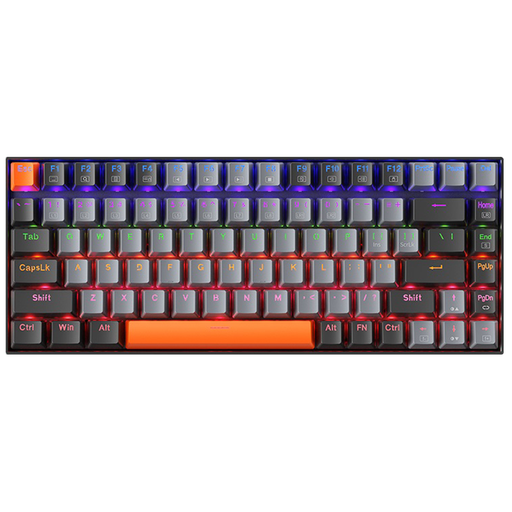
This 75% wired model is an option for a fixed workstation where cable routing is manageable.
The Light Gray variant is listed with red switches and LED backlighting. Check whether its US QWERTY legends and punctuation suit your typing.
 No image available
The 65% UK-layout format may appeal if desk space and familiar key legends both matter.
This is a wired model. Inspect its function and navigation-key access, and confirm compatibility with your intended computer before choosing it for design work.
 No image available
The 60% format is worth considering when keyboard footprint takes priority over direct access to every editing control.
The product description puts arrow access on a modifier key. Check whether that suits frequent navigation, as well as the physical key layout and compatibility with your computer; this is a wired keyboard.
Choose UK-ISO if its key shapes, legends and punctuation positions are what you expect to use; it is a usability choice, not a universal requirement. Keychron identifies a UK-ISO K3 Max variant, so check that you have selected that variation rather than relying on the model name alone.
Yes, if the exact model supports those devices and a suitable connection method. Keychron says the K3 Max can connect to up to three devices over Bluetooth; Apple lists specific Apple-device system requirements for its cited Magic Keyboard, so check compatibility before treating it as a mixed-platform choice.
You may need one for particular functions even if you normally type wirelessly. Keychron says K3 Max key and macro remapping through QMK/VIA can be done with a cable connected; check the instructions for the function you plan to use.
Check a suitable local-authority or retailer collection route for electrical equipment. GOV.UK identifies the Waste Electrical and Electronic Equipment Regulations 2013, as amended, as part of the UK framework for recovery, reuse and recycling; its cited guidance is principally directed at producers, importers and distributors.