What to check when choosing
Choose the keyboard’s position and layout before deciding how much split adjustment or shortcut customisation you will use. The three keyboard types below differ chiefly in how much they let you change hand placement and how much adaptation they demand.
Conventional low-profile
Consider it when: You want familiar typing and may switch between development devices.
Trade-off: A one-piece board cannot position each hand independently; check any shortcut software against your work device.
Fixed ergonomic split
Consider it when: You want a curved split shape or negative tilt without moving to separate keyboard halves.
Trade-off: The distance between your hands remains fixed, and the board still needs to fit at the right desk height.
Fully split and programmable
Consider it when: Independent half placement and configurable layers matter enough to change your typing habits.
Trade-off: A columnar layout or thumb keys can take time to learn; check desk fit and the exact configuration before ordering.
| Concern |
What to check |
Who this matters to |
| Standing-desk fit |
Check that the keyboard can sit centrally, just below elbow height, with relaxed shoulders. If considering a split model, check whether its halves separate or its angle changes. |
When I stand to code, I need a keyboard position that does not make me raise my shoulders or bend my wrists awkwardly. Around 36% of consumers put standing-desk fit first. |
| Shortcuts and symbols |
Check the keys you use for coding symbols and whether remapping works on your operating system, through onboard settings or compatible software. |
If I repeatedly move between extension code, browser tools and tests, I want shortcuts I will actually set up and use. For around 29% of consumers, workflow customisation is the primary concern. |
| Desk space and devices |
Check the board’s footprint, retained navigation keys and stated connection or device-switching options. |
My keyboard needs to leave room on the desk while I work across a main computer and test devices. That flexibility comes first for around 21% of consumers. |
| Typing feel and noise |
Check the exact switch or key variant and its return terms if you cannot try it; do not assume every model in a range feels alike. |
In a shared room, I need a key feel I can settle into without choosing a sound that disrupts others. Around 14% of consumers prioritise feel and noise. |
Joybuy keyboard choices
These keyboards offer different ways to address desk space, key layout, positioning or shortcuts while building a browser extension. Compare each board’s exact layout and controls with the work you do at standing height.
 No image available
HP 960 Ergonomic Split Layout Wireless Keyboard with Padded Wrist Rest
Consider this split-layout option if changing your hand position matters more than keeping a compact conventional board.
The named variant is wireless and includes a padded wrist rest. Confirm its physical UK layout and whether the shortcut software works with your operating system.
View on Joybuy
 No image available
Rapoo E9050L 75% Wireless Membrane Keyboard, US QWERTY, White
The 75% layout is worth considering when desk space matters and you prefer a conventional board.
This variant is labelled US QWERTY, with 2.4 GHz and Bluetooth 5.0/4.0 connection options. Check whether its physical symbols suit your coding and whether it offers the remapping you need.
View on Joybuy
 No image available
HyperX Alloy Rise 75 Wireless Keyboard UK
Consider this 75% wireless board if you want a smaller keyboard while keeping a layout you can assess against your navigation-key needs.
Check the exact physical UK key layout before ordering. If key reassignment matters, confirm that its software works on your development computer.
View on Joybuy
 No image available
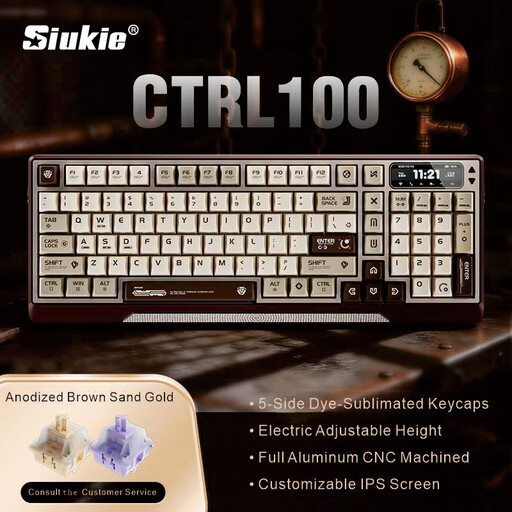
Siukie CTRL100 96% US QWERTY Mechanical Keyboard, HMX Cream Taro, Brown
The motorised-lift design is relevant if you want to investigate an adjustable typing angle at your standing desk.
This variant names a 96% US QWERTY layout and HMX Cream Taro switches. Confirm the lift’s adjustment range, physical symbol positions and any required remapping or device-switching features.
View on Joybuy
 No image available
Razer Huntsman V3 Pro Mini 60% Analog Optical Keyboard
A 60% board can free desk space, but check how you will access the navigation functions you use while coding.
This named variant is a compact keyboard. Confirm its physical layout and operating-system compatibility against your development setup before choosing it for shortcut work.
View on Joybuy
Common questions
How high should my keyboard be when I code standing up?
Place it just below elbow height, with the keyboard and screen central in front of you, according to the Health and Safety Executive. Adjust the desk and monitor as well as the keyboard so you do not have to raise your shoulders or twist towards the screen.
Will a split keyboard prevent pain or injury?
A split keyboard cannot guarantee that outcome. Kinesis states that ergonomic keyboards are not medical treatments; assess the whole workstation and seek appropriate professional advice if symptoms persist or are significant.
Will a fully split keyboard slow down my coding at first?
It may while you learn a different layout. PCMag UK notes that developing muscle memory for ergonomic layouts can take weeks; Kinesis says most Advantage360 Pro users take 1–2 weeks to regain full typing speed, with individual results varying. If possible, make the change outside a deadline-critical period.
What should I check before trying an unfamiliar keyboard?
Confirm the exact key layout, switch variant, software compatibility and seller’s return terms before ordering. Keep your order and warranty documents; Citizens Advice notes that a warranty adds to, rather than replaces, your legal rights.


