Start with workstation fit: position the keyboard just below elbow height and keep it centred with the screen, as the Health and Safety Executive advises. For lengthy theatre-review edits, consider a split layout if hand position is your priority, a conventional full-size board if familiar keys and quiet typing matter more, or a compact board if desk space and shortcuts take precedence. Check the exact layout and allow for the compromises each choice brings.
Who these choices suit
Standing-desk long-form editors
If you draft and revise substantial reviews while standing, keyboard height, angle and position need to work with the desk and screen. The Health and Safety Executive advises keeping the keyboard just below elbow height and centred with the screen.
Quiet-space reviewers
If you edit around colleagues or other people at home, key sound may matter alongside a familiar layout for sustained prose and punctuation work. Check the sound of the particular keyboard or switch variant rather than judging by its category alone.
Shortcut-driven, multi-device writers
If your editing moves between devices or repeatedly uses formatting and revision commands, device switching and configurable keys may be worth checking. Confirm that the functions you want work with your devices and software.
What matters when choosing
Choose a layout that fits your standing workstation and the keys you use most often; then decide how much you value quiet typing, device switching and custom shortcuts.
Split ergonomic layout
Consider it when: You want an alternative hand position during long editing sessions and have room to position the keyboard comfortably.
Trade-off: A curved or split shape can take more desk space and time to get used to than a conventional board.
Conventional full-size layout
Consider it when: Familiar editing keys and a dedicated number pad matter more than changing your hand position.
Trade-off: It occupies more desk width than a compact board and does not offer the separated hand positions of a split layout.
Compact mechanical layout
Consider it when: You want more clear desk space and are willing to configure editing shortcuts.
Trade-off: A 75% layout has no dedicated number pad, and key feel and sound depend on the selected switches.
| Concern |
What to check |
Who this matters to |
| Standing posture and wrist position |
At your standing height, check keyboard height and central alignment; assess whether its angle feels comfortable during normal typing. |
If long edits leave me raising my shoulders or reaching awkwardly, I need the whole workstation to fit before changing keyboards. Around 36% of consumers put posture and hand position first. |
| Quiet, accurate prose editing |
Check the exact key mechanism and layout, and assess typing sound in a setting relevant to your workspace. |
When I revise prose around other people, I want keys I can use accurately without disruptive sound. Quiet typing is the primary need for around 29% of consumers. |
| Shortcuts and device switching |
Confirm compatible devices, connection methods and whether remapping needs software. |
Moving between drafts and reference material makes repeatable editing commands important to my workflow. Around 21% of consumers prioritise shortcuts or switching between devices. |
| Layout and desk space |
Decide which dedicated keys you need, then confirm the physical UK or UK-ISO variant if that is your preferred layout. |
With limited space on my standing desk, I need to balance keyboard width against access to navigation keys and punctuation. Layout and space come first for around 14% of consumers. |
Buying pitfalls
-
Treating the keyboard as the whole ergonomic solution
A different keyboard will not put an off-centre screen or unsuitable desk height right. The Health and Safety Executive advises positioning the keyboard just below elbow height and keeping it central with the screen.
Adjust the desk, screen and keyboard together. For work covered by display-screen-equipment requirements, use the appropriate workplace assessment process.
-
Changing to a split layout just before a deadline
A curved or split key arrangement may feel unfamiliar during fast revisions, even if its hand positions appeal to you.
Try the layout during ordinary editing before relying on it for deadline work, and check the applicable retailer return terms before buying.
Allow time to adapt to the new key positions.
-
Assuming a compact keyboard keeps every editing key
A 75% layout saves desk space but omits a dedicated number pad and may change access to other keys you use while revising.
Note which keys you reach for during an editing session before deciding whether a compact layout, full-size board or separate keypad suits you.
-
Choosing a product family without checking its layout
A UK-ISO version can be one variant within a keyboard range, rather than the layout supplied with every version.
Check the selected variant and its key photographs for the punctuation and symbol positions you expect.
Brands to consider
Logitech
Its keyboard range includes conventional low-profile models and the ERGO K860 curved split model.
- Logitech lists device switching for MX Keys S and 0°, -4° and -7° palm-lift positions for ERGO K860.
- The ERGO K860 shape takes more room than a compact layout and may require time to get used to.
HP
The HP 960 is a split-layout option with a separate number pad rather than a permanently full-width key arrangement.
- HP specifies negative tilt, a padded wrist rest and twenty programmable keys for the 960.
- Check whether its separate keypad and the space needed for both components suit your desk.
Keychron
The K3 Max is a compact low-profile mechanical option available in a UK-ISO variant.
- Keychron specifies wired, Bluetooth and 2.4 GHz connections, plus VIA remapping, for the K3 Max.
- Its 75% layout has no dedicated number pad; check the chosen switch and physical-layout variant.
CHERRY
The KC 6000 SLIM offers a conventional full-size scissor-switch layout for office typing.
- CHERRY specifies a full-size layout and adjustable feet for the KC 6000 SLIM.
- It does not offer the separated hand positions or movable keypad arrangement of the split models discussed here.
Joybuy product choices
These choices cover split and full-size layouts for editing at a standing desk. Compare each keyboard's physical layout and key arrangement with your own workstation before choosing.
 No image available
HP 960 Split Layout Wireless Keyboard with Padded Wrist Rest
Consider this if you want a split key arrangement for long editing sessions. HP specifies negative tilt, twenty programmable keys and a separate number pad for the 960; check the physical layout of the variant you select and allow time to get used to the shape.
View on Joybuy
 No image available
Targus EcoSmart Full-Size Wireless Keyboard (UK)
Consider this if you prefer a full-size UK keyboard for familiar editing keys. Check whether its height and angle fit your standing workstation, and assess key sound if you work around others.
View on Joybuy
 No image available
ET Silent Full-Size Wireless Keyboard and Mouse Combo, US Layout
Consider this combo if you want a full-size keyboard and a mouse together. Its title specifies a US layout and 2.4 GHz wireless connection; check whether the punctuation positions suit your editing and whether you need the accompanying mouse.
View on Joybuy
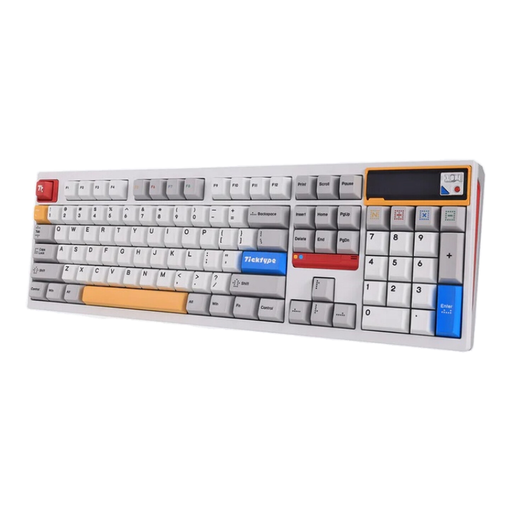 No image available
Ticktype DP104 Full-Size Mechanical Keyboard, Powder White, Silent Tactile Switches, US Layout
Consider this if you want mechanical switches while keeping a full-size key arrangement. The named variant has 108 keys, silent tactile switches and a US layout; assess its actual sound and check the punctuation positions before choosing it for shared-space editing.
View on Joybuy
Common questions
How high should my keyboard be when I edit while standing?
Position it just below elbow height and keep it centred with the screen, following Health and Safety Executive posture guidance. Adjust the desk and screen together if that position makes you raise your shoulders or twist to see your work.
Is a split keyboard necessary for long theatre-review edits?
No particular layout suits everyone: a split keyboard offers a different hand position, but it can take time to learn and room to place. Start by checking workstation height and alignment, then decide whether the split shape suits your normal editing.
How do I make sure I get a UK keyboard layout?
Check the exact purchasable variant and its key photographs for the punctuation and symbols you use. Keychron, for instance, offers a UK-ISO version of the K3 Max; the product-family name alone does not identify the selected layout.
Do I need a separate number pad?
Choose dedicated number keys if you use them often enough to justify the desk space. A full-size keyboard keeps them attached, while the HP 960 has a separate pad that you can position independently; a 75% keyboard such as the Keychron K3 Max omits a dedicated number pad.


