Choose a compact keyboard with quiet keys if desk space and shared-room noise matter most; choose a layout with a dedicated number pad if you repeatedly enter prices, quantities or product codes. Programmable keys are worth considering when your catalogue work includes recurring shortcuts, but check the physical layout, device compatibility and connection method before buying. For longer laptop sessions, the Health and Safety Executive recommends a separate keyboard and mouse when the screen is raised.
Who needs which layout?
Small-desk catalogue editor
If you mainly update titles and descriptions, with only occasional numbers, a compact keyboard leaves more room for your mouse and other desk items. In a shared room, key noise may matter too. Logitech describes its Pebble Keys 2 K380s as compact and quiet; check the sound and layout of any model you consider.
Number-heavy stock and price updater
If quantities, prices, stock counts or product codes occupy much of each session, a dedicated number pad may justify a wider keyboard. Logitech describes the K120 as full size with an integrated number pad, while HP lists its 150 wired keyboard as full size. Measure the space left for your mouse before choosing a wider layout.
Shortcut-focused multi-device user
If you move between devices or repeat the same catalogue actions, look for the particular switching or remapping functions you will use. Logitech states that Pebble Keys 2 K380s switches between three devices; Keychron describes key and macro customisation on the K3 Version 3. Those are model-specific features, so check compatibility and setup requirements.
What matters when choosing?
For catalogue updates in a student room, start with the task that shapes most of your typing, then check whether the keyboard fits your desk and devices.
| Concern |
What to check |
Who this matters to |
| Space and key noise |
Check the keyboard’s dimensions and physical layout. Treat descriptions of quiet keys as model-specific rather than a measured noise comparison. |
When I share a small room, I want space for my mouse without disturbing someone nearby as I type; around 40% of consumers would put compact, quiet use first. |
| Repeated number entry |
Confirm that the layout has a dedicated number pad and that the keyboard and mouse will both fit on the desk. |
If prices, quantities and codes fill much of my session, direct access to number keys matters more than a narrow footprint; roughly 30% of consumers would prioritise numeric entry. |
| Device connections |
Check operating-system support, available ports and Bluetooth requirements; confirm the device-switching function on the exact model. |
I move catalogue work between a laptop and another device, so changing connections needs to fit the devices I actually own; about 20% of consumers would make connection flexibility their primary concern. |
| Shortcuts and lighting |
Check whether remapping needs software and whether its device and browser requirements suit your setup. Decide whether illuminated keys would be useful in your room. |
For recurring catalogue actions, I would use configurable keys enough to make setting them up worthwhile; around 10% of consumers would put customisation or lighting first. |
Mistakes to avoid
-
Choosing a compact layout without checking number entry
A narrow keyboard can suit a student-room desk, but frequent prices, quantities and codes may make a dedicated number pad more useful. Logitech identifies the integrated number pad on its K120 as a feature for data entry.
Look at the fields in a typical catalogue-editing session, then compare a compact layout with a full-size or compact-with-numpad option.
-
Expecting a keyboard alone to fix the workstation
Keyboard choice does not address screen and mouse placement. For longer laptop work, the Health and Safety Executive advises using a separate keyboard and mouse so the screen can be raised.
Arrange the screen, keyboard and mouse together, keeping the keyboard just below elbow height and the working position central.
-
Assuming every keyboard works with every device
Connections and stated compatibility differ by model: Logitech lists several desktop and mobile operating systems for Pebble Keys 2 K380s, while HP lists Windows 10 and 11 and a USB Type-A connection for its 150 wired keyboard.
Check your operating system, ports and Bluetooth capability against the exact model. If you plan to switch devices, confirm how that function works.
-
Putting an old keyboard or battery in household rubbish
GOV.UK advises that electrical products and batteries marked with a crossed-out wheelie-bin symbol should go to an appropriate recycling collection point rather than household rubbish.
Check a suitable electrical-waste collection route for the keyboard and a battery collection route for any removable batteries.
Brands to consider
Logitech
Logitech lists compact Bluetooth, compact illuminated and full-size wired keyboards relevant to different catalogue-editing needs.
- Logitech describes Pebble Keys 2 K380s as compact and quiet, MX Keys Mini as illuminated with programmable keys, and K120 as full size with a number pad.
- Choose by model: a compact option does not provide the K120’s dedicated number pad for repeated numeric entry.
HP
HP lists wired layouts including the full-size 150 and the illuminated 400 with a number pad.
- HP states that the 150 uses USB Type-A; its 400 has a removable USB-C cable and includes a USB-A adapter.
- HP lists Windows 10 and 11 compatibility for the 150. Check operating-system support and physical size for the specific model you want.
Keychron
Keychron’s K3 Version 3 is an option to examine if a UK-ISO mechanical layout and configurable keys matter to your workflow.
- Keychron states that K3 Version 3 supports Bluetooth and wired connections, with key and macro customisation.
- Its configuration options call for more checking than a basic typing keyboard. Confirm the selected layout, switches and software setup before ordering.
Joybuy keyboard options
These keyboards offer compact layouts for a student-room desk, with different approaches to number entry, connections and configurable features. Check each model’s physical layout and dimensions against your workspace before choosing.
 No image available
AULA F99 mechanical keyboard, US layout, Reaper Switch, light blue
Consider this model if you want a compact keyboard while keeping number-entry keys close at hand.
The title specifies a QWERTY US layout and wired, Bluetooth and 2.4 GHz connections.
Check its dimensions and whether the US layout suits you. Confirm the supplied switch before buying: the title names Reaper Switch, while the product description names a different switch.
Joybuy
 No image available
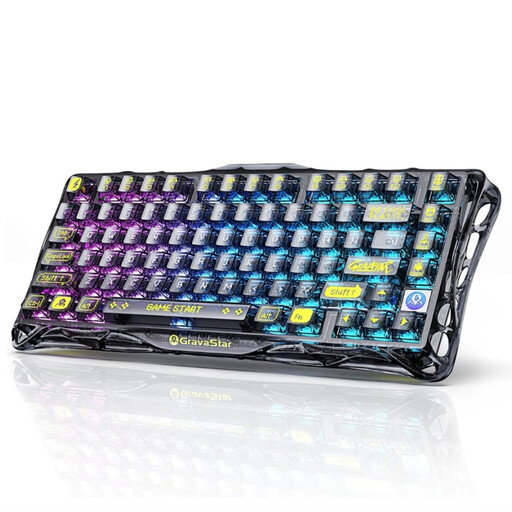
GravaStar Mercury K1 Lite 75%, Chinese Retail Version, black
This is a compact option if you want a choice of wired and wireless connections for catalogue work.
Its title specifies a QWERTY US layout, Bluetooth 5.0, 2.4 GHz wireless and USB-C connections, RGB backlighting and hot-swappable switches.
Check the exact dimensions, physical layout and number-pad arrangement if you enter figures frequently.
Joybuy
 No image available
AULA F75 75% wireless mechanical keyboard, US layout
Consider this compact model if you want backlit keys and a choice of connections at a student-room desk.
Its title specifies wired, Bluetooth and 2.4 GHz modes, RGB backlighting and PBT keycaps.
Check its dimensions, QWERTY US layout and number-pad arrangement. If room noise matters, assess the typing sound rather than assuming a particular noise level.
Joybuy
 No image available
Rapoo E9050L 75% wireless membrane keyboard, white
Look at this model if a compact desk setup and switching between devices are more important than advanced mechanical-key customisation.
The title specifies a 78-key QWERTY US layout, Bluetooth 5.0 and 4.0, and 2.4 GHz wireless connectivity. It names Windows, Mac, Linux and Chrome compatibility and support for four devices.
Check its dimensions and number-pad arrangement, and confirm that the stated compatibility covers your particular device.
Joybuy
 No image available
Lofree OE907 65% keyboard with mouse, Jellyfish Switches
This compact keyboard and mouse listing may suit a desk where you want Bluetooth and a wired connection option.
The title specifies 68 keys, a QWERTY US layout, Bluetooth 5.1, wired USB-C use and white backlighting.
Check its dimensions, number-pad arrangement and bundle contents. If you share the room, consider whether its typing sound suits that setting.
Joybuy
Common questions
Is a compact keyboard or a number pad more useful for catalogue updates?
Choose according to how often you enter numbers: a compact layout suits a tight desk and mostly text-based updates, while a dedicated number pad is worth considering for repeated prices, quantities and codes. Logitech describes the K120’s integrated number pad as intended for data entry; a wider layout still needs to fit beside your mouse.
Does a separate keyboard help with longer laptop sessions?
A separate keyboard lets you raise the laptop screen while keeping the keys at a usable height. The Health and Safety Executive recommends a separate keyboard and mouse for that arrangement and advises keeping the screen and keyboard central; the keyboard is one part of the workstation setup.
Will a Bluetooth keyboard work with my laptop and tablet?
It will work only where the particular keyboard supports those devices and they meet its connection requirements. Logitech lists Windows, macOS, iPadOS, iOS and Android compatibility for Pebble Keys 2 K380s and says it can switch between three devices. Check the exact model and your devices rather than assuming every Bluetooth keyboard has the same support.
Can I set up keyboard macros for repeated catalogue tasks?
You can if the specific keyboard supports remapping or macros and its configuration tool works with your setup. Keychron states that K3 Version 3 uses its Launcher web app for key and macro customisation, with wired mode and a current Chrome, Opera or Edge browser required for that tool.


