Creators short on sockets and ports
If your laptop or tablet shares a crowded desk with other devices, Bluetooth can leave a USB port free when the host supports it. Decide whether occasional charging or replacement batteries fit your setup.


If plug sockets are limited, choose a Bluetooth-capable keyboard when you also need to keep a computer USB port free; it will still need charging or replacement batteries. For tileset work, choose a layout around the shortcuts and navigation keys you use, and consider remapping only if it suits your editor. A dual-wireless keyboard adds a receiver option, but that mode uses a USB port; a wired keyboard uses a port too.
If your laptop or tablet shares a crowded desk with other devices, Bluetooth can leave a USB port free when the host supports it. Decide whether occasional charging or replacement batteries fit your setup.
If you repeatedly use tool, layer or navigation commands, check the keys your editor needs before choosing a compact layout. Remapping may help when the keyboard and its configuration method support the commands you use.
If you spend extended periods editing assets or typing documentation, assess the physical layout and key access rather than choosing the smallest keyboard solely to clear desk space.
Treat mains sockets and computer USB ports as separate constraints. Check your everyday connection mode first, then match the physical keys and any configuration features to the commands you actually use.
| Concern | What to check | Who this matters to |
|---|---|---|
| Connection and power | Check that your host supports Bluetooth, whether a receiver is optional, and whether the keyboard charges or uses replaceable batteries. | If my computer ports are already occupied, I need the keyboard to work without a receiver in everyday use, while leaving room to manage its power needs. Around 36% of consumers would put that connection-and-power need first. |
| Shortcuts and remapping | List your editor commands; check the required dedicated keys and whether remapping needs compatible software or a temporary wired connection. | When I repeat tool or layer commands, quick access matters more to me than saving every bit of desk space. For around 29% of consumers, shortcut access would be the primary concern. |
| Desk space and key access | Compare the exact 65%, 75%, tenkeyless or full-size layout against the function, navigation and numeric keys you need. | With little room beside my other equipment, I want a smaller keyboard without losing direct access to the keys my editing requires. Keeping that balance would come first for around 21% of consumers. |
| Device switching | Check how many devices the keyboard remembers, how switching works and whether each host supports the intended connection. | If I move between a computer and another device, I want one keyboard that can switch without repeated pairing. Around 14% of consumers would prioritise that multi-device need. |
A 2.4 GHz wireless mode uses a USB receiver. Bluetooth can leave the port free only when both the keyboard and host support that connection.
Check the exact connection modes and decide which one you will use day to day. A receiver-only model will not resolve a shortage of USB ports.
Compactness can come at the expense of dedicated keys. Razer says its BlackWidow V3 Mini HyperSpeed 65% layout omits the function row, home cluster and numpad, which may matter if your editor uses those keys often.
Write down the keys you use regularly, then compare how the exact 65%, 75%, tenkeyless or full-size model makes them accessible.
Physical layouts and configuration methods can vary between variants. Keychron identifies particular UK-ISO models, so a family name alone does not establish the keys or software support you will receive.
Check the selected variant, your operating system and its remapping method; confirm whether setup requires a temporary cable connection.
A keyboard that does not occupy a mains socket continuously still needs a power source. Rechargeable and replaceable-battery models call for different upkeep.
Before buying, check the stated battery type or charging connector and choose the approach you can manage at your desk.
Its MX Keys S line is relevant if you want low-profile typing, device switching and programmable keys.
Its K2, K3 Max and V3 Max lines offer different UK-ISO mechanical layouts and connection arrangements.
Its K75502UK compact scissor-key keyboard is relevant to general typing and switching between devices at a smaller desk.
Its BlackWidow V3 Mini HyperSpeed illustrates a compact wireless mechanical option for a desk where footprint matters.
These keyboards offer different ways to balance wireless connection, desk space and key access. Choose by the connection mode and physical layout you need for your own tileset editor.
 No image available
Consider this full-size option if direct access to more keys matters and your host supports Bluetooth. Its Bluetooth mode avoids using a receiver, while its 2.4 GHz mode uses a USB-A port.
Check the delivered physical layout before ordering. The included AAA batteries will eventually need replacing.
 No image available
Consider this Bluetooth option if you want to avoid a receiver with a compatible host while keeping a full-size keyboard. It is rechargeable, so plan for periodic USB-C charging.
Confirm the delivered physical layout and check whether the charging routine suits your use.
 No image available
Consider its 75% layout if desk space is tight but you still use arrow, navigation and function keys. Bluetooth can leave a compatible host’s USB port free; the alternative 2.4 GHz mode uses a receiver.
Check the delivered physical layout and the charging method for your intended use.
 No image available
Consider its 96% layout if you want numeric and navigation keys without choosing a full-size arrangement. Bluetooth avoids using the receiver on a compatible host; 2.4 GHz mode occupies a USB port.
Confirm the delivered physical layout before ordering. Battery runtime can differ between connection and lighting settings.
 No image available
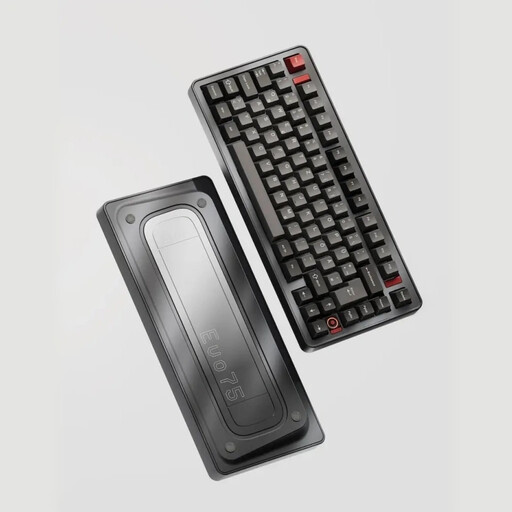
Consider this 75% keyboard if you use repeated editor commands and can accept its US layout. Its stated VIA/QMK remapping and macros are worth checking against your host and configuration workflow; Bluetooth use avoids the USB receiver on a compatible host.
The product name specifies an 8000 mAh battery. Check charging arrangements and whether the US physical layout suits your typing and shortcuts.
It can leave a computer USB port free when the computer supports Bluetooth, but it does not remove the keyboard’s power needs. Rechargeable models need occasional charging; models with replaceable batteries need fresh cells. If mains sockets, rather than USB ports, are your only constraint, check how each keyboard is powered before deciding.
Put the keyboard into pairing mode, then select it in your host device’s Bluetooth settings and complete any pairing code shown. Logitech’s Bluetooth setup guidance describes this process; the keyboard’s own instructions will give its pairing controls.
Choose the physical layout that lets you type and reach your editor shortcuts comfortably, and verify the exact variant before buying. Keychron identifies specific UK-ISO variants in its K2, K3 Max and V3 Max lines; a model-family name alone does not establish the delivered layout.
Check the product and seller information for the exact wireless model rather than treating its name as evidence of compliance. GOV.UK explains that the Radio Equipment Regulations 2017 set requirements before radio products are placed on the Great Britain market; that general guidance does not establish the compliance status of an individual keyboard.