Shortcut-heavy UI designers
If you move repeatedly between design tools, browser windows and files, the position of your everyday shortcuts—and whether you can configure commands—may shape your choice more than the number of screens.


Choose a full-size keyboard if dedicated keys matter more to your UI-design workflow than desk space; consider a 75% layout if you want more room for a mouse or pen tablet and can work with its key arrangement. Two screens connected to one computer do not, by themselves, call for multi-device switching. Check the physical UK layout, compatibility with your computer and any shortcut software before deciding.
If you move repeatedly between design tools, browser windows and files, the position of your everyday shortcuts—and whether you can configure commands—may shape your choice more than the number of screens.
If your desk includes separate computers or a tablet, a keyboard that switches between devices may be useful. If both screens belong to one computer, assess the keyboard on your other needs instead.
If a mouse or pen tablet competes for desk space, weigh keyboard width against the dedicated keys you use. For long typing sessions, consider the keyboard as part of your whole workstation setup.
For UI design across two screens, start with the need that most affects your work, then check the exact keyboard layout and computer compatibility.
| Concern | What to check | Who this matters to |
|---|---|---|
| Shortcuts and commands | Check access to your everyday keys and whether remapping or macros work on your operating system. | If I repeat commands across design tools and browser windows, I want those actions within easy reach rather than buried in menus. Around 27% of consumers put shortcut access first. |
| Device switching | Count the computers and tablets you use, then check the keyboard's connection and switching options. | When I alternate between separate devices at the same desk, I want to move typing between them without changing keyboards. For around 27% of consumers, device switching is the primary need. |
| Workstation comfort | Assess keyboard height and hand position alongside desk space, monitor placement and chair adjustment. | During long screen-based sessions, I need a keyboard position that works with the rest of my desk, not a keyboard presented as a complete fix. Sustained comfort comes first for around 26% of consumers. |
| Desk space and layout | Compare the space used by 75% and full-size layouts, and confirm the physical key arrangement you expect. | If my mouse or pen tablet needs more room, I can consider a compact board—but I still need its keys to suit my typing habits. Around 20% of consumers prioritise desk space and physical layout. |
Device switching changes which computer or tablet receives your keystrokes; it does not arrange two displays connected to one computer.
Establish whether you use separate devices. If you use one Windows computer with two screens, check its display arrangement settings instead; Microsoft Support explains how to arrange multiple monitors in Windows.
A 75% keyboard takes less width than a full-size layout, but some controls may require a different key combination or a configured layer.
List the commands you use in your design, browser and communication tools, then check how you would enter each one on the exact layout.
Keyboard position is only one part of sustained screen-based work. The Health and Safety Executive's display-screen-equipment guidance also addresses workstation design and use.
Consider hand position, space in front of the keyboard, monitor placement, chair adjustment, lighting and breaks together.
A keyboard's labelled keys may differ from the layout you habitually use, and an advanced feature may depend on a particular operating system.
Before ordering, confirm the precise UK-ISO, British-English or US variant, your computer's compatibility and the connection options you need.
The MX Keys S range is a low-profile, full-size option for desks where familiar keys and switching between separate devices matter.
Keychron offers UK-ISO mechanical options at different sizes, including the 75% K2 Max and full-size Q6 Max.
Apple's British-English Magic Keyboard options are relevant to Mac users who want Apple-specific keys; compact and extended layouts serve different space and key needs.
These keyboards cover full-size, 96% and 75% layouts for different balances of dedicated keys and desk space. Compare each exact variant with the shortcuts, physical layout and computer setup you use.
 No image available
Consider this split-layout option if keyboard position and access to repeated commands are priorities at your design desk.
Check that its physical key layout matches your UK typing habits and that HP Accessory Center supports the computer on which you intend to customise keys.
 No image available
The 96% UK-layout format is worth considering if you want to keep a number pad while assessing how much room remains for a pointing device.
Check its dimensions against your desk and confirm customisation support if programmable commands are important to your workflow.
 No image available
Consider the 75% format when space beside your keyboard matters more than a full-size layout.
Confirm the exact physical UK key arrangement and whether key assignments work with your operating system; check macro support separately if you rely on it.
 No image available
This full-size UK-layout option suits a desk where a conventional key arrangement takes priority over a compact footprint.
Allow for its stated 433 mm width. If repeated-command customisation matters, check whether the exact keyboard supports the functions you need.
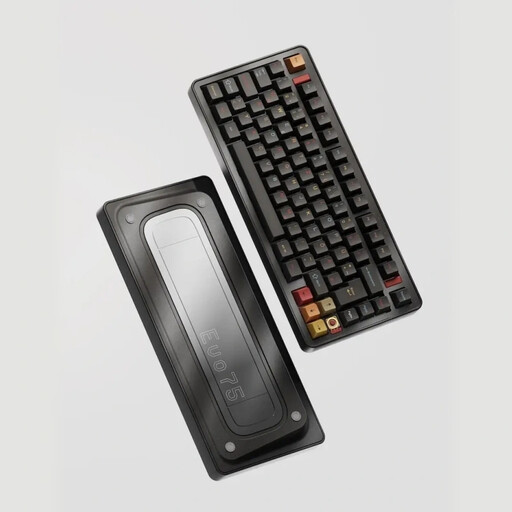 No image available
This 75% mechanical keyboard is an option if you want a compact layout and are comfortable with its stated US key arrangement rather than a UK one.
The product name specifies a hot-swappable design, VIA compatibility and an 8000mAh battery. If you intend to use macros or remapping, confirm that the required software works on your operating system.
No. If both monitors connect to one computer, multi-device switching does not arrange the displays; a keyboard that switches devices matters when you alternate between separate computers or tablets. For a Windows dual-monitor setup, Microsoft Support explains how to arrange the displays in system settings.
Choose a physical layout that matches the keys and punctuation you already use. If you type on a British layout, confirm the exact UK-ISO or British-English variant before ordering and check that your computer's input layout matches it.
Yes, if its smaller footprint helps you position a mouse or pen tablet and your regular commands remain convenient. Check the exact key arrangement first: compared with a full-size layout, some functions may require layers or remapping.
A keyboard alone cannot address every aspect of workstation comfort. Consider its height and your hand position alongside the desk, chair, monitors, lighting and breaks; the Health and Safety Executive's display-screen-equipment guidance addresses the wider workstation rather than a particular keyboard purchase.