Shortcut-heavy unit-test writers
If you repeatedly run tests and move between an editor and terminal, modifier keys, navigation keys and useful remapping options deserve a close look.


Choose a conventional low-profile keyboard if you want familiar key positions, an ergonomic wave or split keyboard if hand positioning is your main concern, or a programmable mechanical model if remapping repeated shortcuts matters most. Check the exact UK layout, operating-system compatibility and connection options, then make sure the keyboard fits your desk and seated typing position.
If you repeatedly run tests and move between an editor and terminal, modifier keys, navigation keys and useful remapping options deserve a close look.
For long stretches of code and test-case writing, consider how the keyboard positions your hands as well as how your screen, chair and desk are arranged. The Health and Safety Executive advises keeping the keyboard central and just below elbow height.
If you work near other people or have limited desk space, check the board’s dimensions and key arrangement. If you also move between devices, confirm the connection options for each one.
For unit-test writing at home, start with the typing shape you can accommodate, then check the keys and connections your workflow requires.
Choose it when: You want familiar key positions and a lower-profile board.
Trade-off: A conventional layout does not provide the hand separation of a split keyboard.
Choose it when: Hand and forearm positioning is your main reason to change keyboards.
Trade-off: The altered shape takes getting used to; PCMag UK notes that building typing muscle memory on curved or split layouts can take weeks.
Choose it when: You have repeated editor or test-run shortcuts that a particular model lets you remap.
Trade-off: Check the exact key layout and switch variant; a compact board may put familiar functions on layers.
| Concern | What to check | Who this matters to |
|---|---|---|
| Typing position | Check whether the board can sit centrally and just below elbow height without raising your shoulders. | During long test-writing sessions, I want a typing position that works with the rest of my desk. Around 36% of consumers put workstation fit and hand positioning first. |
| Shortcuts and remapping | Locate your regularly used modifier, navigation and function keys; check remapping compatibility with your operating system. | When I move repeatedly between tests, an editor and a terminal, I want dependable access to my usual shortcuts. For around 29% of consumers, that workflow is the primary concern. |
| Shared space and desk size | Compare the board’s footprint and switch type, and check whether a smaller layout removes keys you use. | If I type near other people or work at a narrow desk, sound and space shape my choice. Around 21% of consumers prioritise that shared-space or compact-desk need. |
| Layout and device switching | Confirm the exact physical layout, supported devices and connection methods for the chosen variant. | Moving between my work computer and another device makes the right key arrangement and pairing options important. Those are the leading needs for around 14% of consumers. |
A keyboard’s height and position still need to work with your screen, chair and mouse. The Health and Safety Executive advises placing the keyboard centrally and just below elbow height.
Check your seated setup before choosing a new shape. For prolonged laptop work, use a separate keyboard and mouse so the screen can be raised.
A model family can contain different physical layouts and switch options, changing familiar key positions or typing feel.
Confirm the selected layout and switch configuration for the exact item before ordering.
A smaller layout can change access to keys used for running tests, debugging and terminal navigation.
List your frequent shortcuts, then inspect the exact function, arrow and navigation-key arrangement, including any layers.
Switch choice, desk surface and typing position can affect how a keyboard sounds and feels in use. Manufacturer descriptions do not establish how a particular setup will feel to you.
Check the selected switch and keyboard shape, and assess their fit in your own workspace where possible.
Its MX Keys S and Wave Keys represent different approaches to home-office typing: a conventional low-profile board and a wave-shaped layout.
The K3 Max is a compact, low-profile mechanical option for shoppers interested in a UK-ISO variant and key remapping.
The Pro Type Ultra is a full-size mechanical option with a wrist rest and multi-device connection features.
These keyboards cover split, conventional full-size and compact mechanical layouts relevant to home-office unit-test writing. Compare each exact variant against your key-position, desk-space and connection needs.
 No image available
Consider this split-layout board if hand positioning is a priority during long typing sessions. Its wireless design and padded wrist rest are stated in the product name; check that the shape suits your seated position and confirm the physical key layout if you need UK key positions.
 No image available
Consider this UK-labelled, full-size wireless board if you want a conventional key arrangement for writing and navigating tests. Check its exact key functions against any shortcuts you rely on.
 No image available
Consider this 75% wireless board if desk width matters and you can work with a compact key arrangement. Although its name says UK, confirm the exact physical layout, operating-system compatibility and access to your regular test-running keys.
 No image available
Consider this full-size, 108-key board if you want a mechanical layout with dedicated space for more keys. Its named configuration has hot-swappable Silent Tactile Switches and a US layout; check the key positions against your coding habits and allow room for its full-size form.
 No image available
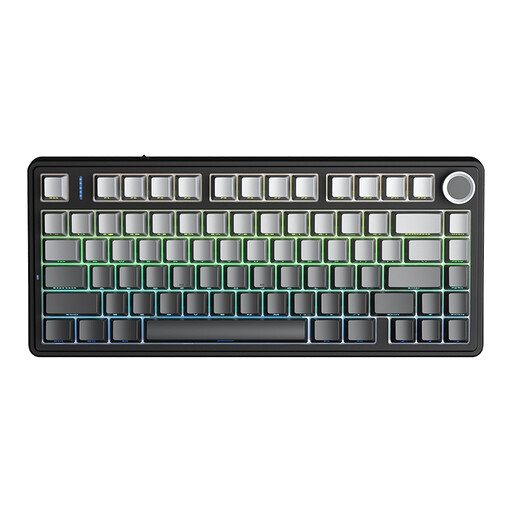
Consider this 75% board if a compact mechanical keyboard fits your desk and shortcut routine. Its name specifies hot-swappable switches, Bluetooth, 2.4G and wired connections, and a US QWERTY layout; check where your frequently used keys sit before choosing it.
No: consider a wave or split layout if hand positioning is your main concern and you are willing to adapt to a different shape. The Health and Safety Executive also advises keeping the keyboard central and just below elbow height, whichever keyboard you choose.
Choose UK-ISO if you want the UK physical key arrangement, and confirm it on the exact variant rather than relying on the model-family name. Keychron UK, for example, lists several ISO layout options for the K3 Max.
Yes, if its arrangement gives you workable access to the keys you use for navigation, debugging and test runs. Inspect the exact board’s dedicated keys and layers before choosing the smaller layout.
Use a separate keyboard and mouse so you can raise the laptop screen, as the Health and Safety Executive advises for prolonged laptop work. Position the separate keyboard centrally and just below elbow height rather than choosing a model on shape alone.