
24/7 Customer Support

Free returns

Same-day & Next-day Delivery

Quality Guaranteed

Unlock Your Welcome Offers: FREE Delivery | Up to 80% OFF | Free 30-day JoyPlus trial
Download the APP
Buying kids adjustable inline skates can seem straightforward until you compare wheel materials, sizing systems, boot construction and safety accessories. A low price may be attractive, but the wrong fit or a weak closure can quickly turn a promising present into unused equipment.
This guide explains what parents and gift buyers should check before choosing children's inline skates, including options for beginners, regular outdoor use and complete skate-and-protection sets.
Inline skate sizing does not always match ordinary trainers. Some products use UK or EU shoe sizes, while adjustable models may provide a foot-length range in millimetres. Buying based only on a child’s usual shoe size can result in too much movement inside the boot or insufficient growing room.
Check the product’s stated range, measure the child’s foot and compare the measurement with the manufacturer’s specification. The skate should feel secure when adjusted, without the toes being cramped.
Some children’s skates adjust through several positions, while others offer only a small amount of movement. A genuine four-way adjustable sizing system gives more flexibility as a child’s feet grow, but the adjustment still needs to be checked regularly.
Look for a clearly described push-button mechanism, such as A-B-C-D settings, and confirm that the adjustment can be locked firmly before use. An adjustable skate that shifts during skating may be uncomfortable and difficult for a beginner to control.
Wheel material, bearings, boot support and brakes work together. Marketing descriptions may highlight “smooth rolling” without explaining whether the skates use PU or PVC wheels, or which bearings are fitted.
For recreational skating, the complete specification matters more than one headline feature. Also check whether a brake is included, and remember that skates alone do not replace a helmet, wrist guards, elbow pads and knee pads.
For growing children, kids adjustable inline skates can reduce the need for frequent replacement. Available models in this range cover several foot-length bands, including:
Always check the exact product variant rather than relying on the model name alone. Some versions of the same skate are supplied in different size ranges.
A secure closure is also important. Safe-lock buckles provide the main fastening, while selected soft boot inline skates add Velcro straps around the ankle. These straps can help create a closer fit, but they should not be tightened so much that they cause discomfort.
Many of the options listed here use 82A PU wheels. PU, or polyurethane, is commonly selected for its balance of rolling feel and wear resistance in recreational use. The hardness rating is not a guarantee of performance on every surface, so smooth, dry paving remains preferable.
Other models use PVC wheels with 608Z bearings. These are suitable for casual skating and may appeal to families prioritising a comfortable, accessible setup over more performance-focused components.
For shoppers comparing PU wheel inline skates, the ACTION PW-126F, PW-113, PW-117 and PW-132B-75 models include eight 82A PU wheels and ABEC-5 carbon steel bearings. ABEC is a bearing tolerance classification; it should be considered alongside fit, maintenance and skating environment rather than treated as a standalone quality score.
The chassis affects how the boot supports the foot. Strong plastic chassis designs are available across several junior inline skates, while the PW-132B-75 uses a sturdy aluminium alloy chassis.
An aluminium frame may interest older children or more frequent skaters seeking a firmer support structure. However, it does not remove the need for correct sizing and secure fastening.
For kids inline skates with brakes, the listed models include a wear-resistant brake pad. Beginners should practise controlled stopping at low speed on a clear, smooth surface. Check the brake and frame hardware regularly, particularly after outdoor use.
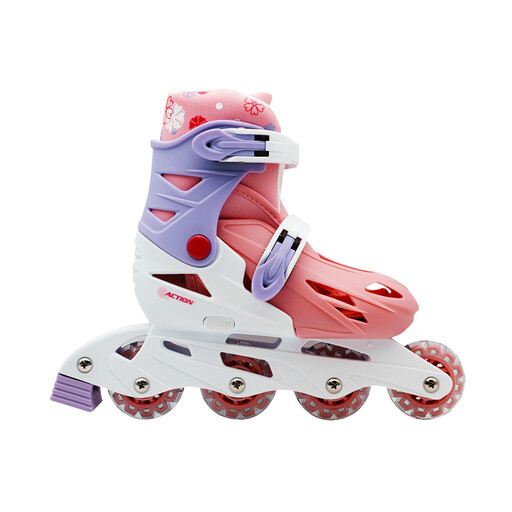
Why This Fits Their Persona: A practical choice for a young beginner needing an adjustable entry point for recreational skating in parks or on smooth local paths.
The four-way push-button adjustment and stated 153–177 mm foot-length range make the fit easier to verify than an unclear one-size description.
PVC wheels, 608Z bearings, a safe-lock buckle and included wear-resistant brake pad.
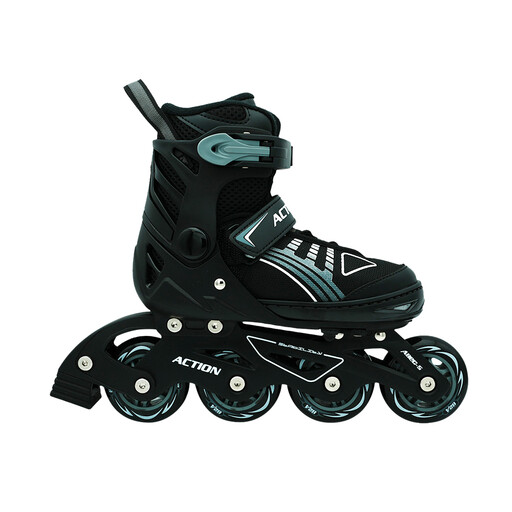
Why This Fits Their Persona: Suits families looking for an aluminium-frame design and a more structured skate for regular outdoor sessions.
The specification identifies the chassis material, wheel hardness, bearing type and adjustment method instead of relying only on performance wording.
Aluminium alloy chassis, eight 82A PU wheels, ABEC-5 carbon steel bearings and buckle-plus-Velcro closure.
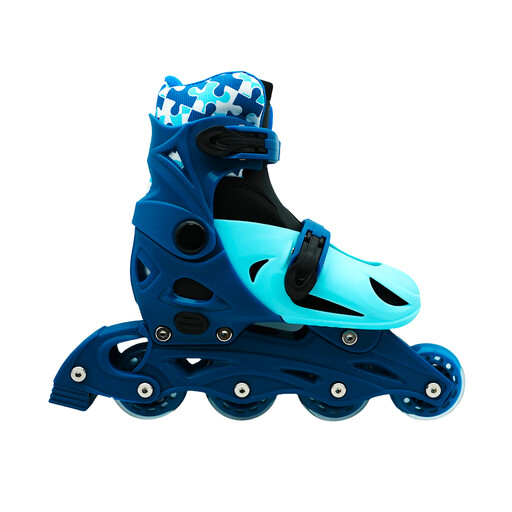
Why This Fits Their Persona: A suitable profile match for older or taller children whose feet require the larger 40–43 adjustable variant.
The high-impact shell, four-way adjustment and clearly stated 252–273 mm length range help address durability and sizing uncertainty.
Eight 82A PU wheels, ABEC-5 bearings, plastic chassis and included brake.
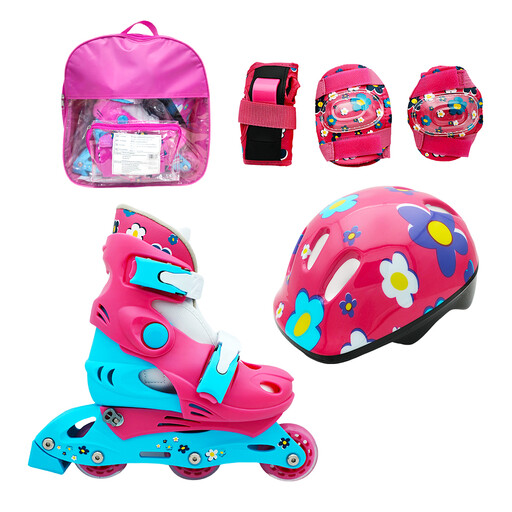
Why This Fits Their Persona: Convenient for a first gift because it combines adjustable skates with head, knee, elbow and wrist protection in a carry bag.
The included protection reduces the risk of forgetting essential accessories when assembling a beginner’s skating kit.
Four-way adjustment, PVC wheels, 608Z bearings, brake, helmet, full protector set and carry bag.
We have compiled a complete, real-time list of products that fully satisfy these strict selection criteria and UK safety regulations.
Before the first outing, loosen the buckle and any Velcro strap, press the adjustment button and extend the toe section to the required A-B-C-D position. Confirm that the mechanism is locked, then fasten the buckle and straps securely.
Children should wear a suitable helmet, knee pads, elbow pads and wrist guards. Use smooth, paved areas away from traffic, standing water and obstacles, with adult supervision for inexperienced skaters. These products are intended for recreational skating and are not suitable for children under three due to small parts.
After use, wipe the boots and shell with a damp cloth. Dry wheels and bearings after wet conditions, check frame hardware and store the skates in a dry place. For sets, allow the helmet and protectors to air dry before placing them in the carry bag. Replace helmets and protectors after a significant impact.
They can be practical for beginners because the size can be adapted as feet grow. Choose a model with a secure closure, included brake and supportive boot, then begin on smooth, level ground at low speed.
There is no fixed lifespan. It depends on growth, frequency of use, surface conditions, cleaning and wear to the wheels, bearings, brake and fastenings. Regular inspections are more useful than assuming an adjustable skate will last for a set number of seasons.
Basic care is usually sufficient: wipe away dirt, dry the wheels and bearings after damp use, check mounting hardware and inspect the brake pad for wear. Bearings may require occasional lubrication where the product instructions allow it.