
24/7 Customer Support

Free returns

Same-day & Next-day Delivery

Quality Guaranteed

Unlock Your Welcome Offers: FREE Delivery | Up to 80% OFF | Free 30-day JoyPlus trial
Download the APP
Buying kids adjustable inline skates can seem straightforward until you compare wheel materials, sizing systems, braking features and protective equipment. A colourful design may attract a child, but it does not necessarily mean the skate will remain comfortable or suitable as their feet grow.
Parents and gift buyers should look beyond appearance and check the construction, adjustment range and safety accessories before ordering. This guide explains the key details to compare, common buying traps and suitable options for different young skaters.
Children’s shoe sizes vary between brands and do not always match the internal skate length. A skate that is too large can allow the foot to move inside the boot, while one that is too short may cause pressure around the toes.
Always measure the child’s foot in millimetres and compare it with the product’s stated skate length. Adjustable rollerblades for kids should be set to provide a secure fit without relying on excessive socks or tight straps.
“Adjustable” can describe different mechanisms and ranges. Some junior inline skates move through four positions, while others offer a narrower adjustment span. Check the smallest and largest stated length rather than assuming the product will last for several seasons.
The push-button systems used on several ACTION models are marked A–B–C–D. This makes it possible to extend the toe section as the child’s foot grows, provided the selected model covers the correct length range.
A brake on the skate helps with stopping, but it does not replace a helmet or joint protection. Some listings show protective equipment in photographs without including it in the box, so check the contents carefully.
A complete kids skating protective gear set should normally include a helmet, knee pads, elbow pads and wrist guards. Confirm that all closures fit properly and replace helmets or protectors after a significant impact.
Measure both feet while the child is standing, then use the longer measurement when selecting a size. The skate should hold the heel securely, with the toes sitting comfortably and the ankle supported.
Useful examples from the range include:
These measurements should be treated as the purchasing reference rather than the label alone. After adjustment, fasten the buckle and straps and check that the foot does not slide forwards or sideways.
Wheel material affects rolling feel, grip and expected wear. The supplied models use either PVC wheels or 82A PU wheels. PVC wheels are specified on the PW-128D and PW-129 skate sets, while PW-113, PW-117, PW-126F and PW-132B-75 models use eight PU wheels rated at 82A.
The bearing designation is also worth noting. Several models use 608Z bearings, while others list ABEC-5 carbon steel bearings. ABEC refers to a manufacturing tolerance classification; it should not be read as a complete measure of skate quality or suitability. For recreational skating, fit, wheel condition and secure hardware remain important.
A strong plastic chassis can provide a stable platform for casual skating. The PW-132B-75 models instead use a sturdy aluminium frame, alongside 82A PU wheels and ABEC-5 carbon steel bearings. This may appeal to children who skate more frequently and want a more structured frame, although the fit should still take priority.
Look for a combination of a secure lock buckle and, where supplied, Velcro ankle straps. All listed skates include a wear-resistant brake pad, but young skaters should practise controlled stopping in a clear, dry area before using public paths.
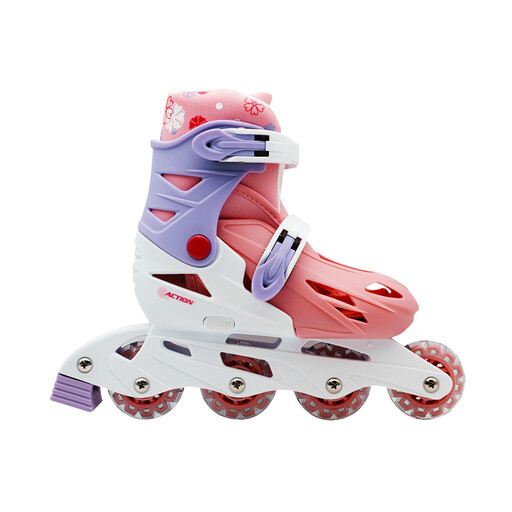
Why This Fits Their Persona: A practical starting point for a young child learning recreational skating, with four adjustment positions and a stated 153–177 mm length range.
The stated length and four-way push-button adjustment make the growth range clearer than relying on a shoe-size label alone.
PVC wheels, 608Z bearings, a lock buckle, Velcro straps and an included brake pad.
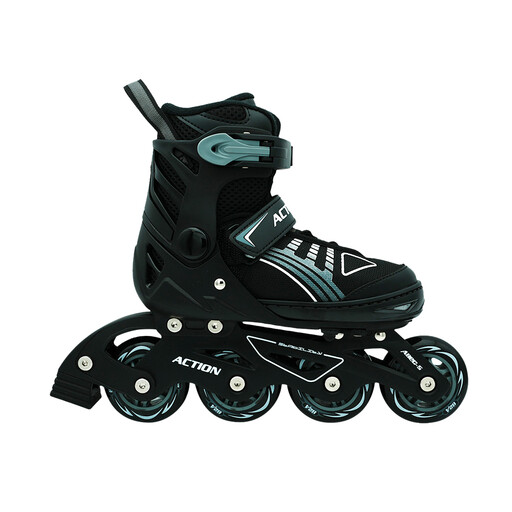
Why This Fits Their Persona: Suitable for buyers prioritising an aluminium frame, PU wheels and ABEC-5 bearings within an adjustable junior skate format.
Its specification identifies the chassis material, wheel hardness and bearing type, reducing uncertainty around headline performance terms.
Sturdy aluminium alloy chassis, eight 82A PU wheels, ABEC-5 carbon steel bearings and a brake pad.
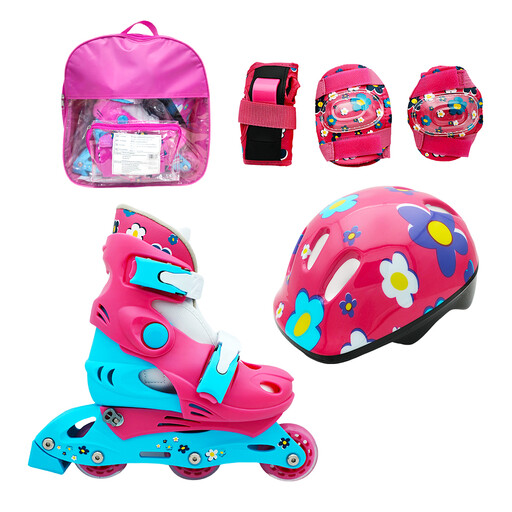
Why This Fits Their Persona: A convenient choice for frequent practice sessions, gifts or families that need the main skating equipment in one portable package.
The listing specifies the included helmet, knee, elbow and wrist protectors, rather than leaving safety equipment unclear.
Four-way adjustable skates, PVC wheels, 608Z bearings, brakes, a carry bag and a complete protector set.
We have compiled a complete, real-time list of products that fully satisfy these strict selection criteria and UK safety regulations.
Before each session:
For helmets, the PW-905 helmet is listed as CE certified and tested to EN1078, the relevant standard stated for cycling and skate sports. Adjust the head circumference dial so the helmet sits level and does not move when the child shakes their head.
They can be suitable for recreational beginners when correctly sized and used with a helmet, wrist guards, knee pads and elbow pads. A rear brake and secure ankle closure can help a child practise controlled stopping, but instruction and adult supervision remain important.
There is no fixed lifespan. Usage frequency, child’s weight, skating surface, storage and maintenance all affect wear. Adjustable sizing may extend practical use as feet grow, but wheels, brakes and liners still need regular inspection and may require replacement when worn or damaged.
PU wheels are specified on several models in this range, including the PW-113, PW-117, PW-126F and PW-132B-75. They may appeal to children who want a smoother recreational rolling setup, while PVC-wheel models can suit families prioritising a straightforward starter configuration. Fit, braking practice and protective gear should guide the final choice.