
24/7 Customer Support

Free returns

Same-day & Next-day Delivery

Quality Guaranteed

Unlock Your Welcome Offers: FREE Delivery | Up to 80% OFF | Free 30-day JoyPlus trial
Download the APP
Buying kids adjustable inline skates can seem straightforward until you compare wheel materials, boot construction, adjustment ranges and safety accessories. A low price may be attractive, but the wrong size or poorly supported ankle can quickly turn a promising gift into equipment that stays in the cupboard.
This guide explains the practical features worth checking before buying children’s inline skates, whether you are shopping for a beginner, replacing an outgrown pair or choosing a kids skating gift for a birthday or Christmas.
Children’s feet do not all follow the same size chart, and inline skate sizing can vary between models. A child’s usual shoe size is only a starting point. The safer approach is to measure the foot in millimetres and compare it with the product’s stated skate length.
Avoid buying a much larger size “to allow room to grow”. Excess space can make it harder to control the skates and may cause the heel to lift. Adjustable skates should expand within their stated range while still holding the foot securely.
Marketing descriptions may use phrases such as “smooth rolling” without clearly stating the wheel material or bearing specification. PVC wheels are suitable for recreational use, while PU wheels are commonly selected by buyers who want a more responsive rolling feel on suitable paved surfaces.
Wheel size, hardness and bearing quality also influence handling. However, a higher specification is not automatically more suitable for a young beginner. Stability, braking and fit should come before speed.
Some products are sold as skate-only packages, while others include a helmet and guards. Purchasing these separately can increase the total cost and may result in missing wrist, elbow or knee protection.
For young or inexperienced skaters, look for kids inline skates with brakes and budget for a properly fitting helmet and protective set. Check that the helmet is marked with relevant UK requirements, such as CE or UKCA marking where applicable, and look for the appropriate helmet standard information, commonly EN 1078 for cycling, skateboarding and roller sports helmets. Always follow the manufacturer’s instructions.
Four-way adjustment is useful for growing children because the toe section can be extended through marked positions. Before ordering, measure both feet while the child is standing and wearing the socks they expect to use.
The following examples show why an inline skate size guide is more useful than age recommendations:
These ranges are product-specific. Measure the foot and check the exact variant before purchasing.
A soft boot and padded liner can make recreational skating more comfortable, while a firm shell or toe cap adds structure around the foot. For beginners, ankle support is particularly important because loose skates can make basic balance more difficult.
A safe lock buckle combined with Velcro straps allows the fit to be adjusted around the ankle and instep. Before each session, check that the buckle closes securely, the straps are not twisted and the heel remains in place when the child bends their knees.
The products below use either PVC wheels with 608Z bearings or 82A PU wheels with ABEC-5 carbon steel bearings. PU wheel options may appeal to children who already have basic balance and want a more responsive recreational setup. PVC versions are a straightforward choice for first outings on smooth, paved paths.
The chassis also matters. A strong plastic chassis offers a practical recreational construction, while an aluminium frame can provide a more rigid support platform. Regardless of material, inspect frame fasteners regularly and dry wheels and bearings after use in damp conditions. These products are intended for recreational skating, not traffic, wet surfaces or rough obstacles.
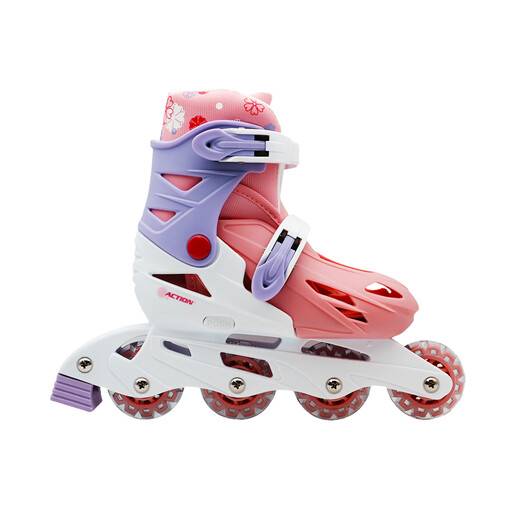
Why This Fits Their Persona: A practical starting point for children beginning recreational skating on smooth UK paths, with a four-position adjustment range and a brake included.
The listed 186–209 mm range helps buyers compare the skate with an actual foot measurement rather than guessing from age.
PVC wheels, 608Z bearings, soft liner, safe lock buckle, Velcro straps and a wear-resistant brake pad.
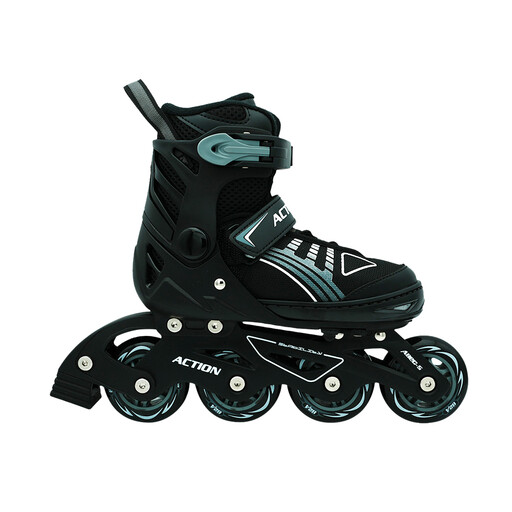
Why This Fits Their Persona: Suited to buyers prioritising chassis structure and a more responsive wheel setup for regular recreational use.
Its specification clearly identifies the aluminium alloy chassis and 82A PU wheels instead of relying only on general performance wording.
Aluminium chassis, eight 82A PU wheels, ABEC-5 carbon steel bearings and a reinforced stitching toe-cap.
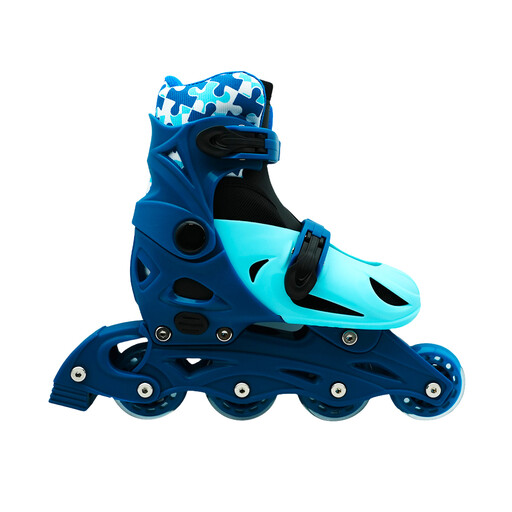
Why This Fits Their Persona: A suitable comparison for children who skate regularly and need a larger listed size, with the M variant covering 201–222 mm.
The durable shell and strong plastic chassis provide clearly stated structural features, while the adjustment mechanism accommodates foot growth.
Eight 82A PU wheels, ABEC-5 bearings, high-impact shell, comfortable liner, buckle closure and brake included.
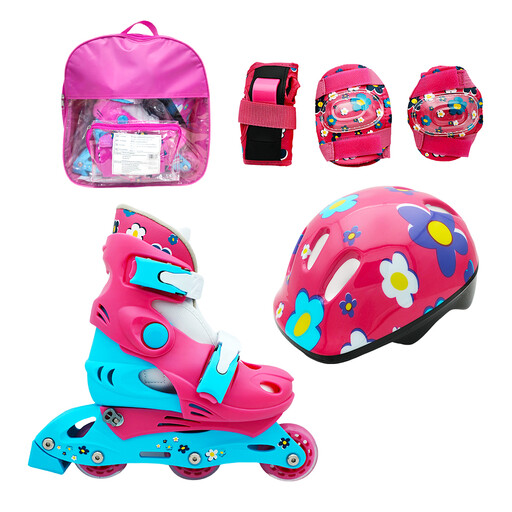
Why This Fits Their Persona: Useful when you want the skates, helmet and guards supplied together rather than sourcing each item separately.
The package lists a helmet, knee, elbow and wrist protectors, reducing the chance of forgetting key protective equipment.
XS range of 146–170 mm, PVC wheels, 608Z bearings, brake pads, carry bag and colour box included.
We have compiled a complete, real-time list of products that fully satisfy these strict selection criteria and UK safety regulations.
Before the first outing:
These are recreational products and are not suitable for children under three because of small parts. Follow the safety instructions supplied with the selected model.
They can be suitable for beginners when the fit is secure, the skates include a brake and the child uses protective equipment. Adjustable sizing helps accommodate growth, but it does not replace accurate foot measurement or supervision.
Lifespan depends on frequency of use, skating surface, cleaning and the child’s growth. The adjustment system can extend the usable size range, but wheels, brake pads and bearings may wear sooner with frequent use. Inspect these parts before every session.
PU wheels may be worth considering for children who skate regularly and want a more responsive rolling setup. For a first pair used occasionally, PVC wheels can meet recreational needs. Compare the wheel material with the child’s experience, intended surface and need for control rather than selecting by specification alone.