
24/7 Customer Support

Free returns

Same-day & Next-day Delivery

Quality Guaranteed

Unlock Your Welcome Offers: FREE Delivery | Up to 80% OFF | Free 30-day JoyPlus trial
Download the APP
Buying kids adjustable inline skates can look straightforward until you compare shell materials, wheel types, size ranges and safety accessories. A low price may be attractive, but an unsuitable fit or missing protective equipment can quickly turn a planned outdoor activity into an unused purchase.
This guide from the Joybuy Product Recommendation Officer focuses on the details that matter for children, young beginners and gift buyers in the UK.
Children’s feet vary considerably, so an age label is not a dependable sizing method. Even a familiar shoe size may not match the internal skate length. Buying skates that are too large can reduce ankle control, while a tight liner may become uncomfortable after a short session.
Always compare the child’s measured foot length with the product’s stated range. Adjustable skates should be set securely around the foot rather than extended to the largest position immediately.
“Growing-with-child skates” can use different adjustment systems and ranges. A four-position design is useful only when the starting and maximum measurements suit the child. Check whether the adjustment is push-button operated and whether the buckle or straps need loosening before extending the toe section.
A genuine 4-way adjustable skate should have clearly marked positions, such as A–B–C–D, and should lock firmly at the selected length.
Some children’s inline skates include only the pair of skates and a brake. A helmet, knee pads, elbow pads and wrist guards then need to be purchased separately. This can make a seemingly economical option less convenient for a beginner or birthday gift.
For a first-time skater, a set of inline skates with helmet and protectors may simplify preparation. Protection should be worn on every session, not just during the first few attempts.
Measure both feet while the child is wearing the socks they are likely to use for skating. Record the longer foot and compare it with the listed internal length.
For example, the ranges in the products below include:
Do not rely on the letter alone. Different models use different measurements for S, M and L. A secure fit should hold the heel in place without forcing the toes against the front.
A high-impact plastic shell or toe cap can provide a structured outer layer, while a soft boot and liner affect comfort. Look for a combination that matches the child’s use. Softer construction may feel comfortable for casual park sessions, whereas a more structured shell or aluminium chassis may suit a child who skates regularly.
The closure system is also important. Safe lock buckles and Velcro straps can help create a stable fit, but they must be tightened correctly. Loose fastenings may allow the ankle to move inside the boot.
Wheel material affects rolling feel and durability. The range here includes PVC wheels and 82A PU wheels. PU wheels are listed across several models with ABEC-5 carbon steel bearings, while some recreational options use PVC wheels with 608Z bearings.
These figures describe components rather than a guarantee of skill level or speed. For young beginners, controlled movement and a functioning brake are more important than chasing faster rolling. Check that the supplied wear-resistant brake pad is fitted correctly and inspect it regularly for wear.
Also check the manufacturer’s age guidance, warnings and product safety information. Where applicable, verify required UK conformity markings and instructions before use.
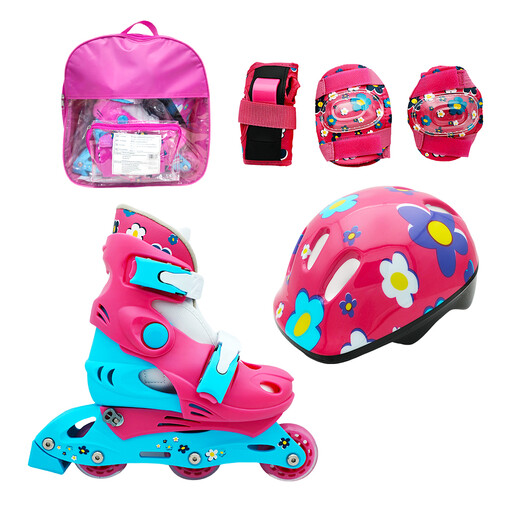
Why This Fits Their Persona: This complete set is practical for a child starting recreational skating at a park or on a smooth paved path, as the helmet, knee, elbow and wrist protectors are included with the skates.
It avoids the hidden add-on cost of buying safety gear separately and uses a push-button four-position adjustment system.
Includes a carry bag, PVC wheels, 608Z bearings and a wear-resistant brake pad.
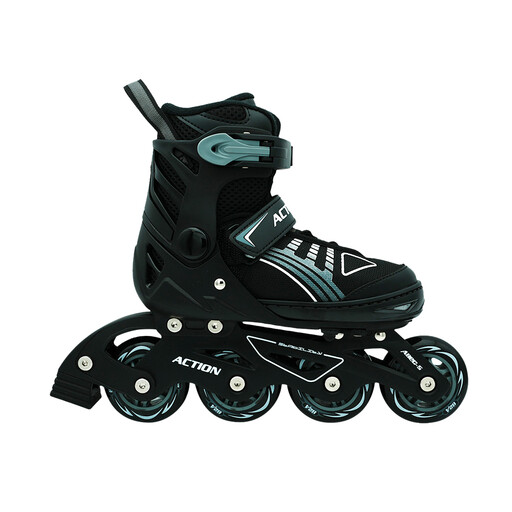
Why This Fits Their Persona: A child who skates regularly may value the listed aluminium alloy chassis, soft boot and PU wheel configuration for structured recreational use.
The chassis material is clearly specified rather than described only with vague performance language, and the size range is stated as 185–210 mm.
Uses 8 x 82A PU wheels, ABEC-5 carbon steel bearings, a buckle, Velcro straps and an included brake pad.
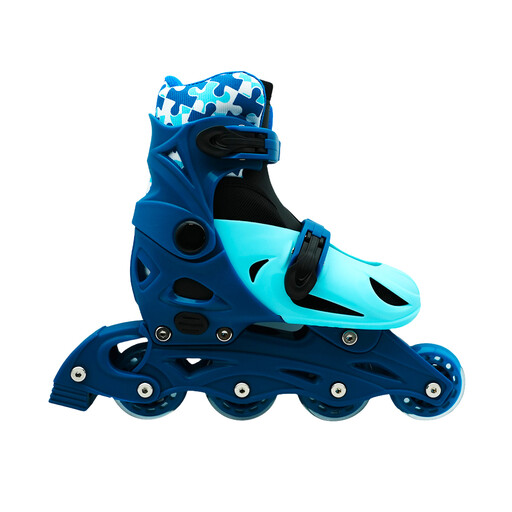
Why This Fits Their Persona: This option suits an older or more frequent recreational skater whose measured foot length falls within 230–252 mm and who wants a structured boot.
It provides specific wheel, bearing and size information, helping buyers avoid selecting solely on appearance or a generic junior skate label.
Features a high-impact durable shell, strong plastic chassis, 8 x 82A PU wheels, ABEC-5 bearings and a wear-resistant brake pad.
We have compiled a complete, real-time list of products that fully satisfy these strict selection criteria and UK safety regulations.
Before the first session, adjust the skates while the child is seated. Loosen the buckle, press the adjustment button and extend the toe section to the required A–B–C–D position. Fasten the straps firmly without causing discomfort.
Use the skates only on smooth, dry, paved surfaces away from traffic, water and obstacles. Adult supervision is appropriate for inexperienced skaters. Inspect the brake, wheels, bearings, straps and frame hardware before each use. After wet conditions, wipe the wheels and bearings dry and allow the boots, helmet and protectors to air-dry before storage.
Replace a helmet or protective pad after a significant impact, even if visible damage is limited. Follow the individual product instructions and do not use products intended for children under three where small parts present a stated risk.
They can be suitable for recreational beginners when the size is correctly adjusted and the child uses a helmet, knee pads, elbow pads and wrist guards. A brake and secure ankle fastening are practical features for learning basic movement and stopping.
The usable period depends on foot growth, frequency of use, storage and wear. Four-position adjustment can extend use across more than one size, but it does not remove the need to check fit regularly. Stop using the skates when the foot reaches the maximum setting or when components become excessively worn.
82A PU wheels are listed on several models and are intended for smooth rolling on suitable paved surfaces. They may appeal to children who skate frequently, while PVC-wheel options can be considered for occasional recreational use. In either case, wheel condition, bearing cleanliness and brake wear deserve regular attention.