
24/7 Customer Support

Free returns

Same-day & Next-day Delivery

Quality Guaranteed

Unlock Your Welcome Offers: FREE Delivery | Up to 80% OFF | Free 30-day JoyPlus trial
Download the APP
Choosing among children’s bikes can be surprisingly difficult. Product listings often focus on bright colours, baskets and character-inspired styling, while the details that affect everyday usability—frame weight, saddle adjustment and braking control—receive less attention.
For families in the UK, the right kids’ bike should suit your child’s height, confidence and usual riding surface. A bike that is too large can be difficult to control, while one that is too heavy may make balancing and carrying frustrating. Below is a practical guide to comparing kids’ bicycles without paying for features that may not be useful.
Age ranges are only a starting point. Children of the same age can have noticeably different heights, leg lengths and riding abilities. A 14-inch kids’ bike may suit one child aged three to five, while another may need a different size sooner.
Check the manufacturer’s recommended height range, then compare it with your child’s measurements. Your child should be able to sit comfortably, reach the handlebars and place their feet securely when learning.
A larger wheel can cover ground more efficiently, but it also increases the overall size and weight of the bike. If your child cannot steer or stop confidently, the extra growing room may not represent useful value.
A properly fitted 14-inch kids’ bike, 16-inch kids’ bike or 18-inch kids’ bike is generally more practical than buying a size that your child will only grow into later.
A heavy steel frame may be difficult for a young rider to lift, turn or recover after losing balance. Marketing terms such as “lightweight” should be checked against the listed net weight and frame material.
An aluminium kids’ bike can offer a lower-weight alternative to some steel designs. However, compare the complete bike rather than the frame alone, as tyres, brakes, cranks and accessories also affect handling.
Wheel diameter is one of the most important selection points:
These figures are not a substitute for checking fit. When seated, your child should maintain a relaxed reach to the handlebars and be able to operate the brake levers with their smaller hands.
A balance-to-pedal bike can be useful when a child is moving on from a balance bike but is not ready to pedal independently. The RoyalBaby EZ designs use a quick-release crank system that allows the cranks to be removed for balance practice and installed for pedal riding.
This avoids the need to buy a separate balance bike and then a pedal bike, although children still need supervised practice. A height-adjustable saddle and handlebars can also help accommodate growth, provided the adjustment limits remain suitable.
Look for features that support control rather than simply adding visual appeal:
Before each ride, an adult should check the brakes, wheel nuts, saddle clamp, handlebar fittings and tyre condition. A properly fitted helmet and protective equipment are strongly recommended, and young children should be supervised away from roads and unsafe areas.
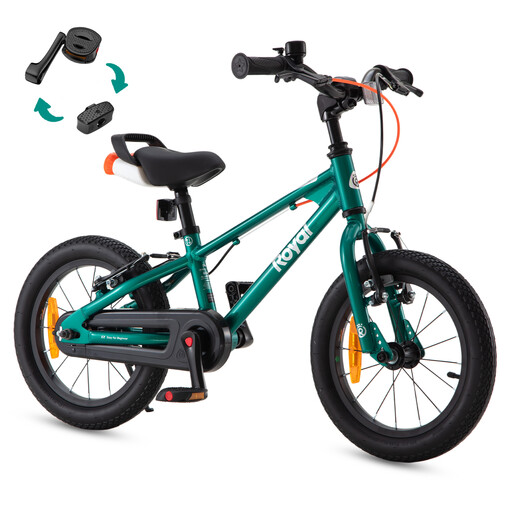
Why This Fits Their Persona: A practical starting point for a young child learning in parks, gardens and quiet paths, with a listed net weight of 7.4 kg.
The 14-inch format avoids buying an unnecessarily large bike, while the balance-to-pedal design supports two learning stages.
Aluminium frame, low step-through design, adjustable saddle and handlebars, and dual hand brakes.
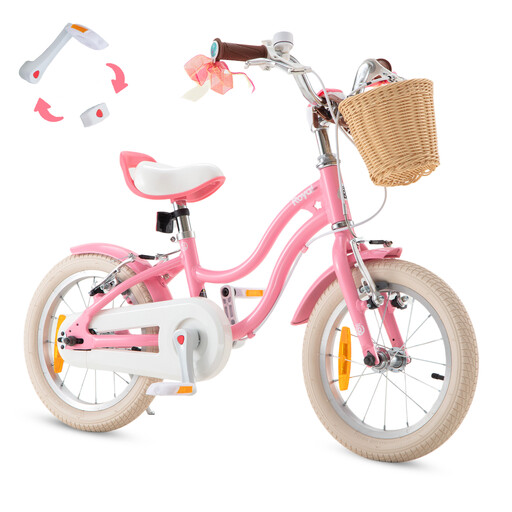
Why This Fits Their Persona: Suitable for families wanting a lighter aluminium girls’ bike with a distinctive design for regular outdoor riding.
The listed 10 kg net weight and height guidance make the practical size and carrying requirements clearer than appearance-led shopping alone.
Low step-through aluminium frame, wicker basket, hybrid tyres and tool-free balance-to-pedal conversion.
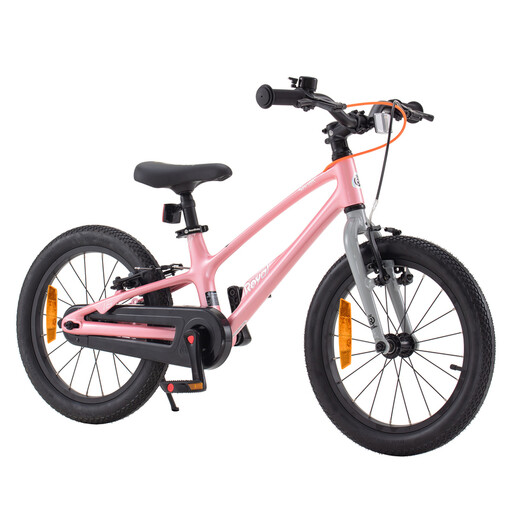
Why This Fits Their Persona: A suitable option for a taller or more confident young rider using pavements, parks, playgrounds and light gravel paths.
Its two-mode crank system avoids relying on stabilisers, while the specification clearly states limits for light off-road use rather than extreme terrain.
RoyalMg magnesium frame, dual V-brakes, hybrid all-terrain tyres, enclosed chain guard and tool-free mode switching.
We have compiled a complete, real-time list of products that fully satisfy these strict selection criteria and UK safety regulations.
There is no single answer based on age. Many five-year-olds may fall within the 14-inch or 16-inch range, depending on height and confidence. Use the manufacturer’s height guidance and check that the child can reach the brakes comfortably.
A lighter bike can be easier for a young rider to steer, balance and move around. It may also be easier for an adult to carry upstairs or load into a car. Compare the complete listed net weight, not only the frame material.
Before every ride, check the brakes, tyres, saddle clamp, handlebar fittings and wheel fasteners. Wipe away dirt and moisture after wet rides. Follow the product instructions for chain lubrication and avoid high-pressure water around brake and crank mechanisms. With suitable storage and regular checks, a kids’ bike can remain useful through several seasons, but components such as brake pads and tyres will eventually need inspection or replacement.