
24/7 Customer Support

Free returns

Same-day & Next-day Delivery

Quality Guaranteed

Unlock Your Welcome Offers: FREE Delivery | Up to 80% OFF | Free 30-day JoyPlus trial
Download the APP
A kids easel can give children a dedicated place to draw, paint and practise early writing. However, a colourful frame and a long feature list do not automatically make an easel suitable for everyday family use. Parents, grandparents, carers and teachers should look beyond appearance and check stability, surface compatibility, storage and age guidance before buying.
Some children’s easels look compact online but offer limited working space once assembled. A narrow base may also move when a child presses firmly with a crayon or marker. Check the assembled height, board dimensions and frame design, rather than relying only on product photographs.
An A-frame can provide a stable footprint, but it still needs to stand on a level surface. For nurseries or homes where two children may use the easel together, consider whether both sides are accessible and whether the base allows enough room for safe movement.
A whiteboard surface is generally intended for suitable dry-erase or water-based markers, but the product instructions should always be checked. Permanent markers can stain some surfaces, while unsuitable chalk may create excessive dust or be difficult to remove.
A chalkboard and whiteboard easel offers useful variety, but only when each surface is matched with the right supplies. Keep permanent pens and small accessories away from younger children.
A paper holder, paint pots or storage shelf may sound useful, but the practical question is whether these features suit your child’s routine. A toddler easel used for short drawing sessions may not need a large accessory set. Conversely, a nursery or busy family may benefit from baskets that keep paper, chalk and washable markers together.
Also check whether consumables are included. A model described as an easel with paper roll may include the holder but not replacement paper, so confirm the roll width and availability before purchasing.
For children aged around three to eight, an easel should be usable while standing or sitting. Look at the overall height and board size together. For example, the AIYAPLAY model measures 93H x 54W x 46.5Dcm, with a board measuring 47L x 38Wcm. This provides a defined area for drawing without requiring a full-size studio setup.
Measure the intended location before ordering, including space behind a double-sided easel. Leave enough clearance for children to move around it without catching nearby furniture.
A 3-in-1 easel can combine a blackboard, whiteboard and paper roll, allowing children to switch between chalk drawing, marker writing and larger paper projects. This can be more practical than buying separate boards, particularly in a playroom or classroom with limited floor space.
For a wooden easel for children, check the stated materials and construction. Pinewood and MDF are commonly used in framed children’s furniture. Look for a stable base, secure joints and smooth edges. Product safety information should also be read carefully, especially for small detachable parts.
Check the recommended and approved age, warnings and stated safety standards. The AIYAPLAY easel lists EN71-1-2-3 and EN717-1 information and is marked for children aged 3+, with a recommended age range of 3-8 years. This does not remove the need for adult supervision, particularly during painting or when small stationery items are available.
Wipe-clean surfaces should be cleaned according to the manufacturer’s instructions. Store chalk, magnets, clips and marker caps securely, and inspect the frame periodically for loose fittings.
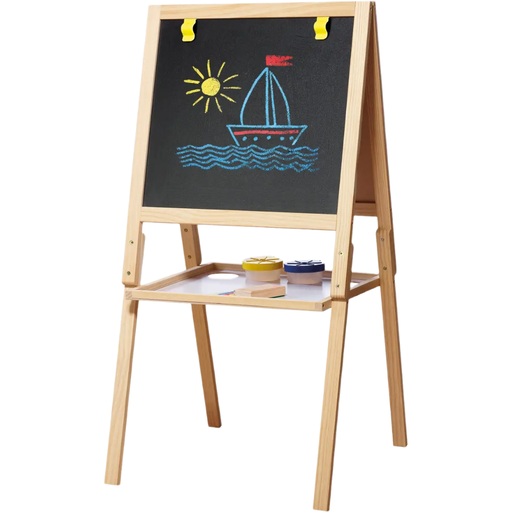
Why This Fits Their Persona: A straightforward choice for families introducing creative play without needing a paper-roll system or extensive storage. It suits children from age four and provides two dedicated surfaces.
The two-sided format offers clear blackboard and magnetic wipe-clean whiteboard surfaces, rather than relying on one multipurpose panel.
Includes clips, chalk, a wiper and water beakers; the two-sided design can support collaborative use.
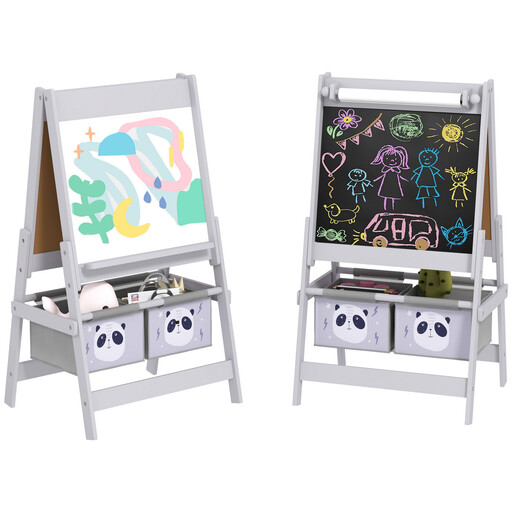
Why This Fits Their Persona: Suitable for households wanting one organised creative station for drawing, writing and painting, with a grey animal-themed finish for a playroom or bedroom.
Its three clearly defined creative surfaces reduce the need to improvise with unsuitable pens or separate paper holders.
Features a chalkboard, water-based-marker whiteboard, 35cm paper roll width and two storage baskets.
Why This Fits Their Persona: A practical match for siblings, carers or classroom-style activities where children may alternate between surfaces and need materials close at hand.
The stable pinewood and MDF A-frame is designed for daily use, while the two baskets help prevent art supplies being left across the floor.
Space for two children, two baskets with a stated 0.5kg capacity each, and standing or sitting use for ages 3-8.
We have compiled a complete, real-time list of products that fully satisfy these strict selection criteria and UK safety regulations.
Many models are intended for children aged three and above, but age guidance varies. Check the approved age, recommended age range and warnings for the specific product. Younger children should use an easel with adult supervision, particularly when chalk, marker pens, clips or other small parts are involved.
Use only the recommended chalk and markers, clean the whiteboard regularly and avoid abrasive products that may damage the surface. Tighten or inspect fittings after assembly and do not exceed any stated storage-basket weight limit. Keeping the easel indoors and away from damp areas can also help preserve wooden components.
A double-sided easel can be useful when two children want to create at once or when a child wants to switch between surfaces. It does require more floor space than a single board, so measure the room and check that children can access both sides safely. For smaller homes, a folding or compact children’s drawing board may be more suitable.