
24/7 Customer Support

Free returns

Same-day & Next-day Delivery

Quality Guaranteed

Unlock Your Welcome Offers: FREE Delivery | Up to 80% OFF | Free 30-day JoyPlus trial
Download the APP
A kids electric motorbike can be one of the most exciting gifts a child receives, promising hours of outdoor fun and adventure. However, the path to finding the right one is often cluttered with confusing specifications and marketing claims. Many parents find themselves with a toy that is either too fast and intimidating, too slow and quickly boring or simply not built for the reality of a British garden.
Before you make a purchase, it is wise to be aware of a few common pitfalls that can lead to disappointment:
To choose a childrens electric motorcycle that will be loved and used for years, focus on a few core parameters rather than just the colour or branding.
The voltage of the battery is the single biggest indicator of a bike's power and intended age group.
For any young rider, safety is the primary concern. An electric motorbike with stabilisers is non-negotiable for beginners. These training wheels provide the balance needed to build confidence and prevent tumbles. As the child's coordination improves, they can often be removed.
Braking systems also vary. Simpler models for toddlers often brake automatically when the accelerator is released. More advanced models for older children feature manual brake levers, similar to a bicycle, which gives them more precise control over stopping, a crucial skill for managing higher speeds.
Pay close attention to the wheels. Hard plastic tyres are common but are best suited for smooth, hard surfaces. For those with gardens, gravel paths or older patios, look for models with pneumatic rubber tyres or some form of shock absorption. These features provide a much smoother, quieter and more comfortable ride, absorbing bumps and improving traction significantly.
To help you navigate the options, we have matched a few models to different user profiles, focusing on how they address the common buying pitfalls.
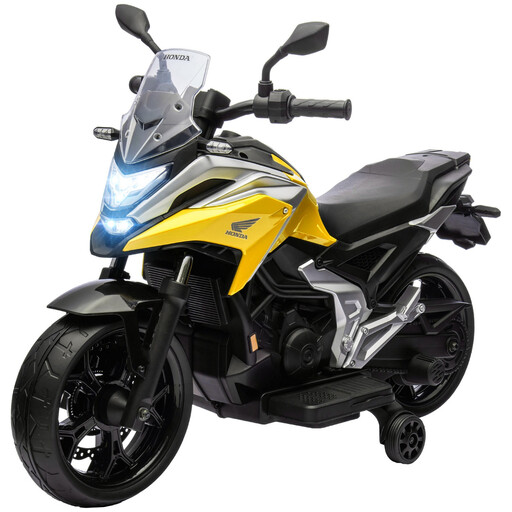
Why This Fits Their Persona: Perfect for a child's first ride-on toy. The official Honda licensing provides an authentic look, while the simple one-button start and steady 3 km/h speed are ideal for building confidence without being overwhelming. Also available in Red.
Its 12V motor and fixed low speed directly address the 'power mismatch' pitfall for young children. The included stabilisers ensure stability from day one, making it a safe introductory model.
The combination of an officially licensed design, simple controls and essential safety features like training wheels makes it exceptionally user-friendly for beginners.
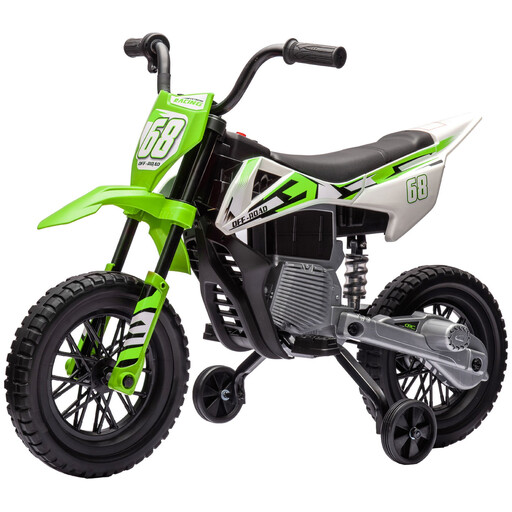
Why This Fits Their Persona: This model is for the child who is ready for a more interactive experience. The twist-grip throttle allows them to control the speed between 2.4-5 km/h and the rear suspension system provides a smoother ride on less-than-perfect surfaces.
The adjustable speed prevents the bike from becoming 'too slow' as the child's confidence grows. Its shock-absorbing wheels directly counter the 'unsuitable terrain' pitfall, making it more versatile for garden use.
Features a manual throttle and rear suspension, offering a more engaging and comfortable ride on varied surfaces like garden paths or slightly uneven pavement.
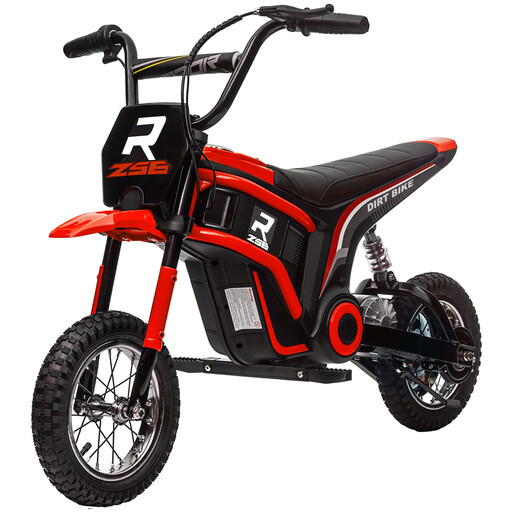
Why This Fits Their Persona: This is a serious step-up for older, more experienced riders. The powerful 24V motor delivers two speed settings (8km/h and 16km/h), while the large pneumatic tyres and steel frame are built for performance on grass and dirt paths.
This model directly solves the problem of buying an underpowered toy for an older child. Its robust steel frame and large pneumatic tyres are built for performance, not just looks, avoiding the flimsy build pitfall.
A powerful 24V motor with two speed settings and 12" pneumatic tyres deliver a true mini-motorbike experience suitable for harder terrain and more adventurous riding.
We have compiled a complete, real-time list of products that fully satisfy these strict selection criteria and UK safety regulations.
The run time for a battery powered motorbike for kids typically ranges from 30 to 60 minutes per charge. This depends heavily on the battery's capacity (measured in Ah), the motor's power, the rider's weight and the terrain. A bike running on flat pavement will last longer than one on hilly grass. Most models require an 8-12 hour charge, so it is often best to charge them overnight.
Whether a bike is suitable for grass depends almost entirely on its wheels and power. Models with basic, hard plastic wheels will struggle to gain traction and will provide a very bumpy ride. For regular use on a lawn, you should look for a kids ride on motorbike with larger, pneumatic (air-filled) rubber tyres and ideally a more powerful 12V or 24V motor.
Safety should always be the priority. At a minimum, a child should always wear a correctly fitted helmet. For more powerful models or as children become more adventurous, it is highly recommended to also use elbow and knee pads. Always ensure an adult is supervising, especially when children are first learning to ride.