
24/7 Customer Support

Free returns

Same-day & Next-day Delivery

Quality Guaranteed

Unlock Your Welcome Offers: FREE Delivery | Up to 80% OFF | Free 30-day JoyPlus trial
Download the APP
A kids electric quad bike can offer entertaining outdoor play, but choosing the wrong model may lead to disappointment. A ride-on that is too fast, too large or unsuitable for the intended surface can be difficult for a young child to control. Battery claims can also be unclear, particularly when the advertised run time depends on the child’s weight, terrain and frequency of stopping.
Before buying a battery-powered kids ATV, focus on three common pitfalls:
For an electric quad bike for ages 18 months to 5 years, voltage is a useful starting point, but it should not be the only consideration.
A 6V kids quad bike generally suits younger toddlers who need a slower introduction to powered movement. The models featured here travel at around 2.5–3km/h, which is close to walking pace. A 12V kids quad bike can provide more power for grass and outdoor paths, with the AIYAPLAY models listed at 3–6km/h.
Always compare:
A forward and reverse ride-on quad can be practical in gardens and paved areas, but children should be supervised whenever the vehicle is moving.
Wheel construction affects how the quad feels over outdoor surfaces. Treated or wear-resistant wheels can be useful on asphalt, brick, cement and short grass. Suspension, included on the AIYAPLAY 12V models, may help the ride feel less abrupt over minor surface changes.
However, “all-terrain” should not be treated as permission to use a children’s ATV on roads, steep inclines or unsuitable ground. Use the quad on a controlled private area with enough space for stopping and turning.
A stable design is also important. Check the overall dimensions, wheel diameter, seat measurements and maximum load rather than relying on promotional photographs.
Battery capacity, charging time and advertised run time should be read together. The featured models require an initial charge of approximately 6–10 hours, followed by regular charging of around 8–12 hours, depending on the product. Run time is listed as approximately 45–60 minutes, but actual performance varies with terrain, rider weight and use.
Look for clear information about:
The 6V AIYAPLAY and HOMCOM models listed below specify EN71-1-2-3 and EN62115 qualifications. These references relate to toy and electrical safety requirements, but parents should still follow the supplied manual, supervise use and ensure the child wears a suitable helmet.

Why This Fits Their Persona: A straightforward starting point for toddlers aged 18–36 months, with a 3km/h speed and forward and reverse movement.
The stated age range, 25kg capacity and walking-speed travel make sizing easier to assess before purchase.
6V 4.5Ah battery, LED headlights, up to one hour listed run time and EN71-1-2-3 and EN62115 qualifications.
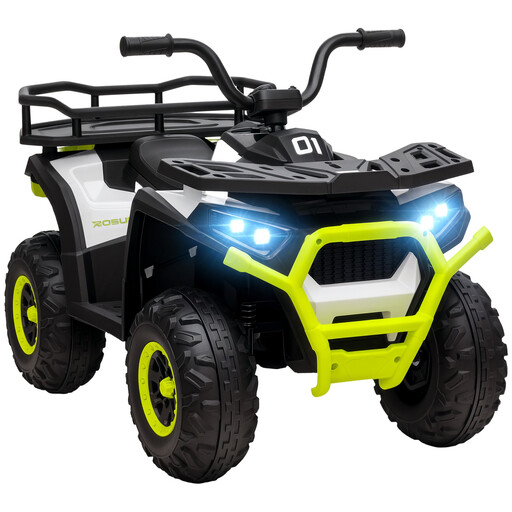
Why This Fits Their Persona: Suitable for families wanting a more feature-led 12V quad for outdoor play with children aged 3–5 years.
Its published speed range, dimensions and 30kg maximum load provide concrete details instead of relying on appearance alone.
Two 12V motors, four suspension wheels, headlights, music, USB port, basket and forward/reverse functions.
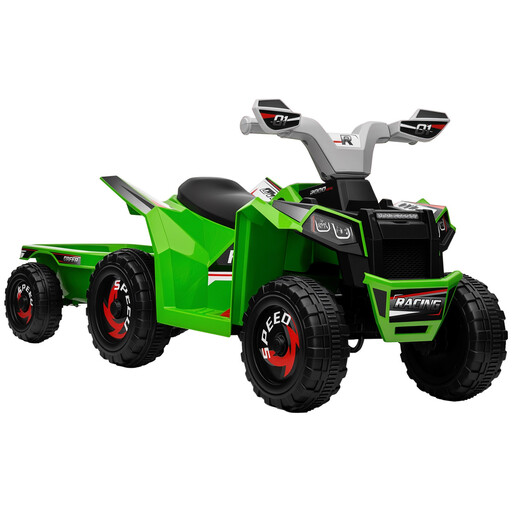
Why This Fits Their Persona: A practical choice for toddlers aged 18–36 months who would benefit from a rear trailer for carrying small toys.
The 2.5km/h speed, wide seat and stated 25kg load help parents compare suitability for early riders.
Rear trailer, forward and reverse pedal control, wear-resistant wheels, 50-minute listed run time and EN71-1-2-3 and EN62115 qualifications.
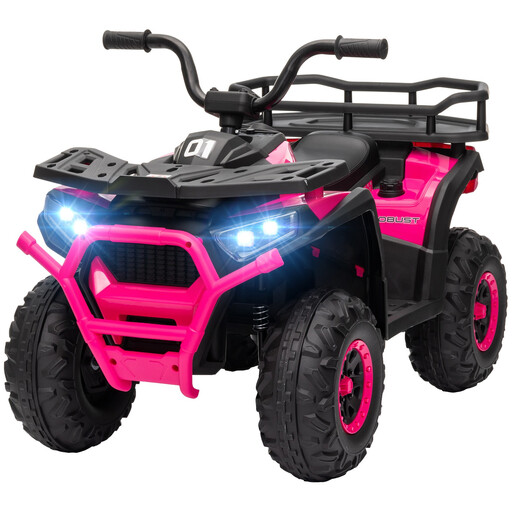
Why This Fits Their Persona: A pink 12V option for gift buyers seeking lights, music and outdoor play features for one child aged 3–5 years.
The product information states the 45-minute run time, charge periods, dimensions and single-rider capacity.
Four lights, music, USB port, storage basket, suspension wheels and 3–6km/h speed range.
We have compiled a complete, real-time list of products that fully satisfy these strict selection criteria and UK safety regulations.
Allow time for assembly before presenting the quad as a gift. Check that the handlebars, wheels, seat and trailer, where included, are firmly fitted. Charge the battery according to the manual and avoid leaving the charger connected beyond the stated guidance.
For UK use, select a private, level area away from roads, ponds, steps and parked vehicles. A child should wear a helmet and remain within direct adult supervision. Keep the ride-on dry and store it indoors or in a protected area when not in use. Do not carry a second rider unless the product specifically allows it; the models above state a single-rider seat capacity.
The products listed typically require an initial charge of 6–10 hours. Regular charging is generally listed at 8–12 hours. Follow the product manual, as charging requirements differ between batteries and models.
The listed run times range from approximately 45 minutes to one hour on a full charge. Actual use depends on the child’s weight, riding surface, speed, stops and how frequently the vehicle is driven in reverse.
Some are specifically listed for children from 18 months, but age alone is not enough. Check the seat dimensions, maximum load, speed and control layout. A slower 6V model may suit an early rider, while a 12V model is generally listed for children aged 3–5 years. Adult supervision and helmet use remain necessary for every ride.