
24/7 Customer Support

Free returns

Same-day & Next-day Delivery

Quality Guaranteed

Unlock Your Welcome Offers: FREE Delivery | Up to 80% OFF | Free 30-day JoyPlus trial
Download the APP
Buying a kids’ electric scooter can look straightforward until you compare motor power, speed, battery range, braking systems and weight limits. Product pages may highlight colourful lights or impressive maximum speeds while leaving out details that matter more for everyday family use.
The first point to understand in the UK is legal: a privately owned e-scooter may only be used on private land with the landowner’s permission. It is illegal to ride one in public places, including roads, pavements, cycle paths, parks and other public open spaces. This applies regardless of the rider’s age.
A higher maximum speed is not automatically more suitable for a young rider. Children may need time to learn steering, braking and balance. Look for a kick-to-start or non-zero-start system, which requires the scooter to be moving before the motor engages. This can help prevent sudden launches when a child accidentally touches the throttle.
A controllable speed, responsive brake and suitable riding environment are more important than selecting the highest figure available.
A quoted range is usually based on specific conditions. Rider weight, surface type, temperature, slopes, riding style and battery condition can all affect actual distance. A 12 km maximum range, for example, should be viewed as an upper specification rather than a promise for every journey.
For occasional riding on private land, a shorter range may be perfectly practical. If sessions are longer, compare battery capacity, charging time and the child’s weight against the manufacturer’s limits.
A children’s electric scooter can be difficult to store if the folded measurements are not checked first. A model may fit in a car boot when folded, but still be awkward to carry upstairs or move between storage areas.
Weight also matters. A lightweight electric scooter for children is easier for an adult to lift, while a heavier frame may offer a more substantial feel. Always balance portability with the stated weight capacity and the child’s ability to handle the scooter safely.
For children aged 6 and over, a kick-to-start feature is worth prioritising. The SPORTNOW model uses kick-to-start operation, while the HOMCOM models listed below use a non-zero-start system. These designs are intended to reduce unintended acceleration, but children still need supervision and protective equipment.
Check whether the scooter uses an electronic handbrake, rear foot brake or a combined braking arrangement. A child should practise stopping at low speed on private land before riding for longer periods.
Motor power helps indicate how the scooter may perform, but it does not determine suitability on its own. The HOMCOM options use 120 W motors and reach up to 8 km/h, making them suited to controlled, low-speed recreational riding. The SPORTNOW uses a 200 W motor and reaches up to 16 km/h, so it may suit an older or more confident child within its recommended age and weight guidance.
Review the complete specification, including:
Solid or puncture-resistant tyres remove the need for inflation and reduce the risk of a puncture interrupting use. The SPORTNOW has 6.5-inch solid rubber tyres and front and rear spring suspension. This combination may be useful where permitted private-land surfaces are uneven.
A kids’ scooter with lights can be more visible in dim conditions, although lighting should not be treated as permission to ride in public areas or as a replacement for supervision. The SPORTNOW includes RGB lights on the stem and deck, as well as an LED display showing speed and battery level.
A foldable kids’ electric scooter is easier to store and transport, but inspect both the folded dimensions and the locking mechanism. Adjustable handlebars can help achieve a more comfortable riding position as a child grows. The HOMCOM AA1-089V70BK offers two handlebar heights, while the AA1-092V70LB adjusts from 75–80 cm.
Look for an anti-slip deck, a stable riding position and materials suitable for the stated weight limit. Product compliance information such as CE, RoHS, LVD and EN62115 may appear in specifications, but buyers should still read the product manual and follow the stated operating conditions.
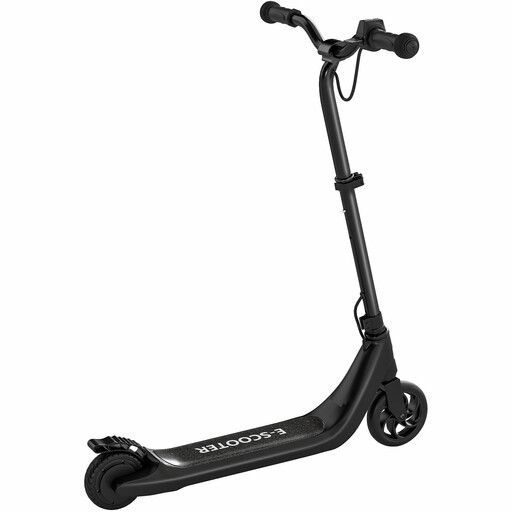
Why This Fits Their Persona: A practical starting point for families seeking an electric scooter for age 6+ with moderate speed, adjustable height and a stated 50 kg weight capacity.
Its non-zero-start system avoids an immediate motor launch, while the rear foot brake provides a straightforward stopping method.
120 W motor, up to 8 km/h, up to 6 km range and two handlebar heights of 90 cm and 95 cm.
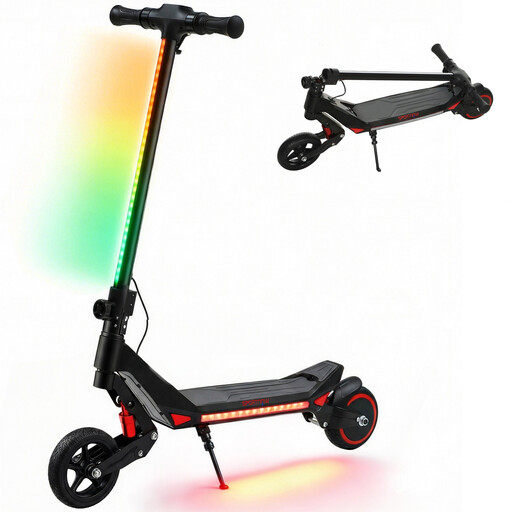
Why This Fits Their Persona: Suitable for families prioritising suspension, display information, lighting and a higher stated capacity for children aged 6–14.
Kick-to-start operation counters accidental launches, and solid tyres avoid routine inflation and puncture-related maintenance.
200 W motor, up to 16 km/h, up to 12 km range, front and rear suspension, RGB lights and a 70 kg capacity.
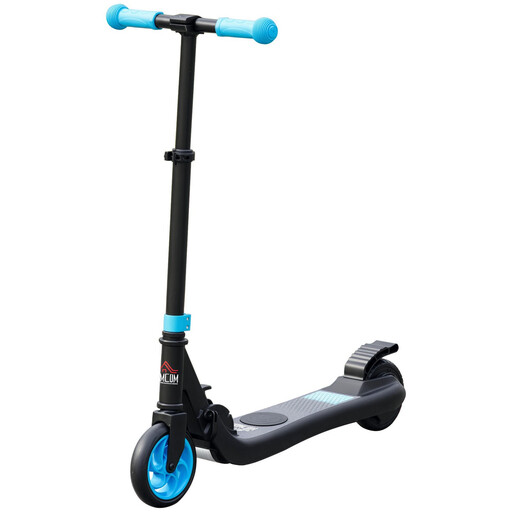
Why This Fits Their Persona: Designed for families who frequently carry a scooter between home, car and private riding areas and need a compact, lightweight format.
Its 4.8 kg foldable design addresses storage and transport concerns, while the non-zero-start system limits sudden engagement.
Up to 8 km/h, up to 6 km per charge, 75–80 cm adjustable handlebar height and a folded length of 66 cm.
Privately owned e-scooters may only be ridden on private land with the landowner’s permission. They cannot legally be used on public roads, pavements, cycle paths, parks or other public spaces, regardless of age.
The usable range depends on rider weight, terrain, temperature, speed and battery condition. Follow the supplied charging instructions, use the approved charger and unplug the scooter when charging is complete. Do not charge overnight, unattended or near flammable materials.
Use a properly fitted helmet and consider knee, elbow and wrist protection. Ride one person at a time, supervise children and practise starting, steering and braking at low speed on a suitable private surface.
We have compiled a complete, real-time list of products that fully satisfy these strict selection criteria and UK safety regulations.