
24/7 Customer Support

Free returns

Same-day & Next-day Delivery

Quality Guaranteed

Unlock Your Welcome Offers: FREE Delivery | Up to 80% OFF | Free 30-day JoyPlus trial
Download the APP
Choosing a kids go-kart can look straightforward until you compare battery voltage, speed modes, seat dimensions and wheel types. Marketing descriptions often focus on drifting, racing sounds or impressive motor figures, while the details that determine everyday usability are easier to miss.
For UK families, the most suitable choice usually depends on three things: the child’s age and height, where the kart will be used and whether you prefer electric convenience or pedal-powered play. This guide highlights common buying traps and compares practical options available from Joybuy.
An age range is only a starting point. Two children of the same age may have noticeably different heights, leg lengths and confidence levels. A kart can technically be suitable for a child’s age but still feel cramped if the seat is too narrow or the pedals are difficult to reach.
Always compare the seat dimensions, seat height, weight capacity and recommended height where provided. For example, some smaller electric models are designed for ages 3–8 and support up to 30kg, while larger karts for ages 6–12 can support up to 50kg.
A higher speed is not automatically more enjoyable or suitable. Younger drivers may benefit from selectable speed modes, while older children might prefer a faster electric go-kart for kids with drifting capability.
Check whether the kart has soft-start technology, adjustable speed settings or a progressive pedal response. These features can make the first few rides easier to manage than a model that moves abruptly when the pedal is pressed.
Wheel materials and size affect how a kart behaves. EVA wheels are generally suited to smoother pavements, concrete and brick paths. Rubber tyres and suspension may offer a more comfortable ride over gravel or uneven outdoor surfaces, but no children’s kart should be treated as an off-road vehicle.
Before buying, consider your actual riding area. A small footprint, driveway or paved garden path has different requirements from a larger private outdoor space.
A battery-powered go-kart is convenient for children who want motor-assisted movement, reverse driving, music or drifting features. Battery models require charging and have a finite running time. The listed products in this guide offer approximately 40–50 minutes of stated run time, depending on the model.
A pedal go-kart for children needs no charging and encourages active movement. It can be ready whenever the child wants to ride, although it requires more physical effort and may be less suitable for long sessions or inclines.
Look for clearly stated speed ranges rather than relying on vague descriptions such as “fast” or “racing style”. A 12V model described as travelling at 3–5km/h provides a different experience from a 24V drift kart listed at 6–13km/h.
For younger users, two-speed selection, forward and reverse functions, a handbrake or a freewheel system can make control more intuitive. Older children interested in a kids electric drift kart may prefer a model with a stronger motor, but drifting should only take place in a suitable private area with close adult supervision.
Check the overall size before ordering, particularly if the kart must pass through a shed door or be stored indoors. Also review the frame material, wheel construction and maximum load.
The products below list compliance with EN71-1-2-3, and several electric models also list EN62115. These references relate to relevant toy and electric ride-on safety requirements, but they do not remove the need to follow the manual. Children should be supervised, wear suitable protective equipment and ride away from roads, slopes, traffic and obstacles.
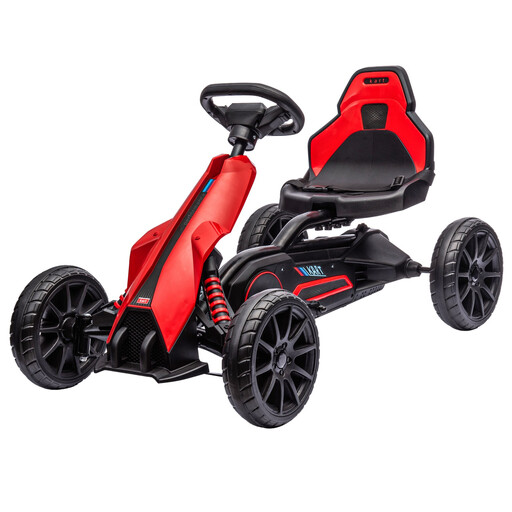
Why This Fits Their Persona: A practical entry point for children aged 3–8 who want a ride-on experience without the higher speed of larger karts. Its compact dimensions may suit a driveway or paved garden area.
It provides two selectable speeds from 3–5km/h instead of relying on one fixed pace, helping match the kart to a younger driver’s confidence.
12V 7Ah battery; stated run time up to 50 minutes; two-point belt, backrest and EVA wheels.

Why This Fits Their Persona: Suitable for families looking for a more adaptable ride-on kart for children aged 6–12, particularly where more than one child may use it over time.
The seat adjusts across three levels from 53–67cm, reducing the chance of outgrowing the kart quickly.
24V 5Ah battery; stated run time up to 50 minutes; soft start, horn, music and a maximum load of 50kg.
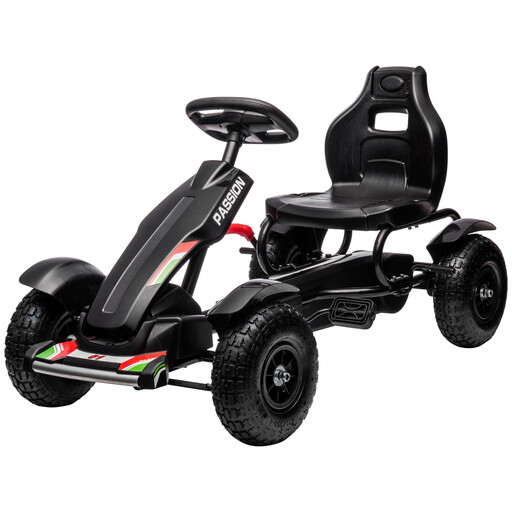
Why This Fits Their Persona: A sensible match for children aged 5–12 who will ride frequently and for families that prefer to avoid battery charging and replacement costs.
It does not depend on a quoted battery run time. The pedal system is ready to use whenever the kart is assembled and maintained.
Three-position adjustable seat; handbrake and reverse function; inflatable rubber tyres with suspension; maximum load 50kg.
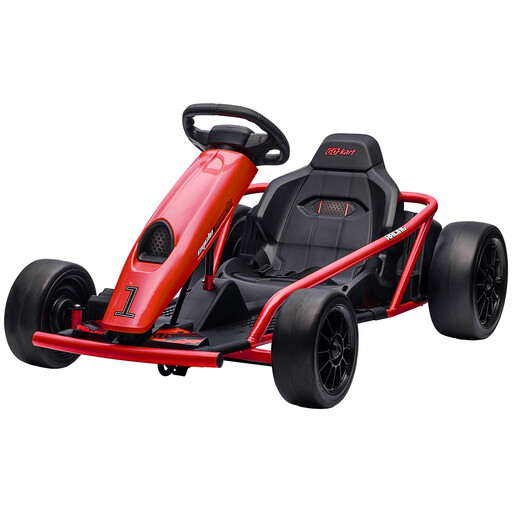
Why This Fits Their Persona: Designed for older children aged 8–12 who specifically want a children’s racing kart with electric drifting functions for suitable private outdoor areas.
The specification states a 6–13km/h speed range, soft start and a two-point belt, giving more information than a general “racing” label.
24V dual-drive motor; stated run time of 40 minutes; horn and music controls; maximum load 70kg.
We have compiled a complete, real-time list of products that fully satisfy these strict selection criteria and UK safety regulations.
Charging times vary by model. The listed electric karts typically specify around 6–8 hours for the first charge and 8–12 hours for regular charging. Follow the supplied manual, use the correct charger and allow the battery to cool as instructed before charging.
Electricity use depends on the battery capacity, charging frequency and local tariff. The ongoing costs may also include eventual battery replacement and storage. A pedal model avoids charging costs, but its tyres, brake components and moving parts still require inspection and maintenance.
These ride-on karts are intended for suitable private areas, not public roads. Avoid pavements, cycle lanes, public paths and locations with traffic. Choose a flat, clear surface, keep the child supervised and check the product manual before every session.