
24/7 Customer Support

Free returns

Same-day & Next-day Delivery

Quality Guaranteed

Unlock Your Welcome Offers: FREE Delivery | Up to 80% OFF | Free 30-day JoyPlus trial
Download the APP
Choosing kids go-karts is not simply a case of picking the most colourful design. Parents, grandparents and gift buyers need to consider age, height, weight capacity, control type, surface suitability and storage space before ordering. A kart that looks exciting online may be too large for a younger child, difficult to control or unsuitable for the garden path.
This guide explains the key buying checks and compares practical options, including an electric go-kart for kids, a pedal go-kart for kids and larger outdoor ride-on toys for growing children.
Age guidance is useful, but it should not be the only measurement. Children of the same age can have very different heights and leg lengths. Check the recommended height, seat dimensions and maximum load before buying.
For example, some go-karts for ages 2-5 are designed for children between approximately 90cm and 120cm tall, while larger pedal models for ages 5-12 may have a longer frame and adjustable seat. A child who cannot comfortably reach the pedals or steering wheel may struggle to control the kart.
A higher top speed does not automatically mean a better purchase. Younger children may benefit from a slower, more predictable ride, while older children may want acceleration and drifting functions. Look for features such as adjustable speed, soft start, forward and reverse controls, a handbrake or a safety belt.
Remember that actual speed and battery run time can vary with the child’s weight, surface, gradient and battery condition.
A battery-powered go-kart needs regular charging and safe indoor storage for the battery and charger. The supplied specifications may quote a first charge of 6-12 hours and a run time of around 40-50 minutes. These figures should be treated as stated product information rather than a guarantee for every journey.
Pedal-powered go-karts avoid charging, but they still require assembly and enough storage space. Measure doorways, sheds and vehicle boot space before ordering.
A pedal-powered go-kart is ready whenever the child wants to ride and encourages them to operate the vehicle using their own leg power. It is generally suitable for quieter play and avoids battery maintenance. Useful features include an enclosed chain, freewheel system, handbrake, reverse function and adjustable seat.
An electric go-kart for kids offers motor-assisted driving and may include music, lights, a horn or drift mode. Check whether the model has a soft-start function and whether the speed can be limited. Electric models should only be used under close adult supervision, particularly on shared paths, driveways or sloped ground.
An adjustable seat can extend the useful period of a kart, but adjustment ranges differ considerably. Check:
For example, one larger pedal model offers a three-position seat adjustment, a 50kg maximum load and dimensions of 121 x 58cm. A smaller pedal kart may support 30kg and be better suited to compact gardens or younger riders.
Wheel material affects noise, grip and surface suitability. EVA wheels are usually quiet on hard surfaces, while inflatable rubber tyres with suspension can provide more cushioning on uneven outdoor ground. Always check whether the product is intended for concrete, brick, asphalt, gravel or grass.
Look for a metal or steel frame, a supportive backrest and an accessible brake. Electric models may include a two-point safety belt. The listed products include EN71-1-2-3 compliance, and some electric models also list EN62115. Read the product manual and safety instructions and supervise every ride regardless of the stated standard.
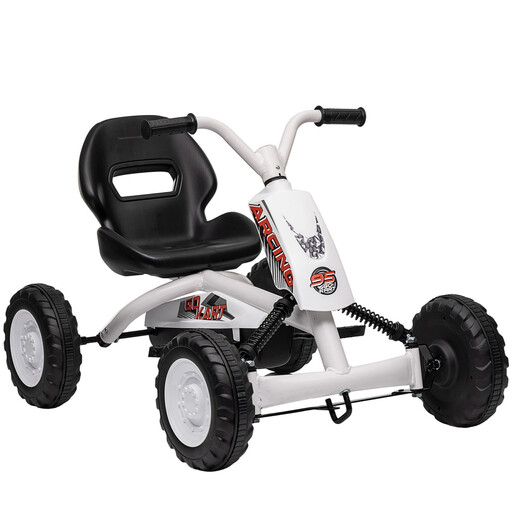
Why This Fits Their Persona: This compact pedal kart is designed for children aged 2-5 and recommended for heights of 90-120cm, making it a straightforward first ride-on for indoor or outdoor hard surfaces.
It avoids battery costs and charging delays, while the low four-wheel structure provides a stable base for younger riders.
Pedal forwards and backwards, steel frame, 23cm PP wheels and a 30kg maximum load.
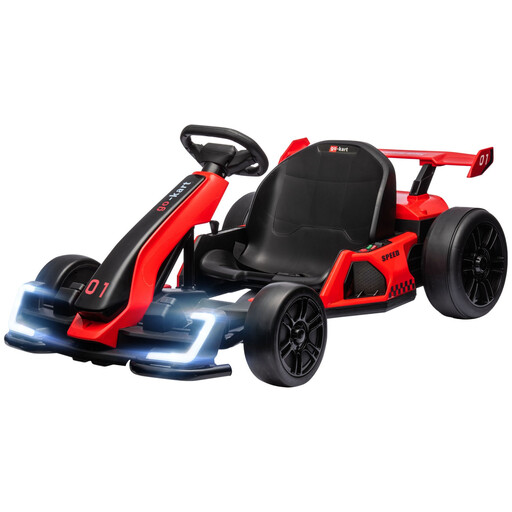
Why This Fits Their Persona: Families wanting a feature-rich children's ride-on go-kart for ages 6-12 may appreciate its adjustable seating and electric driving format for outdoor play.
Its soft-start function is designed to reduce an abrupt launch, while three seat positions help buyers avoid an unsuitable fixed fit.
24V battery, speed range of 6-12km/h, drifting function, music, horn and a 50kg maximum load.
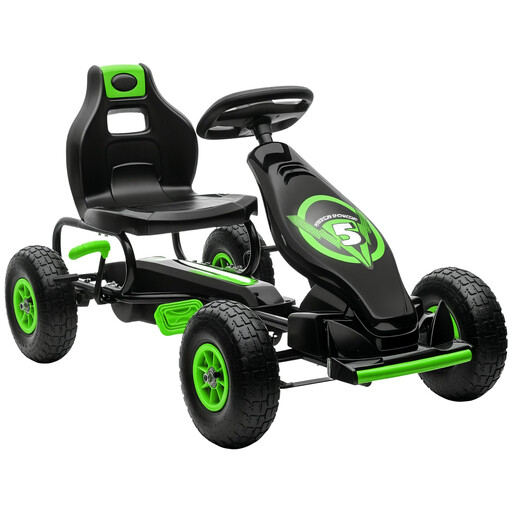
Why This Fits Their Persona: This larger pedal-powered go-kart suits children aged 5-12 who are likely to use it regularly on pavements, brick paths or asphalt around the garden and local outdoor spaces.
It does not depend on charging, and its three-position seat helps accommodate growth rather than forcing an early replacement.
Inflatable rubber tyres, shock-absorbing suspension, handbrake and 50kg maximum load.
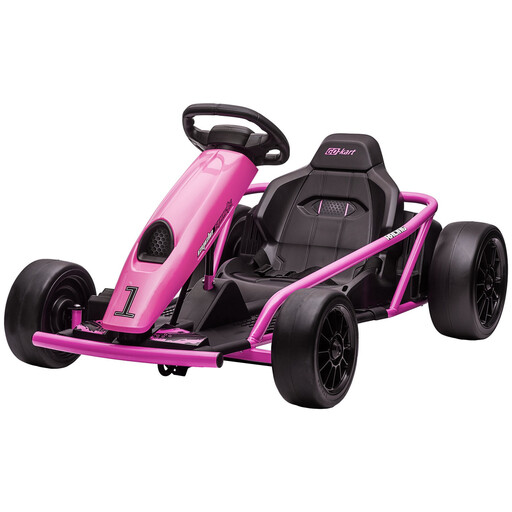
Why This Fits Their Persona: Older children aged 8-12 who specifically want a battery-powered go-kart with drift-style handling may find this format more suitable than a basic pedal model.
The model lists soft-start technology, a two-point belt and a backrest, rather than relying on speed alone as its selling feature.
Listed speed range of 6-13km/h, dual-drive motor, drift mode, horn, music and 70kg maximum load.
We have compiled a complete, real-time list of products that fully satisfy these strict selection criteria and UK safety regulations.
Some are listed for children from age 3, but suitability depends on height, weight, coordination and the child’s ability to follow instructions. A slower model with adjustable speed, a backrest and a safety belt may be easier to manage than a faster drift kart. Adult supervision is required.
The listed products specify first-charge times between 6 and 12 hours, with regular charging commonly taking 8-12 hours. Run time is stated as approximately 40-50 minutes on selected models. Charge the battery according to the supplied manual and avoid leaving the kart exposed to rain or damp conditions.
Check the wheel and surface information carefully. EVA and plastic wheels are generally described for hard surfaces such as concrete, asphalt or brick. Rubber tyres with suspension may be more appropriate for uneven outdoor ground, but no ride-on kart should be used on steep slopes, wet surfaces or near traffic.