
24/7 Customer Support

Free returns

Same-day & Next-day Delivery

Quality Guaranteed

Unlock Your Welcome Offers: FREE Delivery | Up to 80% OFF | Free 30-day JoyPlus trial
Download the APP
A kids inflatable bouncy castle can turn a garden, playroom or birthday party into an active play area. However, product listings often focus on bright colours and the number of activities while leaving out details that affect everyday usability.
Before buying a children’s bounce house, look beyond the photographs. A suitable model needs enough space, a correctly rated blower, clear age and weight limits and practical storage options for the UK climate.
A bouncy castle with a slide, climbing wall, pool, basketball hoop and ball pit may look appealing, but additional features usually mean a larger footprint. Check the full assembled dimensions, not just the bouncing area. Measure the lawn, patio or indoor room and leave clearance around the inflatable for access and anchoring.
Also consider whether the activities suit the children who will use it. A toddler may need a lower slide and enclosed mesh, while older children may prefer a larger jump area.
References to EN71 indicate that the product has been assessed against relevant toy safety requirements, but they do not remove the need for safe setup and active adult supervision. Always follow the supplied instructions, use the included stakes outdoors and keep children within the stated age, height and weight guidance.
Do not allow overcrowding, rough play or children of widely different sizes to use the inflatable together. Check the manufacturer’s instructions before allowing water play or using the bouncy castle indoors.
A kids bouncy castle with blower needs a mains electricity supply and continuous airflow while inflated. Blowers can produce noticeable noise, so consider neighbours and indoor household noise levels. The inflatable should be completely dry before folding and storing, particularly after use as a bouncy castle with pool.
Look for useful accessories such as a carry bag, repair patches, ground stakes and a manual. These can make setup, transport and minor maintenance more manageable.
Compare the overall dimensions with the available space. The listed maximum load is not the same as the recommended number of children, and the jumping area may have its own lower limit.
For example, the HOMCOM model measures 300L x 180W x 160Hcm, is listed for children aged 3–10 and allows up to three children with a total maximum load of 100kg. Its jump area has a stated capacity of 45kg. This distinction matters when deciding whether it suits a playdate or party.
Many options in this guide are specified for ages 3–8, including the inflatable bouncer with slide models. Older children may need more room to bounce safely, so always compare the age guidance with the dimensions and activity area.
Oxford fabric is commonly used for inflatable play equipment because it is designed for regular handling. Some models list 420D Oxford fabric, while others reinforce high-use sections with 840D fabric. A higher fabric-denier figure describes fabric weight and construction, but it is not by itself a guarantee of durability.
Look for reinforced seams, mesh netting around elevated sections and soft landing areas. Patches are useful for minor repairs, but they do not replace safe use or inspection. Before every session, check for visible damage, loose stitching, unusual air loss and wet or dirty surfaces.
A suitable blower should match the product and be included where stated. The models below include blowers ranging from 350W to 450W, with advertised inflation times of about one to a few minutes. Inflation speed can vary with temperature, power supply and setup conditions.
For outdoor use, use every supplied ground stake as instructed and place the inflatable on an appropriate, clear surface. An indoor outdoor bouncy castle still needs adequate ventilation, ceiling clearance and protection from sharp objects. Never use an outdoor water feature indoors unless the instructions specifically permit it.
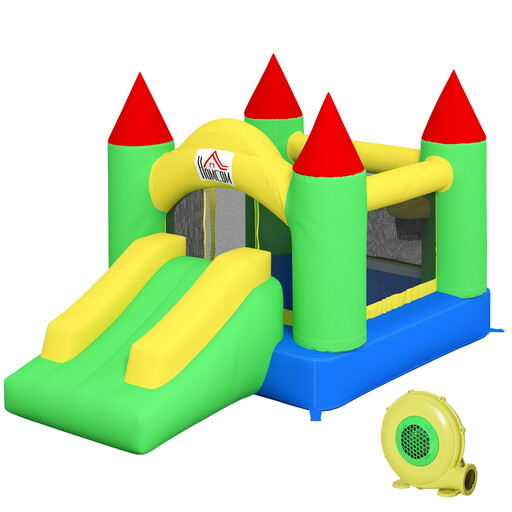
Why This Fits Their Persona: A straightforward option for families wanting a bouncer and slide for garden play or spacious indoor use without a pool or multiple attachments. It is listed for children aged 3–10 and up to three children.
Its listed dimensions and separate 45kg jump-area limit make capacity easier to assess than relying on a general party claim.
300 x 180 x 160cm footprint; 350W blower; mesh netting, double stitching and included instructions.
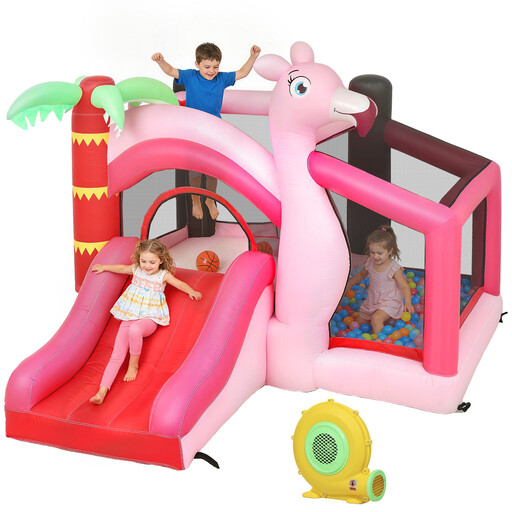
Why This Fits Their Persona: This suits families seeking a structured inflatable play centre for garden parties, playdates and indoor active play where a ball pit is more useful than a water area.
The listing identifies the bouncing, slide, ball-pit and hoop areas separately, helping buyers judge whether the 255 x 230 x 196cm size is suitable.
420D fabric with 840D reinforcement in key areas; 370W blower; storage bag, repair patches and four activities included.
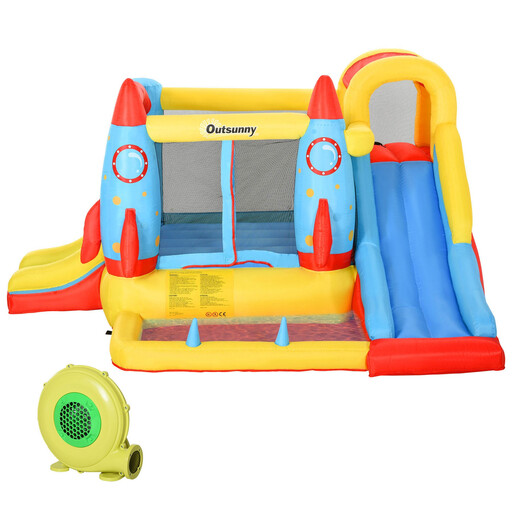
Why This Fits Their Persona: Designed for families planning larger garden sessions, birthday parties and summer playdates, with space listed for up to four children aged 3–8.
The separate pool and slide measurements reveal how much garden space the feature-rich layout requires before purchase.
330 x 265 x 185cm overall size; two slides, climbing wall and pool; 450W inflator, five stakes, carry bag and patches.
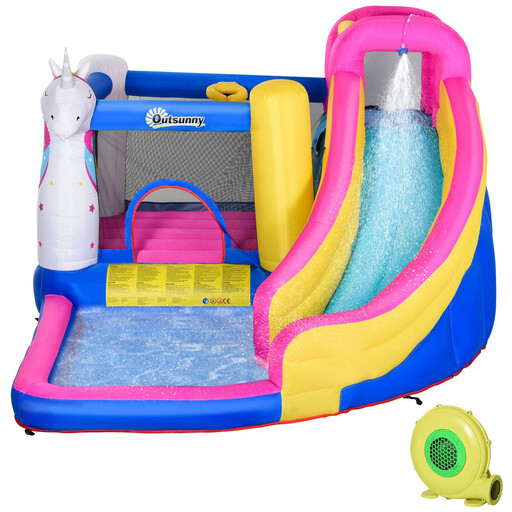
Why This Fits Their Persona: A suitable format for households wanting a garden bouncy castle that combines active play and water play during warmer weather.
The stated 360 x 305 x 210cm dimensions and 90kg maximum load help prevent buyers from underestimating space or capacity limits.
Five play features; six listed ground stakes; 450W inflator; carry bag, water pipe and ten repair patches supplied.
We have compiled a complete, real-time list of products that fully satisfy these strict selection criteria and UK safety regulations.
Before children start playing, check the following:
Running cost depends on the blower’s wattage and the electricity tariff. The products listed use blowers rated between 350W and 450W. As an illustration, a 450W blower uses 0.45kWh for one hour of operation. Multiply that figure by your tariff to estimate the hourly electricity cost. The blower normally needs to remain switched on while the castle is in use.
There is no fixed lifespan because it depends on frequency of use, storage, weather exposure, cleaning and how carefully it is anchored. Keep the inflatable dry, avoid dragging it across rough ground, follow the load guidance and deal with minor damage using the supplied repair materials where appropriate. Retire it from use if structural damage, significant air loss or unsafe stitching is found.
Some models are listed for indoor and outdoor use, but the room must be large enough for the full inflated dimensions, with sufficient ceiling clearance and safe access around the unit. Indoor use avoids changing weather conditions but does not remove the need for supervision, ventilation and a suitable electrical supply. A model with a pool should generally be treated as an outdoor water-play product unless its instructions state otherwise.