
24/7 Customer Support

Free returns

Same-day & Next-day Delivery

Quality Guaranteed

Unlock Your Welcome Offers: FREE Delivery | Up to 80% OFF | Free 30-day JoyPlus trial
Download the APP
Finding a toy that is both entertaining and beneficial for a child's development can be a challenge. A kids kitchen is a classic choice that offers hours of imaginative fun, but with so many options available, it can be difficult to know where to start. From materials and size to interactive features, the right choice depends on your child's age, your available space and your family's preferences.
This guide is designed to help you navigate the choices. We will walk through the key factors to consider when selecting a pretend play kitchen and highlight a few popular models to illustrate the different types you might encounter.
Before you start browsing, considering a few key points can help narrow down your search and ensure you find a toy that will be loved for years to come.
The material of a play kitchen influences its appearance, durability and feel.
A toddler kitchen can range from a compact, tabletop unit to a large, multi-functional corner piece. Before purchasing, measure the area where you plan to place the kitchen. Consider the height of the worktops in relation to your child's height to ensure they can comfortably reach everything. For smaller rooms or for those who need a more portable option, a mini-kitchen or a model with a smaller footprint might be more suitable.
The level of interactivity can significantly impact the play experience.
Here are a few examples that showcase the variety available, each catering to different needs and play styles.

Why It Stands Out: This kitchen combines a stylish, modern aesthetic with the timeless appeal of wooden toys. Its Montessori-inspired design focuses on encouraging independent, creative play without overwhelming electronic features.

Why It Stands Out: This compact kitchen offers the fun of a full-sized unit in a space-saving design. Its realistic Miele branding provides an authentic touch that little ones who love to mimic adults will appreciate.
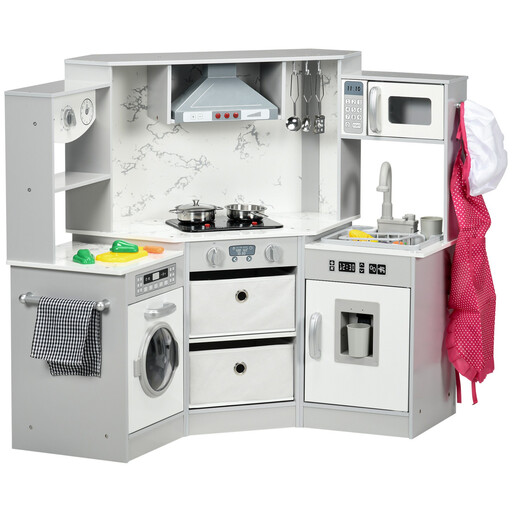
Why It Stands Out: This is a feature-rich playset designed for the ultimate interactive experience. With its corner layout, running water system and electronic effects, it provides a comprehensive setup for immersive play.
The models above are just a starting point. If you are looking for different sizes, materials or feature sets, there are many other designs to consider.
Explore our complete collection of kitchen play set options to find the perfect match for your little chef.
1. What age is a play kitchen suitable for? Most play kitchens are designed for children aged 3 to 6 years. However, simpler, more robust models can be suitable for a t toddler kitchen from around 2 years old with supervision. Always check the manufacturer's recommended age and be mindful of any small parts that could be a choking hazard for children under 3.
2. What are the developmental benefits of a role play kitchen? A role play kitchen is a fantastic tool for development. It helps children build social and communication skills as they play with others, enhances creativity and imagination through storytelling and improves fine motor skills by handling small accessories. It also helps them understand daily routines and sequences, such as preparing a meal and cleaning up afterwards.
3. How do I choose a safe toy kitchen for my child? When buying any toy in the UK, look for the UKCA (or CE) mark, which indicates that the product meets safety standards. For a kids kitchen, ensure it has a stable, sturdy construction that will not tip over easily. Check that materials are non-toxic and that there are no sharp edges. Finally, always adhere to the age recommendations and warnings regarding small parts.