
24/7 Customer Support

Free returns

Same-day & Next-day Delivery

Quality Guaranteed

Unlock Your Welcome Offers: FREE Delivery | Up to 80% OFF | Free 30-day JoyPlus trial
Download the APP
A kids musical piano toy can introduce rhythm, sound and creative play at home, but not every colourful keyboard is suitable for young children. Some products look engaging online yet become frustrating because the volume cannot be adjusted, the controls are unclear or the toy is too advanced for the child’s age.
Before buying a children’s keyboard or toddler piano toy, look beyond the number of melodies and flashing lights. The most useful choice depends on age, available space, supervision, sound control and how the instrument will be used.
A keyboard with dozens of sounds may appear better value, but a one-year-old may benefit more from large, responsive keys and simple controls. Conversely, an older child who is ready to practise melodies may quickly outgrow a basic toy with only a few notes.
Check the stated age range and consider whether the child will use the product independently or with an adult. A musical keyboard for toddlers should be easy to operate without complicated menus or small detachable accessories.
A toy piano can become unpleasant in a flat, terraced home or shared family space if it has only one loud setting. Marketing descriptions often highlight songs and sound effects while giving less attention to practical controls.
A kids keyboard with volume control is more adaptable. A mute function can also be useful during quiet periods, although adults should still supervise use and avoid prolonged loud playback close to a child’s ears.
Music toys can support playful exploration of rhythm, coordination and cause-and-effect. However, claims such as “Montessori-inspired” or “developmental” do not replace basic safety checks.
Look for clear information about:
For children under three, follow the manufacturer’s age guidance carefully. A product designed for stepping or jumping may not be appropriate for a younger toddler, even if the colours and sounds appear appealing.
Volume adjustment should be treated as a practical requirement rather than an optional extra. Check whether the product includes a mute setting, several volume levels, a headphone connection or none of these.
Also confirm whether batteries are included. Some toys require batteries but do not supply them, which can make a birthday gift unusable straight out of the box. Keep spare batteries away from children and ensure the compartment is secured according to the instructions.
The number of keys gives only part of the picture. A 24-key toy keyboard may be more accessible to a toddler than a full-size instrument, while a 61-key electronic piano for kids may suit an older child learning basic notes.
Consider where it will be used:
A piano and drum playmat should be placed on a clear, dry surface. Confirm its folded size if storage space is limited.
For toys sold in the UK, look for relevant safety information, warnings and manufacturer details. CE marking indicates that the responsible party declares conformity with applicable European requirements; it should be considered alongside the product’s age guidance and instructions rather than as a substitute for supervision.
ABS plastic, non-woven fabric and other material descriptions should be checked together with construction details. Smooth edges, a stable design and a secure battery compartment are more useful considerations than broad claims such as “indestructible” or “completely safe”.
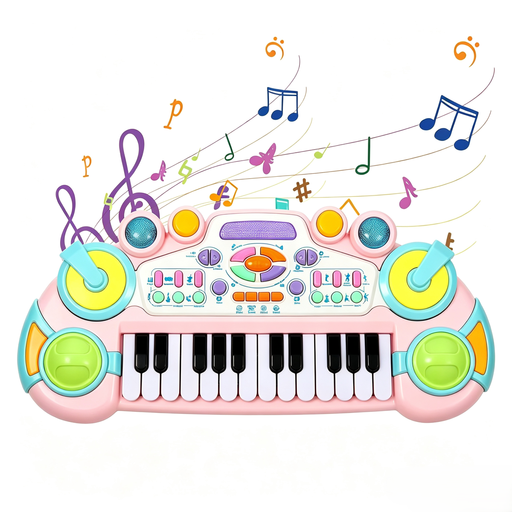
Why This Fits Their Persona: Designed for children aged 1 to 5, this compact pink keyboard suits families looking for an accessible first musical toy for tabletop play, birthdays or Christmas.
The listing identifies a 1–5 age range and includes volume control plus a mute mode, helping parents manage sound levels. Batteries and a microphone are not included, so these should be planned for separately.
It has 24 keys, light effects, animal sounds, drum rhythms and multiple sound modes. The stated ABS construction and rounded edges are practical features for early play.
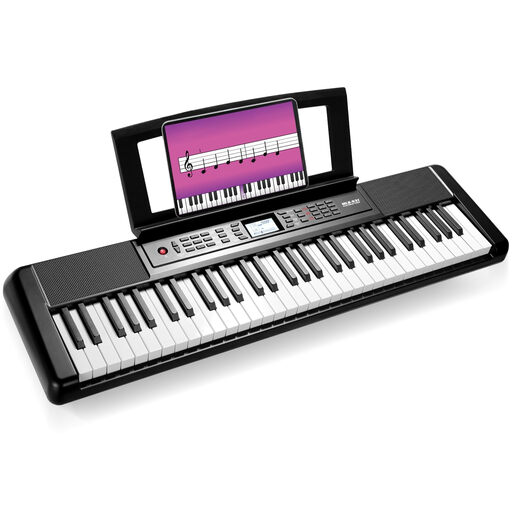
Why This Fits Their Persona: This is more suitable for an older child, family music room or household where a child may progress from playful exploration towards more structured keyboard practice.
The 61-key layout offers more room to develop than a small toddler keyboard. Buyers should still check power requirements, dimensions and whether weighted keys are suitable for the intended child.
The listed features include 300 sounds, 300 rhythms, an LCD, USB-MIDI, speakers, a headphone jack and a music stand.
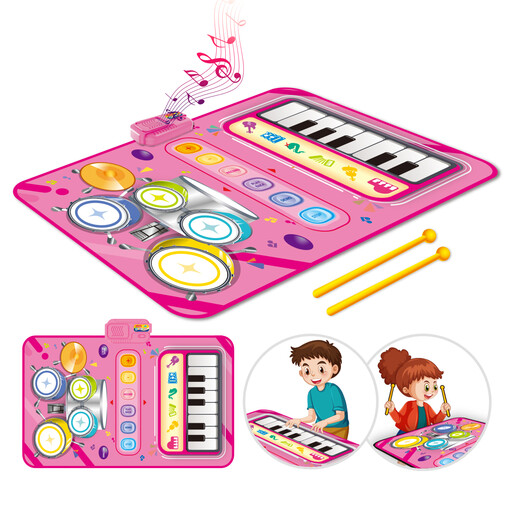
Why This Fits Their Persona: This floor-based option suits active children aged 3 and above who prefer movement, shared play and larger sound-making actions rather than seated keyboard play.
The product states a clear minimum age of 3 years, requires direct adult supervision and includes adjustable volume. This makes the usage conditions more transparent than an age-unspecified playmat.
It combines 13 piano keys with 6 drum functions, supports one or two players and folds for storage. Three 1.5 AA batteries are required and not included.
We have compiled a complete, real-time list of products that fully satisfy these strict selection criteria and UK safety regulations.
Some are designed for children from age one, but suitability depends on the individual product. Choose a keyboard with large, integrated controls, no loose small parts and clear age guidance. Always supervise young children, particularly around batteries and cables.
Select a model with adjustable volume or a mute mode. Place it away from walls and shared boundaries, use the lowest comfortable setting and limit extended loud play. A headphone jack can be useful on larger digital keyboards, but check that the headphones and volume are appropriate for the child.
Lifespan depends on frequency of use, storage, battery condition and how the toy is handled. To reduce wear, keep it dry, remove batteries during long periods of storage and follow the cleaning instructions. A simple toddler keyboard may be outgrown as the child develops, while a larger electronic piano can remain useful for longer if its features match the child’s growing interest.