Parents hosting a mixed-age party
Individual pots and pouches make servings easier to count and hand out. Check both the number of portions and their size: a small pot for a younger child may not suit every guest.


For a children’s party, start with individually portioned yoghurt that you can count against the guest list, then compare sugars per 100g and check each product’s ingredients. Confirm a separate, parent-approved choice for any child with a milk allergy: lactose-free dairy yoghurt is not necessarily milk-free. Follow the finished yoghurt’s own date and storage instructions rather than assuming that filtered or long-life milk changes them.
Individual pots and pouches make servings easier to count and hand out. Check both the number of portions and their size: a small pot for a younger child may not suit every guest.
Use the sugars figure per 100g to compare different pot sizes, then look at the portion each child would receive. A child-focused pack or a no-added-sugar claim does not tell you the product’s total sugars.
Ask parents or carers about the specific product and serving plan for a child with a milk allergy or another food allergy. The Food Standards Agency identifies yoghurt as a common source of milk; Rachel’s Organic also states that its lactose-free natural yoghurt contains cows’ milk and is unsuitable for people with a milk allergy.
Choose the serving format first, then compare the exact packs for sugars, allergens and storage instructions.
| Priority | What to check | Your needs |
|---|---|---|
| Individual servings | Count the pots or pouches in each pack and check the size of one serving. Decide whether children will need spoons or bowls. | I want enough portions for the confirmed guests and a way to hand them out without scooping from a shared tub. |
| Sugar comparison | Compare the “of which sugars” figure per 100g, then read the ingredients and the actual portion size. A no-added-sugar claim does not mean sugar-free. | Different pack sizes make it hard to compare flavoured and plain yoghurt by the sugars in one pot alone. |
| Milk and other allergens | Read the full allergen declaration on each product. Check any dairy-free alternative against the individual child’s requirements and agree how it will be served. | I need a confirmed option for a guest who cannot have milk, without mistaking lactose-free dairy yoghurt for a milk-free product. |
| Dates and storage | Check the finished yoghurt’s use-by date and storage instructions before buying and serving. Follow its chilled-storage directions where stated. | The yoghurt needs to stay within its stated date and storage conditions throughout the party. |
Lactose-free dairy yoghurt can still contain cows’ milk. Rachel’s Organic says its lactose-free natural yoghurt is not suitable for people with a milk allergy.
For a milk-allergic child, use the specific product approved by their parent or carer and follow the agreed serving plan.
A larger pot can contain more sugars per serving even when its per-100g figure is lower than another product’s. The two figures answer different questions.
Compare sugars per 100g on the nutrition labels first, then check how much yoghurt each child would actually receive.
A large tub needs bowls and serving utensils, while separately prepared food may need its own utensils to follow a child’s allergy plan.
Count the required servings in advance and arrange separate, clearly identified portions where the agreed plan calls for them.
Filtered or long-life milk does not establish how a particular yoghurt must be stored. The Food Standards Agency warns that food kept too long or at the wrong temperature can cause food poisoning.
Follow the yoghurt pack’s date and storage instructions, including refrigeration where required.
These ranges illustrate formats worth comparing; check the exact product rather than assuming every yoghurt from a brand has the same ingredients or portion size.
Little Yeos includes child-sized no-added-sugar yoghurt pots and pouches.
A fruit-yoghurt option for hosts comparing individual pot sizes and nutrition labels.
A retailer reference for comparing children’s multipacks with plain individual pots.
A reference for natural yoghurt and multipacks as well as a lactose-free dairy option.
A broader yoghurt range that includes Corner and Müller Light products.
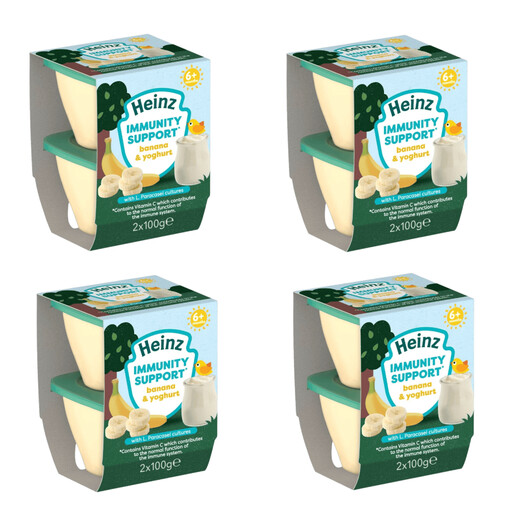
These are two individually portioned dairy yoghurt options: a mango pouch and a bundle of banana-and-yoghurt pots. Neither is a milk-free choice, and each needs to be served according to its own directions.
 No image available
The individual 90g pouch is a countable serving if mango yoghurt suits the guests. Its listing states no added sugar and 8.2g sugars per 100g; it contains milk. The directions say to squeeze the yoghurt onto a spoon or into a bowl rather than let a child drink from the pouch, and warn that the cap is a choking hazard for children under 36 months. Follow the pack’s storage instructions.
 No image available
Eight individual pots make servings straightforward to count; the bundle comprises four packs of 2 × 100g. The listing gives 11.0g sugars per 100g and identifies milk in the ingredients. This is a baby-oriented format, so check whether the pot size suits the party guests, supervise children while eating and follow the pack’s storage directions.
Not simply because it is lactose-free. Rachel’s Organic states that its lactose-free natural yoghurt contains cows’ milk and is unsuitable for people with a milk allergy. Ask the child’s parent or carer to confirm the specific product and handling plan.
Compare the “of which sugars” figures per 100g, then check the size of the portion you intend to serve. NHS food-label guidance uses per-100g figures for comparison and describes more than 22.5g total sugars per 100g as high; total sugars are not the same thing as added sugar.
Do not use a description of the milk to decide how to store the finished yoghurt. Follow that yoghurt’s use-by date and storage instructions. The Food Standards Agency warns that food stored too long or at the wrong temperature can cause food poisoning.
Ask about milk allergy, lactose intolerance and any other food allergy, then confirm the particular product and serving arrangements needed for that child. The Food Standards Agency identifies yoghurt as a common source of milk, while a dairy-free alternative still needs its own ingredients and allergens checked.