Families putting salt first
For regular children’s pasta meals, plain passata offers a base you can season yourself. Compare the salt figure on the particular pack and allow time to make the sauce.


Choose plain passata when reducing salt is the priority and you have time to cook and season it. ASDA Groceries lists Napolina Sieved Tomatoes Passata 690g at 0.12g salt per 100g, within the NHS guide of 0.3g or less per 100g for a low-salt food. A ready-made jar saves preparation, but check its salt per 100g, the amount served and any ingredients you add: the M&S and Stamford Street Co. examples listed by Ocado and Sainsbury’s contain 0.60g and 0.65g salt per 100g respectively.
For regular children’s pasta meals, plain passata offers a base you can season yourself. Compare the salt figure on the particular pack and allow time to make the sauce.
A ready-made jar avoids making a sauce from a tomato base. Compare salt per 100g and consider how much sauce you will serve.
If a child needs to avoid a particular allergen, check the current ingredients and allergen declaration. For food taken to school, check that school’s requirements too; do not assume every tomato sauce has the same ingredients.
For a children’s pasta tea, start with the salt figure on the pack, then decide whether the time saved by a finished sauce matters more than making one from passata.
| Concern | What to check | Who this matters to |
|---|---|---|
| Salt in the finished meal | Compare salt per 100g, then account for the amount served and ingredients added during cooking. | I can spend time making a sauce, but I want to keep track of the salt in the whole meal. About 36% of consumers put reducing salt first. |
| Preparation time | Check whether the pack is a finished sauce or a passata base that needs cooking and seasoning. | On a busy evening, I need a sauce I can use without making one from scratch. Getting tea ready quickly is the primary need for around 29% of consumers. |
| Allergen suitability | Read the current ingredients and allergen declaration; check the individual school’s policy if relevant. | If a child must avoid an allergen, I need to confirm that this particular product is suitable. Approximately 14% of consumers put that check first. |
| Pack size and leftovers | Choose a size you can use within the pack’s after-opening storage instructions. | When I make smaller batches, I do not want an opened jar left over for too long. For about 21% of consumers, using the pack without waste comes first. |
A reduction from another recipe does not, by itself, establish that a sauce meets the NHS low-salt guide of 0.3g salt or less per 100g.
Compare the salt per 100g on the actual packs you are choosing between.
Ingredients differ between products. ASDA Groceries labels its Free From Tomato & Herb Pasta Bake Sauce free from cereals containing gluten, while its listing for Batchelors Tomato, Onion & Herb Pasta ’n’ Sauce declares wheat.
Check the current pack for the child’s specific requirements, and confirm any relevant school policy separately.
A pack’s stated serving may differ from the amount used at tea time, so it cannot replace a per-100g comparison.
Check salt per 100g and the amount you plan to serve. Follow the pack’s storage instructions after opening.
Sauce left unused beyond its stated after-opening period may have to be discarded.
Cheese, stock, cured meat or salty condiments can add salt to a meal made with a low-salt passata.
Check the ingredients added to the finished sauce as well as the passata label.
A passata option for cooks who want to make and season their own pasta sauce.
A ready-made tomato-and-basil sauce option when preparation time matters.
The Stamford Street Co. range includes a ready-made pasta sauce.
A free-from pasta-bake sauce option for shoppers checking declared allergens.
A ready-made bolognese-style sauce option for a family pasta meal.
This 500g passata is for making a pasta sauce when you have time to cook and season it, rather than using a finished jar.
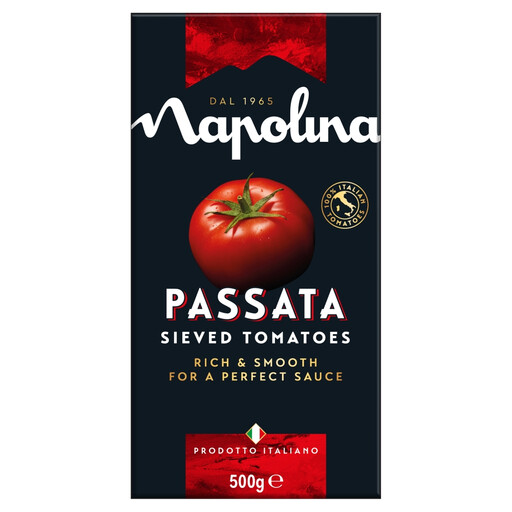 Image unavailable
For a children’s pasta tea when you can make the sauce yourself, this 500g passata is a tomato base rather than a finished sauce. Check the salt per 100g and allergen information on this pack; the ingredients you add will also affect the finished meal.
The NHS guide defines a low-salt food as containing 0.3g salt or less per 100g. Check the figure on the particular pack: ASDA Groceries lists Napolina Sieved Tomatoes Passata 690g at 0.12g per 100g, but passata still needs to be made into a sauce.
The NHS gives maximum daily amounts of 3g for children aged 4–6 and 5g for children aged 7–10. These are amounts for the whole day, not for one pasta meal.
No. Ingredients vary: ASDA Groceries labels its Free From Tomato & Herb Pasta Bake Sauce free from cereals containing gluten, while its Batchelors Tomato, Onion & Herb Pasta ’n’ Sauce listing declares wheat. Check the current pack rather than relying on the product category.
Check the school’s own food policy and the current labels of everything in the meal, including the pasta and sauce. GOV.UK guidance for pre-packed foods in Great Britain says that allergens requiring declaration must be emphasised in the ingredients list.
Follow the storage instructions on the individual pack, including whether it needs refrigeration and when it must be used. A pack size that suits the amount your household will use can help avoid leftovers.