
24/7 Customer Support

Free returns

Same-day & Next-day Delivery

Quality Guaranteed

Unlock Your Welcome Offers: FREE Delivery | Up to 80% OFF | Free 30-day JoyPlus trial
Download the APP
Searching for a toy that can capture a child's imagination for more than a few minutes can feel like a challenge. Many parents and grandparents are looking for engaging, screen-free activities that are not only fun but also contribute to a child's development. A kids play kitchen is a classic choice that ticks all these boxes, providing a wonderful platform for creative and educational play.
As a Joybuy Product Recommendation Officer, my role is to help you navigate the wide array of options available. This guide is designed to offer practical advice and highlight a few standout choices, helping you find a play kitchen that suits your space, budget and your child's interests.
Before diving into specific products, let's cover a few key considerations. Keeping these points in mind will help you make a more informed decision.
The material of a play kitchen influences its feel, longevity and aesthetic.
Safety is paramount when choosing any toy. In the UK, look for products that comply with safety standards such as EN71 certification. This indicates the toy has been tested for safety, including materials and construction. Always check for smooth, rounded edges to prevent bumps and scrapes, especially for younger children.
Some play kitchens come as a standalone unit, while others include a full set of toy kitchen accessories. Consider whether you want an all-in-one package or prefer to purchase pretend play food and utensils separately. A kitchen that comes with accessories can offer great initial value and allows children to start playing immediately.
Here are a few recommendations that cater to different play styles, spaces and budgets.
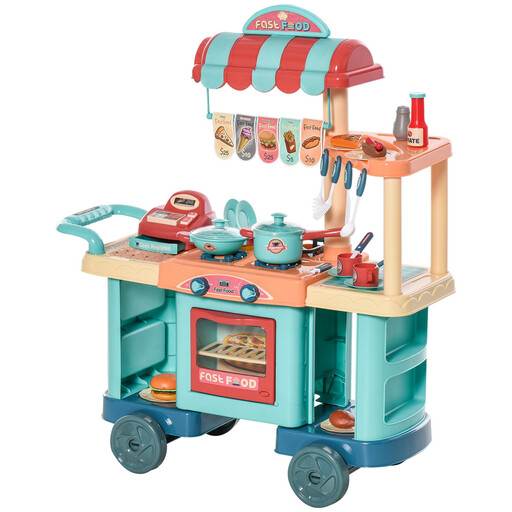
Why It Stands Out: This isn't just a kitchen; it's a complete fast-food shop on wheels. With 50 accessories included, it provides a comprehensive play experience straight out of the box, combining cooking, serving and even paying with a toy cash register.
The interactive elements, like a pop-up drawer on the register, add an extra layer of engagement. Its mobile design means it can be easily moved from room to room, and the built-in racks, hooks and cabinets are great for teaching organisational skills.
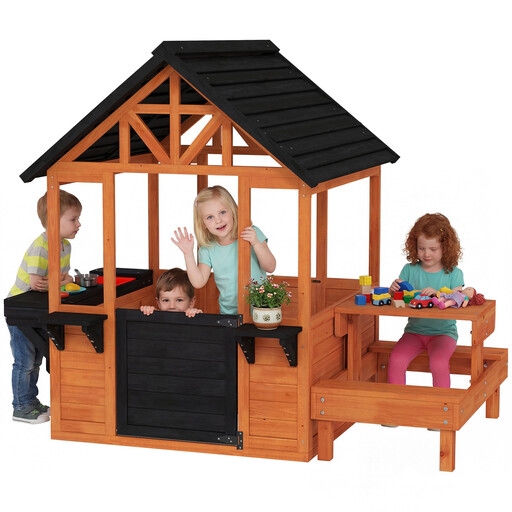
Why It Stands Out: This option elevates the concept of a play kitchen by integrating it into a larger structure. It's a wendy house with kitchen features, including a sink table, a snack bar window and built-in benches. This transforms a garden or playroom into a social hub for kids.
Crafted from solid fir wood, it's built for durability and can be used both indoors and outdoors. The open design with large windows allows for easy supervision and creates a bright, airy play space for multiple children.
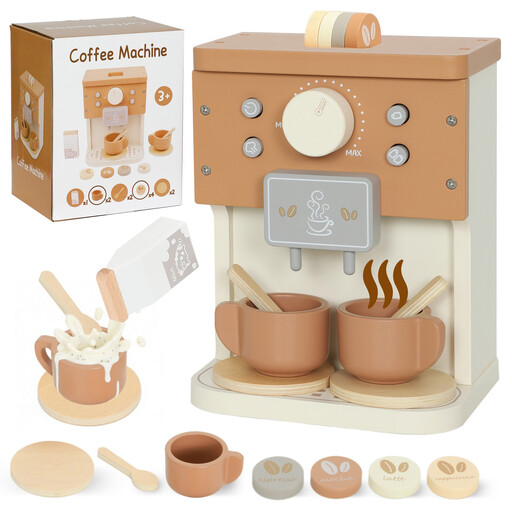
Why It Stands Out: For those with limited space or who want to add to an existing setup, this wooden coffee machine set is a fantastic choice. As one of the more focused Montessori kitchen toys, it allows children to mimic a familiar daily ritual, which is often a favourite form of play.
The set includes a charming wooden coffee machine with pressable buttons and a clicking knob, along with cups, pods and milk. This focus on a single task helps develop fine motor skills, hand-eye coordination and sequential thinking.
While these selections cover a range of play styles, every child is unique. If you're searching for different themes or additional accessories to expand your child's culinary world, you may find the perfect item in our wider collection.
Explore our full range of childrens play food toys to discover even more ways to inspire creativity in the kitchen.
Most play kitchens are designed for children aged 3 to 8. Simpler, more robust plastic models are often great for toddlers (from age 3), while more complex wooden kitchens with smaller accessories are better suited for slightly older children who can handle more detailed imaginative play.
Play kitchens are excellent tools for development. They help children enhance fine motor skills by handling small accessories, develop social and communication skills through role-playing with others and foster creativity by inventing their own recipes and scenarios. They also provide a fun context for learning basic concepts like counting, sorting and colours.
Your choice depends on your priorities. A wooden play kitchen is often valued for its durability, stability and classic aesthetic, making it a long-lasting piece of furniture. A plastic kitchen is generally more lightweight, portable and can be more affordable, often featuring bright colours and moulded designs. Consider your space, budget and how long you hope the toy will be used.