
24/7 Customer Support

Free returns

Same-day & Next-day Delivery

Quality Guaranteed

Unlock Your Welcome Offers: FREE Delivery | Up to 80% OFF | Free 30-day JoyPlus trial
Download the APP
Choosing kids ride-on cars involves more than picking a colour or realistic-looking design. The right model depends on your child’s age, height, confidence, available space and how you plan to use it in the UK. A small indoor ride-on toy car may suit a toddler, while an electric ride-on car for kids needs suitable outdoor space, charging time and active adult supervision.
A product may be certified for a broad age range but still be more comfortable for younger or smaller children. Check the seat dimensions, seat height, maximum load and recommended height, not just the age printed in the title.
For example, a children’s ride-on vehicle designed for ages 3–8 may have a 30kg load limit, but a taller eight-year-old may quickly outgrow the seat or steering position.
Electric models commonly advertise up to 45 or 60 minutes of use, but actual play time varies with rider weight, terrain, speed and frequency of stopping. Grass, gravel and inclines generally place more demand on the motor than a flat indoor floor.
Also check the charging period. Several models in this guide require 8–12 hours to charge, so overnight charging is often more practical than expecting rapid top-ups.
Lights, music, horns and dashboard details add interest, but they do not replace stability or supervision. Look first for features such as wide wheels, textured tyres, seat belts, low seating positions, suspension and parental remote control. A horn is useful for imaginative play, but it should not be considered a substitute for an adult’s attention.
A push-along car for toddlers, foot-to-floor slider or baby ride-on car is generally simpler for children aged around 12–36 months. The child moves the vehicle with their feet, which avoids motor speed and charging considerations. These models can be useful for indoor play and short trips on smooth outdoor surfaces.
A kids electric car requires more planning. Compare:
For toddlers, look for a low centre of gravity, broad wheels and a seat that provides back support. A three-wheel ride-on motorbike can be suitable for simple, controlled play, while four-wheel designs may offer a more planted feel.
Older children may want a ride-on truck with suspension and larger tyres. Even then, check where the manufacturer says it can be used. “Off-road style” does not mean the vehicle is suitable for steep slopes, roads or rough public paths.
Read the manual and product information before purchase. Where listed, standards such as EN71-1-2-3 and EN62115 relate to toy safety and electrically operated ride-on toys. Certification details should be considered alongside correct assembly and supervision.
Never use a ride-on vehicle on public roads. Children should wear suitable footwear, stay away from traffic, stairs and water, and be supervised by an adult. Check fasteners, wheels, cables and the battery area regularly.
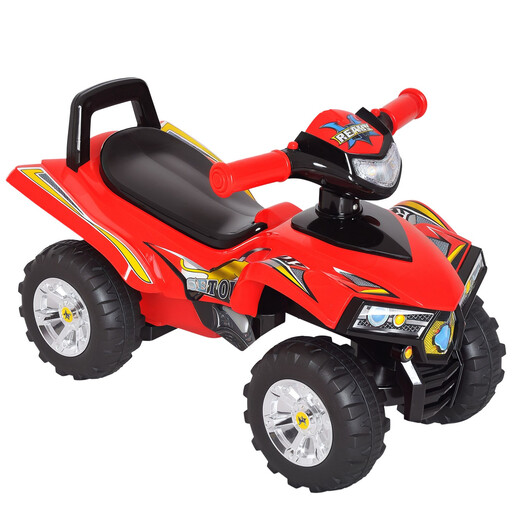
Why This Fits Their Persona: A lightweight, non-electric choice for toddlers aged 12 months and over, suitable for families wanting straightforward play without charging a drive motor.
Its non-electric, foot-powered design avoids battery charging and motor-speed concerns. The low seat and anti-tipping hardware address basic stability considerations.
2.4kg net weight, storage under the seat, rugged tyres and a maximum load of 25kg.
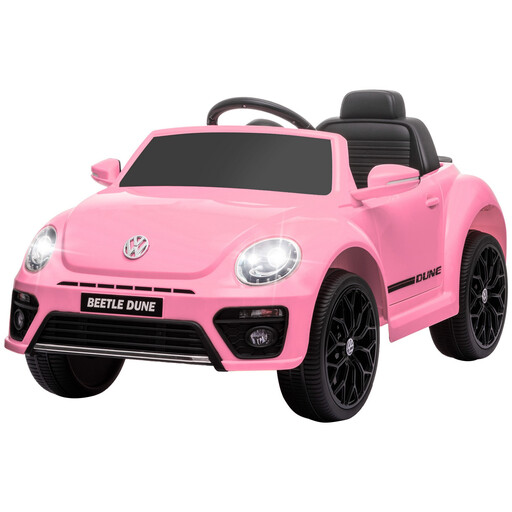
Why This Fits Their Persona: Suitable for families looking for a recognisable one-seat design with manual driving and adult remote control for children aged around 3–5 years.
The soft-start function and three speed settings between 3–5km/h provide more control than a single-speed design. The remote gives an adult another operating option.
12V battery, four-wheel suspension, up to one hour of stated run time and a 30kg maximum load.
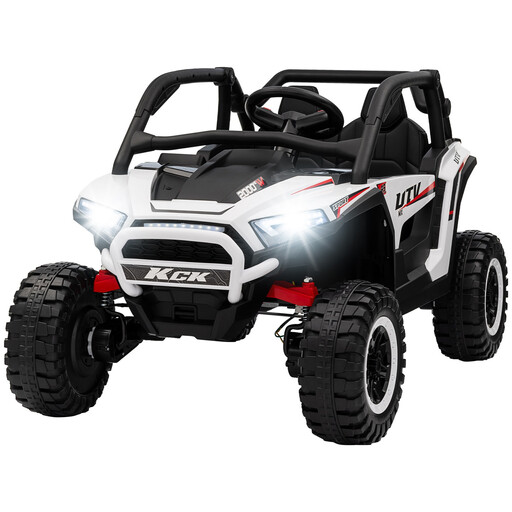
Why This Fits Their Persona: A practical option for siblings or friends, with a two-seat layout and outdoor-focused features for children aged 3–8 years.
The adjustable 5–7km/h speed, seatbelts and parental remote control help adults manage shared outdoor play. Spring suspension is specified for grass, gravel, cement and asphalt.
24V 7Ah battery, four motors, stated 60-minute run time, two seats and a 50kg maximum load.
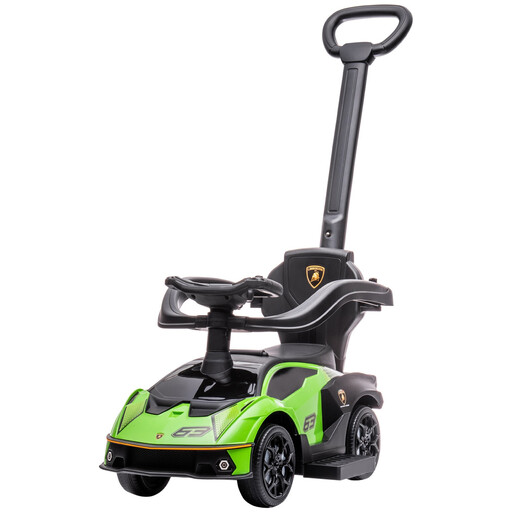
Why This Fits Their Persona: Designed for children aged 12–36 months, this combines a toddler ride-on car with a parent-pushed format for indoor play and short outings.
It uses a foot-to-floor, no-power drive rather than introducing a motor to a young rider. Detachable guardrails, a push handle and footrest allow the configuration to change as confidence develops.
25kg maximum load, under-seat storage, steering wheel, footrest and detachable parent handle.
We have compiled a complete, real-time list of products that fully satisfy these strict selection criteria and UK safety regulations.
The main ongoing cost is electricity and, eventually, battery replacement. Electricity use is generally modest, but charging frequency depends on the model and how often it is used. Follow the supplied charging instructions, avoid leaving the battery connected indefinitely and store the vehicle in a dry place.
Lifespan depends on usage, storage, rider weight and maintenance. A foot-powered baby ride-on car has fewer drive components, while an electric ride-on car for kids includes a motor, battery, charger and wiring that require more care. Inspect wheels, screws and electrical connections before each use and stop using the vehicle if any part is damaged.
Some models are designed for independent driving, but a parental remote control ride-on car gives an adult additional oversight. Manual control should only be used when the child can comfortably reach the pedals or controls and understands how to stop. Adult supervision remains necessary for every ride-on vehicle, whether it is a ride-on truck, motorbike or small push-along model.