
24/7 Customer Support

Free returns

Same-day & Next-day Delivery

Quality Guaranteed

Unlock Your Welcome Offers: FREE Delivery | Up to 80% OFF | Free 30-day JoyPlus trial
Download the APP
A construction-themed vehicle can look exciting online but become unusable when it arrives. Parents and gift buyers often discover that the seat is too high, the toy is too long for the garden or the advertised digging function only works on a particular surface.
Before choosing kids ride-on tractor and digger toys, look beyond bright colours and character branding. The most useful comparison points are the child’s age, the way the toy moves, its dimensions and whether its features suit your intended play area.
A small bulldozer may be ideal for floor-based pretend play but is not necessarily designed for a child to sit on. Check whether the product is a push-along toy, pedal-powered ride-on or a battery-powered vehicle. These offer very different play experiences.
For example, the Paw Patrol Search & Rescue Rubble Rescue Bulldozer is a lightweight character toy for children aged three and over. It is designed to be grasped, pushed and manoeuvred rather than ridden. This makes it more suitable for indoor imaginative play than as a substitute for a children’s ride-on excavator.
Age guidance is useful, but it does not show whether a child will comfortably reach the pedals or steering controls. Compare the seat height, overall length and available legroom with the child’s size.
A pedal tractor for children aged three to six may be physically unsuitable for a smaller toddler, while a compact ride-on digger toy for 18 months to four years may be outgrown sooner. Also check the maximum load, especially if the toy may be used for several seasons.
Working buckets and textured wheels can sound versatile, but loose sand, wet grass, mud and carpet each affect movement differently. A large vehicle may be difficult to turn indoors or store in a typical UK hallway or shed.
Measure doorways, paths and storage areas before ordering. Remember to include space for a trailer or rear attachment when checking the product’s total length.
Start with the manufacturer’s recommended age range and maximum load. The HOMCOM 301-057 is listed for 18–48 months, with a 30kg maximum load. Its seat is 22.5cm high, while the vehicle measures 87cm long by 28cm wide.
The HOMCOM 341-033 is intended for three to six years, supports up to 35kg and measures 179cm long by 42cm wide. Its larger footprint may suit an outdoor play area, but it requires significantly more storage space.
These figures should be treated as selection guidelines, not a replacement for adult judgement. Children should use ride-on toys according to the product instructions and under appropriate supervision.
Manual and pedal-powered designs do not need charging, which can be convenient for gardens, parks or holidays. They also give the child direct control over movement, although younger children may need time to coordinate pedalling and steering.
The 301-057 uses foot pedalling and includes a manually operated front bucket. The 341-033 combines a tractor with a pedal go-kart and includes a steering wheel, gear lever and hand brake. Neither requires a battery for movement.
A small character bulldozer such as the Paw Patrol Rubble bulldozer is simpler: children push it across a floor or play mat while creating rescue scenarios. This can be a practical option where space, noise and assembly are concerns.
Look for a stable wheelbase, a backrest where appropriate, secure steering components and clear assembly instructions. The 301-057 lists an anti-reverse system, backrest and textured wheels. The 341-033 uses a steel frame with thick plastic components and six plastic wheels.
Both HOMCOM products list EN71-1-2-3 qualification information, while the Paw Patrol toy includes a warning about small parts and states that it is not suitable for children under three. Check the specific product listing, packaging and instructions for age guidance, warnings and assembly requirements before use.
No feature removes the need for supervision. Inspect wheels, pedals, handles, bucket arms and fasteners regularly, particularly after outdoor play.
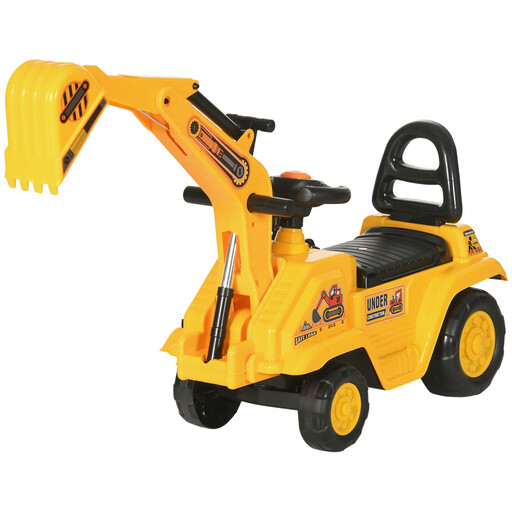
Why This Fits Their Persona: A practical starting point for toddlers aged 18–48 months who want a ride-on construction vehicle for the living room, garden or beach.
The listing clearly identifies the age range, dimensions and 30kg load limit. Its two-in-one digger and pull-cart design avoids paying separately for two play functions.
Foot-powered operation, under-seat storage, a manually operated bucket and a no-battery horn.
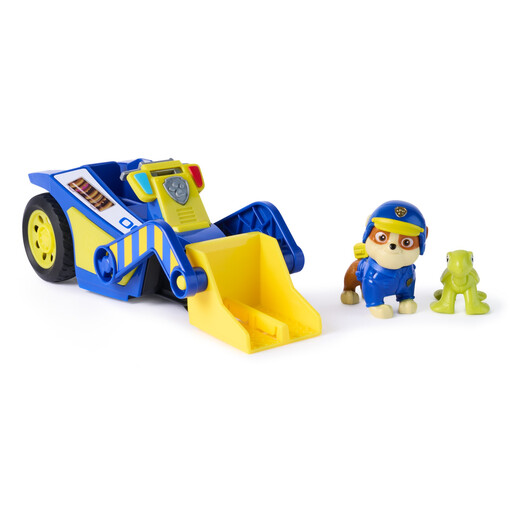
Why This Fits Their Persona: A character-led option for Paw Patrol fans aged three and over who prefer compact indoor play over a full-size ride-on vehicle.
The listing describes it as lightweight and pushable, so buyers can match expectations correctly instead of assuming it is a ride-on excavator.
No batteries are required; its bulldozer styling supports rescue-themed pretend play in a compact format.
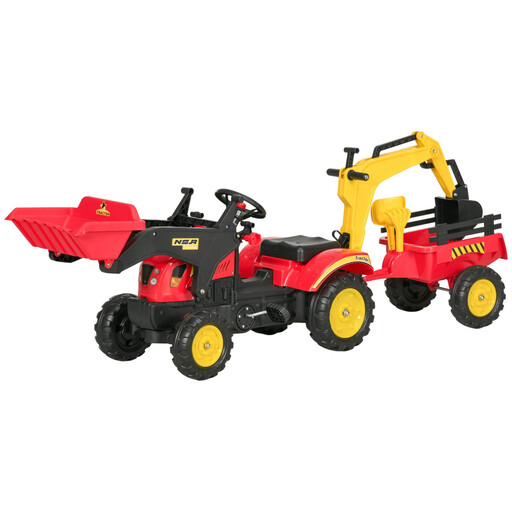
Why This Fits Their Persona: Suits older children aged three to six who have a large outdoor area and want a more involved pretend-play construction truck.
Its unusually long 179cm body is stated clearly, helping buyers assess storage and turning space before purchase. The removable rear section offers some configuration flexibility.
Steel frame with thick plastic parts, six wheels, moving bucket, pedals, steering wheel, gear lever and hand brake.
We have compiled a complete, real-time list of products that fully satisfy these strict selection criteria and UK safety regulations.
Some are designed for toddlers from 18 months, but suitability depends on the individual product’s seat height, controls and stability features. The 301-057 is listed for 18–48 months, whereas the larger 341-033 is recommended for three- to six-year-olds. Always follow the product guidance and supervise play.
Not always. Both HOMCOM models listed here use foot pedalling, so they do not require charging. A manual ride-on tractor can be convenient for outdoor use, although children need enough coordination and strength to pedal and steer. Push-along toys such as the Rubble bulldozer also operate without batteries.
Lifespan depends on use, storage, assembly and whether the child remains within the stated load limit. A smaller toddler ride-on may be outgrown physically before it wears out, while a larger pedal tractor can remain suitable for longer if the child fits the seat and controls. Regularly check wheels, pedals, bucket arms and fasteners for signs of wear.